What Is Story Drift?
Every company starts with a clear story. The founder can articulate the problem, the solution, and why it matters in their sleep. But as the company grows, that story passes through more hands — marketing writes it one way, sales pitches it another, partners paraphrase it, and AI tools remix it into something the founder wouldn't recognize.
That's story drift. It's not a single dramatic failure. It's a slow, compounding distortion that happens every time your narrative passes through another person, tool, or channel without a single source of truth to anchor it.
Story drift is the measurable gap between what your brand intends to say and what your audience actually hears across all touchpoints. The larger the gap, the more pipeline you lose to confusion, inconsistency, and commoditized messaging.
Story Drift vs. Brand Inconsistency
Brand inconsistency is using the wrong logo or colors. Story drift is deeper — it's when the fundamental value proposition, the "why you should care" message, gets diluted or distorted. You can have perfect visual consistency and still suffer from severe story drift.
Think of it this way: brand inconsistency is a cosmetic problem. Story drift is a revenue problem. When your sales team can't articulate the same value prop as your website, or when your AI chatbot gives a different answer than your case studies, prospects lose confidence and deals stall.
What Causes Story Drift?
Story drift doesn't happen because people are careless. It happens because organizations lack a system for keeping their narrative aligned as they scale. Here are the five most common causes:
“Story drift is the silent killer of B2B pipeline. It's not that your story is bad — it's that your audience hears six different versions of it before they ever talk to sales.”
1. Team Growth Without Narrative Onboarding
Every new hire interprets your story through their own experience. Without explicit narrative training, a sales rep who came from a competitor will frame your value proposition through a competitive lens that may not match your actual positioning. Multiply this by 50 hires and the drift compounds rapidly.
2. Content Sprawl Across Disconnected Systems
The average B2B company stores content across 6–8 different tools: Google Drive, SharePoint, CMS, DAM, sales enablement platform, email folders, and Slack channels. Without a central content library to anchor everything, nobody knows which version is current, and outdated materials keep circulating months after they should have been retired.
3. AI Amplification of Inconsistent Content
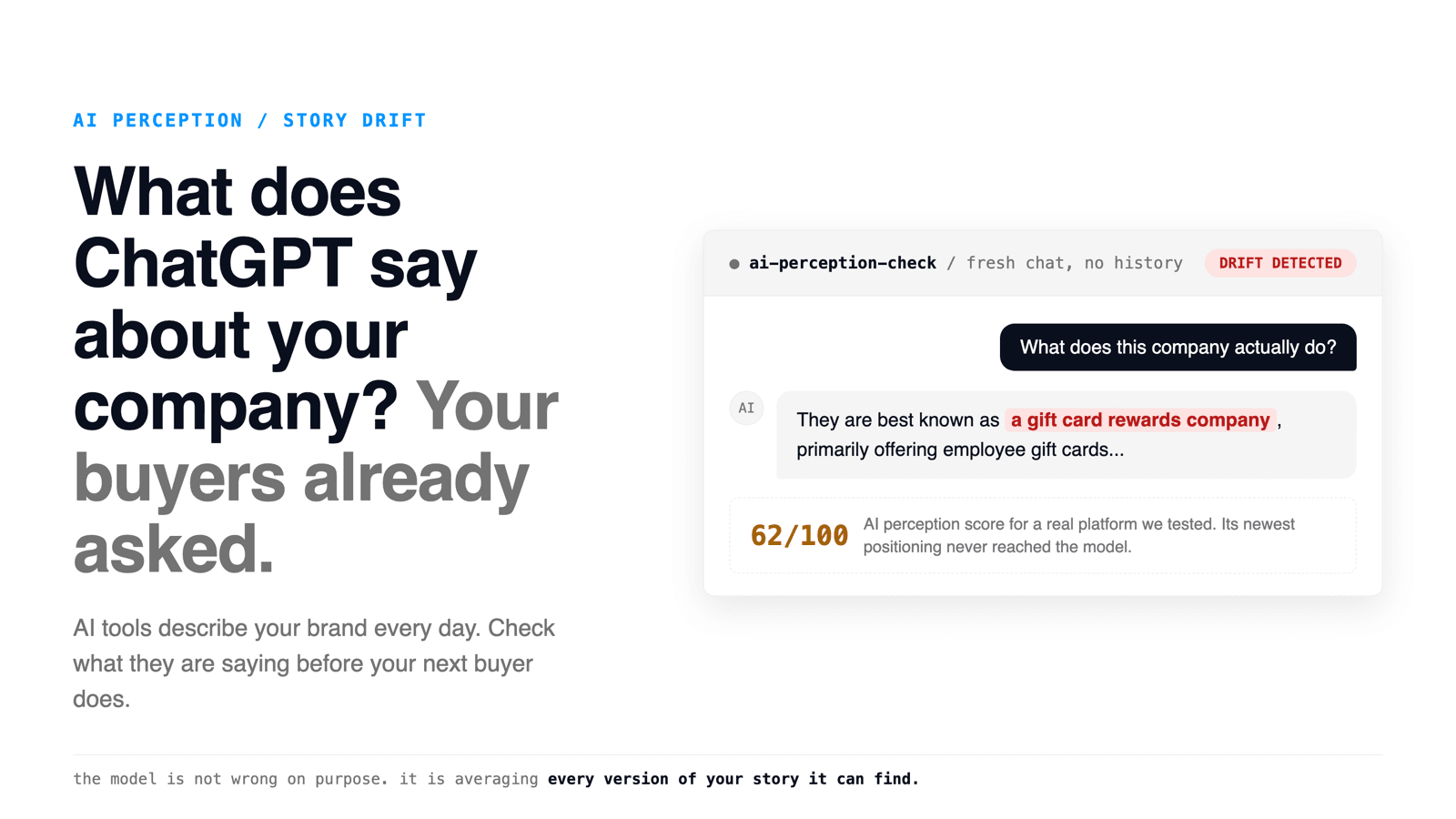
AI tools are story drift accelerators. When ChatGPT, Claude, or your internal AI assistant is trained on or retrieves inconsistent content, it generates outputs that blend and flatten your messaging into generic statements. AI doesn't fix inconsistency — it amplifies it at scale.
4. Partner and Channel Telephone
Partners are your most valuable distribution channel and your biggest story drift risk. They translate your messaging into their own language, pair it with their own positioning, and deliver a version of your story that you never approved and may never see.
5. No Single Source of Truth
This is the root cause. When there is no authoritative, living source of your brand narrative — not a static PDF brand guide, but a dynamic system that connects to the tools people actually use — drift is inevitable. Every other cause on this list is a symptom of this one.
How to Measure Story Drift in Your Organization
You can't fix what you can't see. Here's a practical framework for measuring story drift in your organization, based on our work with over 200 B2B companies.
The Alignment Audit: A 30-Minute Exercise
Ask five people from five different teams (sales, marketing, customer success, product, leadership) to independently write a two-sentence answer to: "What does our company do, and why should someone care?" Compare the answers. If you find more than two materially different versions, you have a story drift problem.
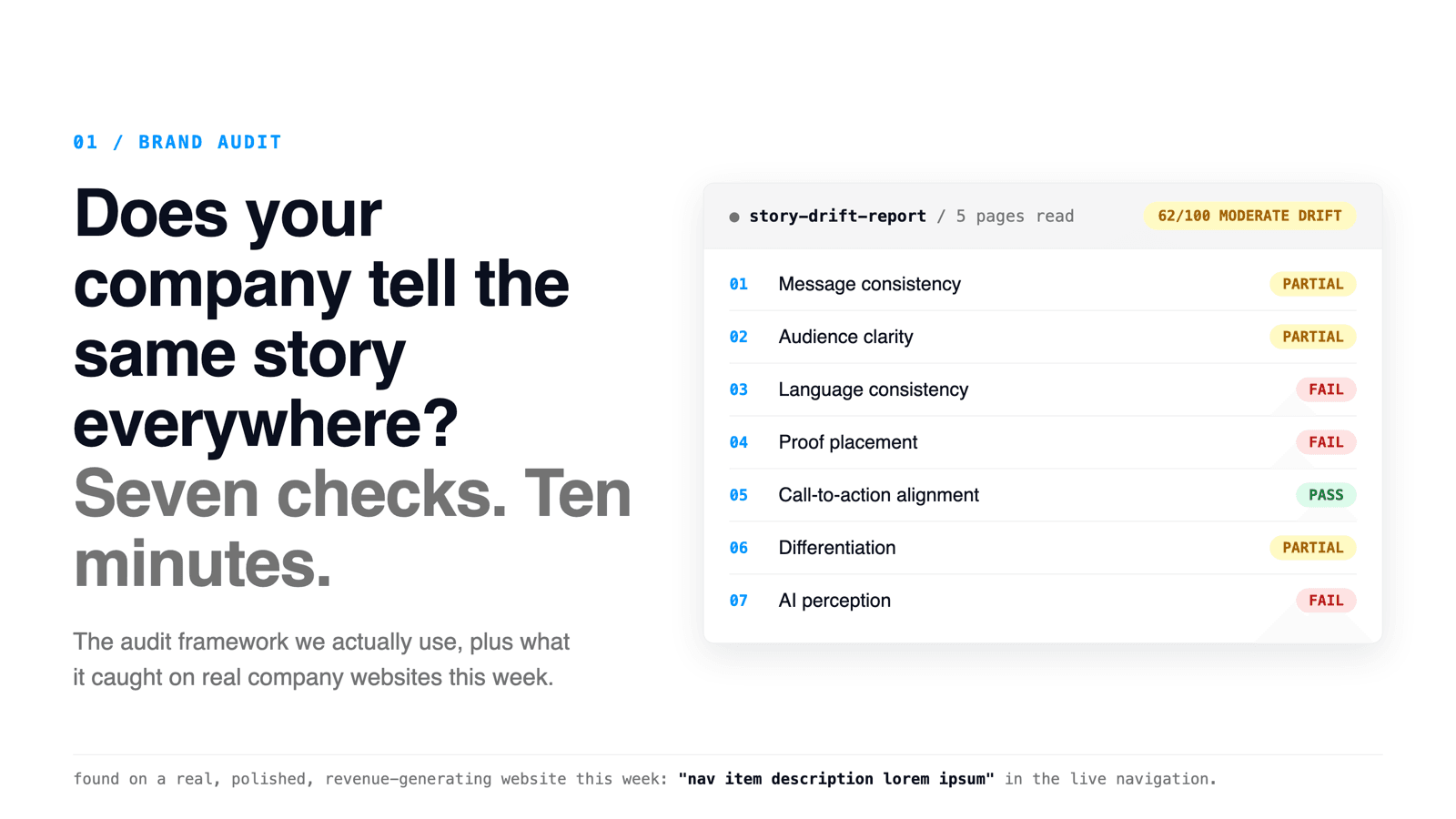
For the website half of this exercise, we now keep a 10-minute, seven-check brand audit framework, and a free tool that scores it automatically, including what AI tools currently say about your brand.
In our experience, 85% of companies that run this exercise discover significant drift — most commonly between sales and marketing, and between headquarters and field teams.
Content Utilization as a Drift Indicator
Track what percentage of your content library is actually being used by sales and customer-facing teams. Industry benchmarks show that 60–70% of B2B marketing content goes unused. This isn't just a waste of marketing budget — it's a symptom of drift. When teams can't find content that matches what they need to say, they create their own, accelerating drift further.
How to Fix Story Drift: The Content Alignment Framework
Fixing story drift isn't about creating more content or writing better brand guidelines. It's about building a system — a living connection between your canonical narrative and every touchpoint where it gets distributed.
The Content Alignment Framework has three pillars:
Pillar 1: Establish a Central Narrative
Document your canonical story in one authoritative place. Not a 50-page brand book nobody reads — a concise, living narrative document that answers: What problem do you solve? For whom? Why now? What makes you different? What does success look like?
This narrative should be accessible from every tool your team uses, not locked in a PDF on a shared drive.
Pillar 2: Connect It to Distribution
Your narrative needs to flow directly into the places where content gets created and shared — your CRM, your AI tools, your sales sequences, your partner portals. If people have to leave their workflow to check the source of truth, they won't. The system must meet them where they work — whether that's asking a question in Slack or pulling approved assets through your existing tools.
Pillar 3: Measure and Iterate
Track content utilization, message consistency across channels, and — critically — whether prospects receive a coherent narrative throughout their buyer journey. Use these metrics to identify drift hotspots and address them before they compound.
Key Takeaways
- Story drift is the gradual distortion of your brand narrative as it passes through teams, tools, channels, and AI systems — and it directly erodes pipeline and revenue.
- Companies with high story drift see 60–70% of their marketing content go unused, because teams create their own materials when the official content doesn't match what they need to say.
- AI tools amplify story drift at machine speed — if your content library is inconsistent, AI outputs will blend those inconsistencies into generic, undifferentiated messaging.
- The Alignment Audit (asking 5 people from 5 teams to independently describe what your company does) reveals drift in under 30 minutes — and 85% of companies discover significant inconsistencies.
- Fixing story drift requires a system, not a document — a living connection between your canonical narrative and every tool and channel where it gets distributed.