
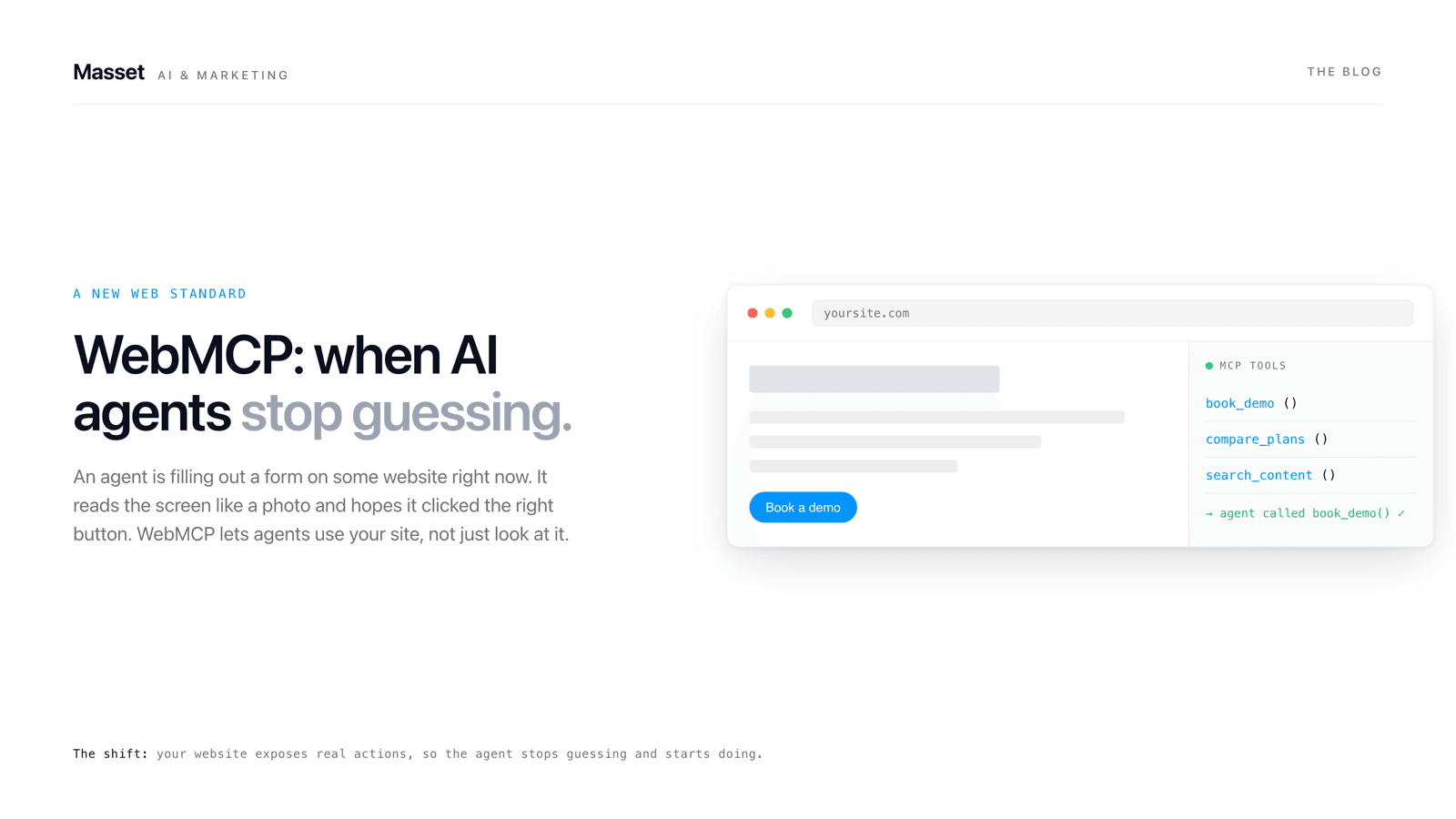
What is WebMCP?
WebMCP is a proposed open standard that lets a website hand AI agents a clear menu of things they can do.
Today an agent works your site by interpreting what it looks like. It studies the page, guesses what a control does, and clicks. WebMCP flips that. Instead of the agent guessing a button's job, the website declares the job directly. This is the search tool. Here is what it needs. Here is what it gives back.
You decide what to expose. Your site looks and works exactly the same for people. The change is a layer underneath, written for machines.
Chrome's documentation describes the payoff plainly: fewer errors, less hallucination. The agent stops guessing because it no longer has to.
How WebMCP works
WebMCP gives developers two ways to expose tools, and most sites will use both.
The declarative way is the simpler one. You take the HTML forms your site already has, a contact form, a search box, a demo request, and add a few attributes that name the form and describe what it does. The form still works normally for people. The attributes make it readable as a tool for agents. For a lot of marketing sites, that alone covers the actions that matter.
The imperative way uses JavaScript for everything a form cannot express: a multi-step flow, a filter, a state change, a calculator. A developer registers each action as a tool with a name, a plain-language description, and a defined set of inputs and outputs.
Either way, the agent gets explicit definitions instead of guesses. It knows the inputs a tool needs and the result it returns, so it can act with intent instead of trial and error.
Where WebMCP came from
WebMCP did not start at Google. It started small.
In March 2025, an engineer named Jason McGhee floated the idea. Microsoft wrote up a similar concept. Google's Chrome team had its own version. A developer named Alex Nahas built a working browser extension for it on the side. Those separate efforts converged into a single proposal at the W3C, the body that maintains the standards the web runs on.
In February 2026 it became an official W3C draft. At Google I/O this year, Chrome announced WebMCP is moving into an origin trial in Chrome 149, which ships in early June. An origin trial means real websites can test it on real traffic for the first time, not just developers behind a flag.
So WebMCP is real. It is also early. It is a proposal, not a finished standard, and it is driven mostly by Google and Microsoft so far. The direction is set. The details will still move.
WebMCP vs MCP
If you have followed AI at all, you have heard of MCP, the Model Context Protocol. Anthropic released it in late 2024, and it became the standard way to connect AI tools to data.
WebMCP is the cousin, not the same thing. Chrome calls it MCP-inspired.
The difference is where it lives. MCP runs on a server. It is always on, reachable by any agent, anywhere. WebMCP lives inside the web page itself. It exists only while someone has your site open in a tab. Close the tab and the tools are gone.
One is your data, available everywhere. The other is your website, usable while someone is on it. Most teams will want both.
What WebMCP means for your website
Here is the part that matters for marketers.
For twenty years we built websites for one audience: people. Human eyes, human clicks, human attention.
That is changing. A growing share of your visitors are agents, working for a person who never loads your page themselves. They do the research, the comparing, the form-filling.
Right now those agents experience your site as a series of guesses. Your demo form. Your pricing page. Your contact form. If an agent cannot work them reliably, that is a buyer it could not move forward, and you will never see it in analytics as anything but a bounce.
WebMCP is the first serious attempt to fix that. It makes your website not just visible to agents, but usable by them. The teams that treat agents as a real audience, the way they once learned to treat mobile visitors or search crawlers, will have a site that works for whoever, or whatever, shows up.
“WebMCP makes your website not just visible to agents, but usable by them.”
Is WebMCP safe?
Letting software take actions on your site raises an obvious question. What stops an agent from doing something it should not?
Several things, by design. WebMCP only runs on secure sites, over HTTPS. It adds no new authentication, so your existing logins and server-side checks still apply. A tool can be marked read-only. And sensitive actions, anything that spends money or sends a message or deletes data, can require the user to confirm before they complete.
The rule for anyone implementing it is simple. Never expose a tool that does something you would not let an anonymous visitor do. WebMCP is a new front door for your site's actions, so treat it like one.
This is also why the standard being early matters. You build WebMCP as an enhancement, never as something your site depends on. A visitor whose browser has never heard of it should not notice a thing.
How to make your site agent-ready
You do not need to rewrite your website. WebMCP is a layer you add to what you already have.
It is also still an origin trial, so this is not a drop-everything moment. The smart move right now is smaller. Understand what WebMCP is, treat agents as a real audience, and get familiar with how the implementation works so you are ready when it ships for good.
To make that easier, we built a free skill that handles the implementation for you. It is a skill for AI coding tools like Claude Code. You hand it to an agent working in your site's code, and it knows how to add WebMCP correctly: which forms to annotate, how to register tools, how to keep sensitive actions safe, and how to make sure nothing breaks for visitors without WebMCP. It works on any site, whatever your stack. It is free, it is ungated, and we keep it current with the Chrome origin trial.
Over the coming weeks we will publish step-by-step guides for specific cases: annotating your forms, exposing a pricing tool, testing in the origin trial. This article is the home base. We will link them here as they go live.
What we're doing at Masset
We are not just writing about this.
Every page on getmasset.com already has a plain-text twin built for machines, so an agent gets clean content instead of scraping our design. We run an MCP server too, so AI tools can pull our content directly.
That makes Masset readable to agents. WebMCP makes a site usable by them, and as of July 2026 that layer is live here too. Every page on getmasset.com registers three tools through the browser's navigator.modelContext API. An agent running in the Chrome origin trial can call request_demo_video to get its user a short, personalized Masset demo video, or it can run a whole brand audit on its user's behalf: analyze_story_drift kicks off our free Story Drift Analyzer against any public website, and check_story_drift_status returns the scored results a couple of minutes later, so the agent can read its user their drift score, their AI perception score, and the top fixes without the person ever opening the report themselves. In both cases the agent is told to confirm details with its user before it submits anything, and the same daily rate limits apply to agents that apply to people.
That is the whole thesis of this article in one working example. Readable to agents was the first layer. Usable by agents is the next one, and this site now does both. As far as we know, this makes getmasset.com one of the first sites where a visitor's AI agent can run a complete piece of analysis, not just submit a form.
Marketers who want to build tools that use that MCP layer directly, like calculators, lead-gen quizzes, and dashboards, can do it today with Claude Artifacts.
The repeatable patterns behind your best content can be captured as a reusable Claude skill, so every tool you build starts from your strongest work instead of a blank page.
The web spent two decades getting good at talking to people. The next stretch is about learning to talk to whatever the person sent instead.
Key Takeaways
- WebMCP is a proposed web standard that lets a website expose its forms and actions as structured tools an AI agent can use directly, instead of guessing from the screen.
- It works two ways: annotate existing HTML forms (declarative) or register tools in JavaScript (imperative). Your site stays the same for human visitors.
- WebMCP is not MCP. MCP runs on a server and is reachable anywhere; WebMCP lives in the page and exists only while the tab is open. Most teams will use both.
- It is early: a W3C draft in a Chrome 149 origin trial. Build it as an enhancement, never as something your site depends on.
- A growing share of website visitors are AI agents acting for a person. WebMCP is how you make your site usable by them, not just visible.
- Masset publishes a free, ungated skill that implements WebMCP on any site.
- getmasset.com runs WebMCP itself: every page registers three tools an agent in the Chrome origin trial can call, including analyze_story_drift, which lets the agent run a full brand audit for its user and read back the scores.
Frequently Asked Questions
Is WebMCP the same as MCP?
No. MCP, the Model Context Protocol from Anthropic, runs on a server and is reachable by any AI tool anywhere. WebMCP lives inside a web page and only works while that page is open in a browser tab. Chrome describes WebMCP as MCP-inspired. Most teams will use both: MCP for backend data, WebMCP for in-browser actions.
Is WebMCP available yet?
It is in an origin trial in Chrome 149, which ships in early June 2026. Real websites can test it on live traffic, but it is not a finished standard and the API will still change. Treat it as something to learn and prepare for, not a production dependency.
Do I need to rebuild my website to use WebMCP?
No. WebMCP is a layer you add on top of your existing site. For form-based actions you add a few HTML attributes to forms you already have. Your site looks and works exactly the same for human visitors.
Does WebMCP replace SEO?
No. SEO helps people and agents find your site. WebMCP helps agents use it once they are there. They solve different problems, and as more browsing is done by agents you will likely want both.
What browsers support WebMCP?
As of May 2026, WebMCP is available in an origin trial in Chrome 149 and behind a flag in earlier Chrome builds. It is a W3C proposal, so other browsers could adopt it, but it is driven mostly by Google and Microsoft today. Always build it as a progressive enhancement.
How do I implement WebMCP?
You can annotate HTML forms with the declarative API or register tools in JavaScript with the imperative API. Masset publishes a free skill that handles the implementation: hand it to an AI agent working in your codebase and it adds WebMCP correctly, on any stack.