Fable was leaving my plan. Then it wasn’t.
Update, July 22, 2026
The premise of this article changed after I published it. On July 18, 2026, Anthropic reversed the plan described below. Fable 5 is now permanent in the premium subscription tiers rather than API-only, though not on equal terms: Max and Team Premium get Fable at roughly half their standard weekly usage limits, while Pro and Team Standard get a one-time usage credit and then pay API rates. Reporting at the time tied the reversal to OpenAI shipping GPT-5.6 Sol on July 9 at materially lower cost.
So I was wrong about losing Fable, and I am glad to be. What I did not expect is that the skills I built still earn their place, for a reason I explain at the end. The original article follows, unedited.
When I got access to Claude Fable 5 again, I was genuinely excited. It's the best model I've used. Then I remembered the catch. For subscription users like me, Fable is going away. It's moving to API-only, on a timeline I already know is coming.
That annoys me more than it probably should. I don't want to pay for API usage to keep a model I already love. I want it in the app I already use. But that's not the deal, so I started thinking about the next best thing.
Then I saw the idea on X. Someone mentioned using Fable to build skills that make Opus behave more like Fable. I didn't even read the full post. I just saw the concept, thought "huh, maybe there's something there," and went to find out.
So I did the honest thing. I asked Fable directly. Is there anything real here, or is this wishful thinking?
Fable's answer was better than I expected. It said no, you can't train me into the new model. But you can help me from a process standpoint. And process is exactly the thing you're good at.
What a skill can and can't do
Let me be clear about the limit, because it's part of the point. A skill file can't give a model more raw intelligence. Fable's real advantages, like getting hard problems right on the first try and holding instructions across a long, messy task, don't transfer through a markdown file. That part is off the table.
If you have never set one up, the mechanics are simpler than they sound. I wrote a complete guide to how Claude skills work that walks through the file itself, the folder it lives in, and the way Claude decides when to load it.
But a surprising amount of what makes Fable feel different isn't intelligence. It's discipline. It's what the model checks before it speaks. When it stops working. How it decides something is actually done. What it cuts from a draft.
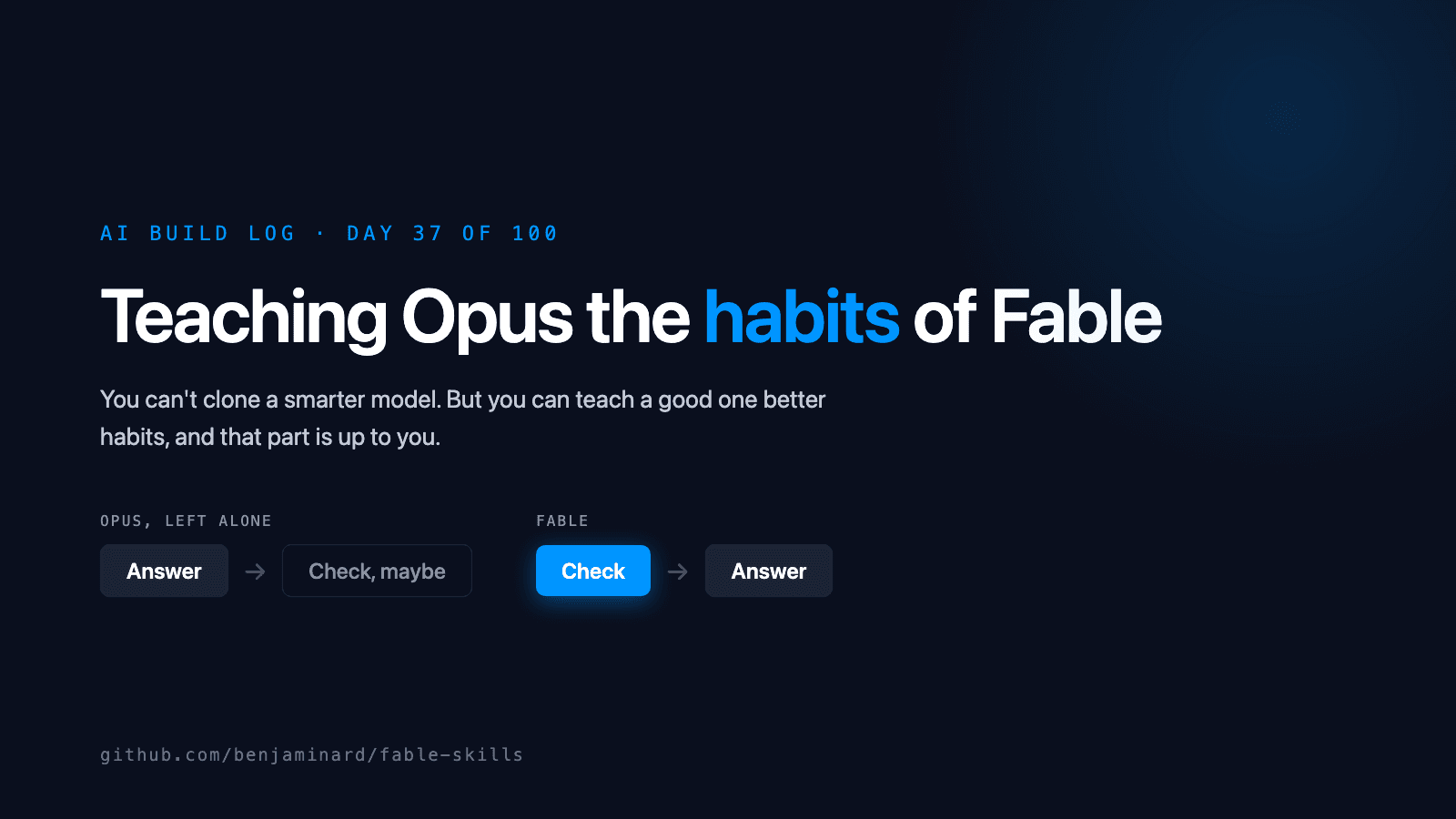
Here's the thing. Fable pauses and verifies before it hands you an answer. Opus tends to answer first. That one difference, where the checkpoint sits, is most of what people feel when they say a model is "better." And a checkpoint is just a rule. You can write a rule down.
The nine skills
So that's what I built. Nine skills, each one a discipline that separates Fable from Opus, written as a plain instruction any Claude model can follow. I grounded them in Anthropic's own published guide for prompting Fable, which spells out these behaviors as short instructions. The guide even notes that skills written for older models are often too prescriptive for Fable. I just pointed that in the other direction. The prescriptive scaffolding Fable no longer needs is exactly what Opus does.
A few of them, so it's concrete. One skill stops the model from telling you a task is done until it can point to the actual evidence. No "this should work now" unless it ran the thing and watched it work. Another forces it to find the root cause of a bug before it starts fixing, and never to retry the same failed fix twice. One keeps code changes small, so you stop getting a two-line fix wrapped in a hundred lines of cleanup nobody asked for. One is about writing: lead with the answer, and get shorter by cutting whole points, not by mashing sentences into fragments.
| Skill | What it makes the model do |
|---|---|
| verified-done | Prove a task is finished with real evidence before claiming it. No "should work now." |
| root-cause-first | Reproduce and trace a bug to its cause before fixing. Never retry the same failed fix. |
| minimal-diff | Change only what the task needs. No surprise refactors buried in a small fix. |
| delegate-and-verify | Fan work out to sub-agents, then check it with fresh eyes, not self-review. |
| finish-the-turn | Act when it has enough to act. Stop ending on "I'll do that next." |
| lessons-ledger | Write down each mistake once so it stops repeating it across sessions. |
| outcome-first-writing | Lead with the answer. Get shorter by cutting points, not mashing words. |
| plain-handoff | Write the final summary for someone who didn't watch the work happen. |
| evidence-audited-analysis | Interrogate the numbers before trusting them. Say what the data can't show. |
I bundled all nine into a library, put it on GitHub, and made it free under an MIT license. You install it once and every new session picks up the habits.
“You can't clone a smarter model. But you can teach a good one better habits.”
Who this is for
I'll be honest about who this is for. It's probably a niche crowd. Most people aren't going to install a set of Claude Code skills. But more and more marketers are becoming builders, and the skills work in other tools too if you know what you're doing.
If you're a marketer who fell for what Fable can do, who's building real things with it, and who's also a little bummed about the API-only move, this one was for me and it might be for you. I've already got a couple of friends I'm excited to send it to, just to see what they think.
I'm not going to throw out fake numbers on how much it helps. I haven't run it long enough to measure that, and I'd rather tell you the truth than sell you a result I don't have yet. What I can tell you is the concept held up when I pressure-tested it with the model it's imitating. That was enough for me to build it and put it out there.
One aside, since it's the other half of the same idea. Skills give the model better habits, but they don't teach it your business. That part comes from connecting your AI to your actual content, which is what an AI-ready digital asset management home does. We build one, so I'm biased. But habits plus context is the whole game.
If you want to try it, the library is public. Point your own Claude at it and see if Opus starts checking its work a little more like Fable does. You can grab it here: github.com/benjaminard/fable-skills.
You can't clone a smarter model. But you can teach a good one better habits, and that part is up to you.
If you're newer to building with Claude and want the on-ramps first, start with your first hour in Claude Code, then the Claude Artifacts guide for marketers, and my honest review of OpenAI Codex Sites if you're comparing tools.
Three weeks later: what I got wrong, and what still holds
I published this on July 2. Here is what has actually happened since, because an article about a deadline should say whether the deadline arrived.
It did not. Anthropic reversed the plan on July 18 and made Fable permanent in the premium tiers. I was wrong, and it is the good kind of wrong. We all have more access to it now than when I wrote this.
But availability was never the real constraint. That is the part I did not see coming. Fable came back capped, not unlimited, and if you are doing a lot of development work you can burn through the limits fast. So the wall did not disappear. It moved. I did not lose the model, I just run out of it.
Which is why the skills still sit in my setup. I built them for a problem I no longer have, and they turned out to solve the problem I actually have.
The honest gap. If you want one sentence on the difference between the two models, it is this: Fable completes tasks more independently, and Opus needs more handholding. That is the thing skills narrow and never close. Nothing is going to completely replace the Fable model itself, and I would not trust anyone who told you otherwise, including me in July.
There are ten skills now, not nine. I added one on July 13 called orchestrate-cheaper-models, and it exists because of the limits problem specifically. It inverts the usual audience. Instead of teaching a cheaper model to act like an expensive one, it teaches the expensive model to spend itself carefully: keep the premium model on planning, decomposition, and checking, and hand the well-specified bulk work down to cheaper ones. In practice that means having Fable divvy out tasks rather than doing everything itself, which stretches the same allowance considerably further. It is still not enough on a heavy build day.
What I cannot tell you. After three weeks of real use, I cannot point at one skill and say that one is carrying the others. I use them as a package and I appreciate the package. I would rather admit that than rank them for you and pretend the ranking came from data. If that changes, this section will change with it.
Key Takeaways
- Claude Fable 5 was going API-only for subscription plans. Anthropic reversed that on July 18, 2026, and Fable is now permanent in the premium tiers at reduced weekly limits.
- The skills still matter, for a different reason than I built them. Availability was never the real constraint. The usage limits are.
- A skill file cannot add raw intelligence. But much of what makes a bigger model feel better is process you can copy.
- The honest gap that remains: Fable finishes tasks independently, and Opus needs more handholding. Skills narrow that. They do not close it.
- The library is ten free, open-source skills, MIT licensed, with the limits stated plainly.
Version history
This article made a prediction that turned out to be wrong within three weeks. Rather than quietly edit it, the original stays and every change is logged here with its source.
- v2.0· Updated by Benjamin Ard
Anthropic reversed the change this article was written about. Fable 5 is permanent in the premium plans as of July 18, 2026. Corrected the premise and added what three weeks of real use actually showed.
- Headline and opening corrected. The article was built on Fable leaving subscription plans, which did not happen.
- Added a dated correction noting the reversal, including that the terms differ by tier: Max and Team Premium keep Fable at reduced weekly limits, while Pro and Team Standard get a one-time credit and then API rates.
- Added a closing section on what held up and what did not: availability was never the real constraint, the usage limits are.
- Corrected the count. The library is ten skills, not nine. The tenth,
orchestrate-cheaper-models, was added July 13 and exists specifically to stretch a premium model's allowance. - The original nine-skill walkthrough and its diagram are left unedited, because they were accurate at publication and the diagram shows what it shows.
- v1.0· Published by Benjamin Ard
Original build log: nine open-source skills teaching Claude Opus the working habits of Fable 5, written while Fable was expected to leave subscription plans.
- Published the nine-skill library, the reasoning behind each discipline, and an honest statement of what a skill file cannot do.