What changed on July 28, in plain English
MCP stands for Model Context Protocol. It is the open standard that lets an AI tool like Claude or ChatGPT connect to outside software: your CRM, your content library, your analytics. If you have ever added a "connector" to Claude, you have used MCP.
On July 28, 2026, the MCP team published a major new version of the spec. Most of it is plumbing that makes servers simpler and cheaper to run. But two additions matter to anyone who works in an AI chat all day:
- MCP Apps. A tool can now return an interactive interface, not just text. The interface renders inline, inside the conversation.
- Tasks. A tool can now run long jobs in the background and report back when done.
Nothing breaks for existing connectors. The old text-only behavior still works everywhere. But the ceiling on what a connector can do just moved, a lot.
Text was the bottleneck. Now the chat can show its work.
Here is the problem MCP Apps solves. You ask your AI a question with numbers in it. It answers in a paragraph. You squint. You ask a follow-up. It answers in another paragraph. Some answers are just not paragraph-shaped.
"Your variant converted at 4.72% versus 3.99% for control. The p-value is 0.101, which does not reach significance at the 95% confidence level, though the Bayesian posterior suggests..."
You: "...so did it win or not?"
With MCP Apps, the tool ships its own little interface along with the answer. The AI still does the talking. But the numbers arrive as something you can see, and in some cases touch: a slider you can drag, a button you can press, a chart that updates.
If you have been reading this blog, you know we believe the AI chat is becoming the center of the marketing stack. This is the moment the other tools start living inside it.
So we built one: Did It Win?
Specs are abstract. Tools are not. So the day after the spec shipped, we built and open-sourced a free MCP App you can connect to your own Claude in about a minute.
It is called Did It Win?, and it answers the question every marketer eventually argues about in a meeting: our A/B test looks better, but is it actually done?
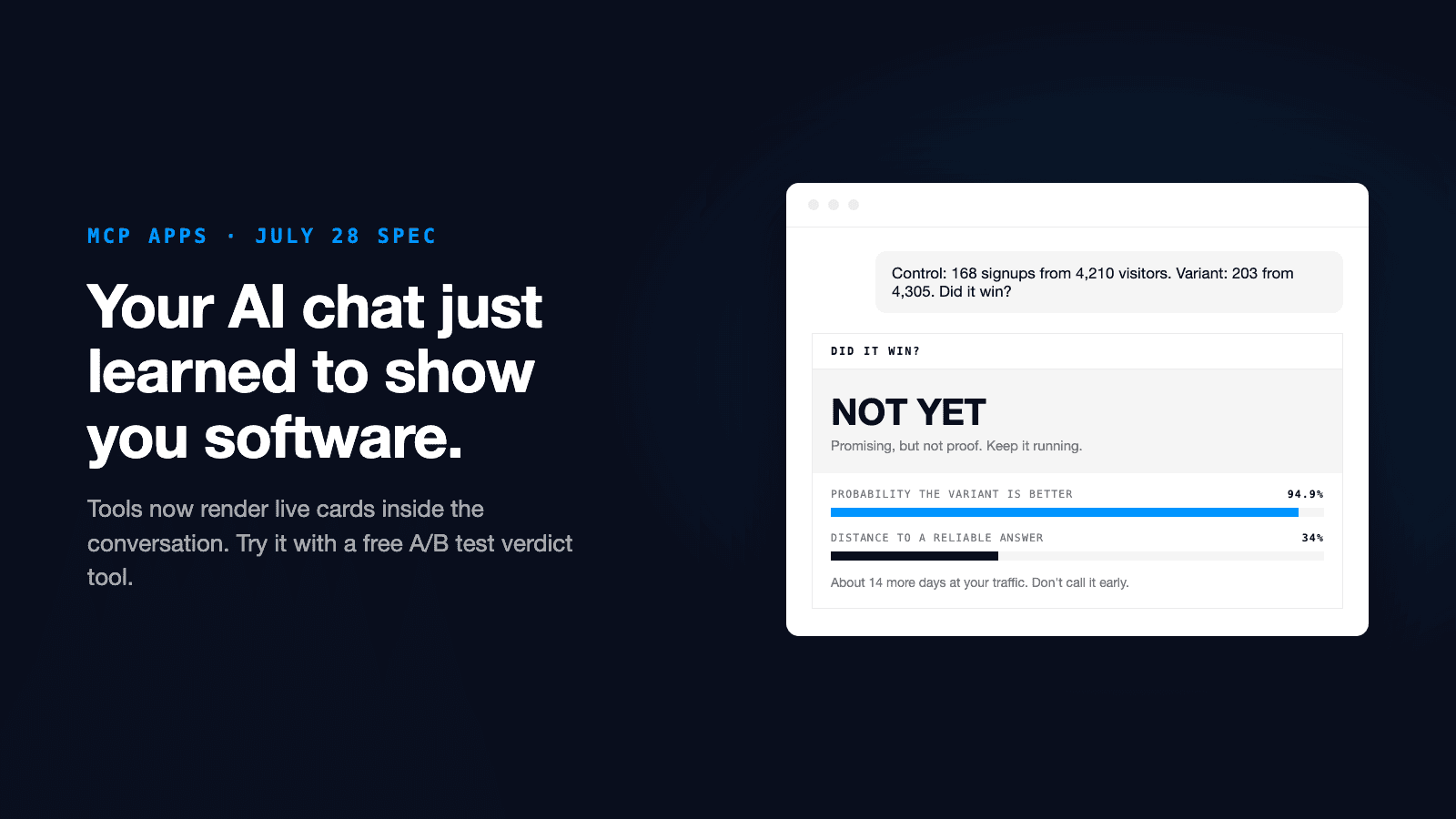
You tell your AI the numbers from your test. Visitors and conversions for each version. The tool answers with a visual verdict card, right in the chat:
- WINNER or LOSER when the math genuinely supports a call.
- NOT YET when the result looks promising but is not proof, along with exactly how many more visitors you need and roughly how many days that is at your traffic.
- NO REAL DIFFERENCE when the gap is so small that proving it would take over a million visitors. It tells you to stop wasting traffic and test something bolder.
The card shows both conversion rates with their uncertainty ranges, so you can see with your own eyes whether they overlap. It shows the probability the variant is genuinely better, which is the sentence you actually want in the meeting. And it has a confidence slider you can drag to feel what "95% confidence" trades away. Drag it down and watch a NOT YET flip to WINNER, which is exactly why teams that lower the bar ship false winners.
Why an A/B checker? Because calling tests early is how teams fool themselves.
We picked this problem on purpose. Marketers run tests every week, and most of us call them wrong.
The classic failure looks like this. The test runs for four days. The variant is ahead. Someone checks the dashboard, sees a bigger number, and declares victory. The team ships it. The lift never shows up in revenue, because the "win" was noise.
The statistics to prevent this have existed for a century. The problem was never the math. The problem is that the math lives in calculators nobody opens, expressed in jargon nobody remembers. p-values, z-scores, power analysis.
Putting the verdict inside the chat, as a card you can read at a glance, moves the statistics to where the conversation is already happening. And the tool is deliberately honest: it warns you about peeking at running tests, it flags shaky sample sizes, and its most common verdict is the one dashboards never give you, which is "not yet."
Test it in one minute
Here is the whole setup. You need a Claude plan that supports custom connectors.
In Claude, open Settings, then Connectors, then Add custom connector.
Paste the tool URL. No signup, no API key, no account.
Give it your test numbers in plain English and read the verdict.
The connector URL:
https://mcp.getmasset.com/did-it-win/mcp
Then try a prompt like this one:
Our homepage test: control got 168 signups from 4,210 visitors. The new version got 203 signups from 4,305 visitors. We get about 1,200 visitors a day. Did it win?
You will get the NOT YET card: a 94.9% probability the new version is better, which sounds like a win, sitting right next to the proof that it is not one yet, and about two more weeks of traffic to a reliable answer. That tension is the whole lesson, on one card.
Before you start, you can also ask it to plan a test: give it your baseline conversion rate and it will tell you how many visitors the test needs before you launch, so you can set the end date up front.
If you use Claude Code, one command does it: claude mcp add did-it-win --transport http https://mcp.getmasset.com/did-it-win/mcp
The math is real, and the AI never guesses it
One design rule mattered more than any other: the model never does the statistics.
Every number on the card comes from deterministic code. The significance gate is a standard two-proportion z-test. The uncertainty ranges are Wilson score intervals. The "probability the variant is better" is an exact Bayesian calculation. The "visitors you still need" figure comes from the classic sample-size formula. All of it is unit-tested against scipy and statsmodels, the reference statistics libraries, and the tests ship in the open repo so anyone can check.
This matters because a language model asked to eyeball significance will happily hallucinate a confident answer. The right division of labor is the one MCP was designed for: the AI handles the conversation, the tool handles the truth.
Nothing you send is stored, either. The server is stateless. Your test numbers go in, a verdict comes out, and nothing is written down anywhere.
“The AI handles the conversation. The tool handles the truth.”
What this means for your stack
Did It Win is the first tool on mcp.getmasset.com, a home we set up for free MCP tools for marketers. The whole thing is open source under MIT, so developers can read every line, run it themselves, or use it as a reference for building their own MCP App.
The bigger point is the direction. Your AI chat is becoming the place where marketing work happens, and MCP Apps means the tools you rely on can now meet you there with real interfaces instead of walls of text. Verdict cards today. Calendars, dashboards, and content libraries next.
That last one is where we live. Masset is the best home for your business content, and it already connects that content to your AI tools over MCP. An interface for it inside the chat is exactly the kind of thing this new spec makes possible.
Connect the tool, run your last A/B test through it, and see what your dashboard should have told you. If it says NOT YET, now you know exactly how much longer to wait.
Key Takeaways
- The July 28, 2026 MCP spec made MCP Apps official: connector tools can now render interactive interfaces inside your AI chat instead of returning only text.
- Did It Win is a free, open-source MCP App that gives honest A/B test verdicts: WINNER, LOSER, NOT YET, or NO REAL DIFFERENCE, with real statistics computed in code.
- Connect it to Claude in about a minute: add https://mcp.getmasset.com/did-it-win/mcp as a custom connector, then describe your test in plain English.
- The most valuable verdict is NOT YET: it tells you the probability the variant is better, and exactly how many more visitors you need before the result counts as proof.
- The AI never does the math. Every number is deterministic, unit-tested against scipy and statsmodels, and nothing you send is stored.