How you actually play it
Mystery Guest doesn't need an app, a download, or a single click outside your chat. It runs entirely as an MCP tool, which is the open standard that lets an AI like Claude connect to outside software. If you've ever added a "connector" to Claude, you already understand MCP.
Here's the whole setup. Add https://mcp.getmasset.com/mystery-guest/mcp as a custom connector, start a new chat, and say "let's play today's mystery guest." No account, no signup, and no key are required.
In Claude, open Settings, then Connectors, then Add custom connector.
Paste this URL and save. No signup, no key.
Start a new chat and say: let's play today's mystery guest.
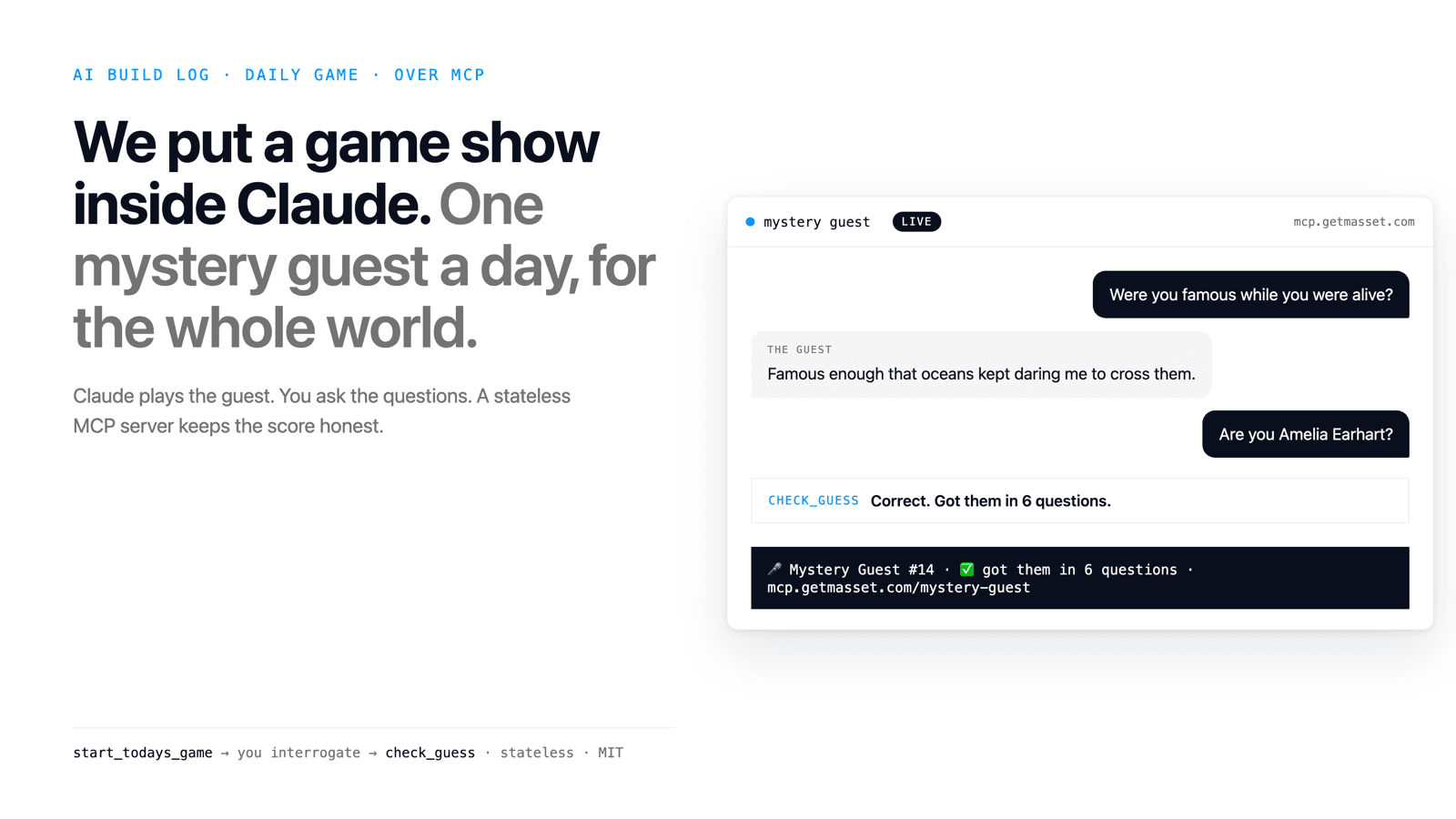
Claude greets you in character and waits. Ask whatever you'd ask a real interview subject: where they lived, what they're known for, whether they're even a real person. Claude answers in character, one question at a time.
When you think you've got it, just guess. Claude checks your guess, tells you if you're right, and hands back a share card with your score: how many questions it took you to get there.
Claude can't keep a secret from itself, so we didn't ask it to
Here's the design problem behind the whole game. Ask a language model to hold a secret and hide it from you, and sooner or later, a clever enough question gets it to slip. Models are built to be helpful and to answer what's asked. Guarding a hidden fact inside the same conversation that's also trying to answer you honestly is a losing fight.
So we didn't fight it. We split the job in two.
- Gets today's dossier: identity, facts, voice, personality
- Plays the guest, in character, one answer at a time
- Never grades your guess itself
- Fixed today's guest in code before you ever said hello
- Judges your guess with string matching, not vibes
- Issues the verdict and the share card
To be clear about what that split does and doesn't mean: Claude does know who the guest is. It has to, or it couldn't play the part. A sufficiently determined player can probably still trick the performer into slipping, the same way you might trick a human party host. What the split protects is everything that has to be trustworthy: today's guest was fixed in code before you ever said hello, your guess is judged by string matching on the server, and the score on your share card comes from the referee, not from a model being agreeable.
So when you're ready, Claude sends your exact guess to check_guess. The server checks it and hands back the verdict. Claude relays the result. It never decided it, and no amount of sweet-talking changes what the referee saw.
If this sounds familiar, it should. It's the same pattern behind Did It Win, our free A/B test tool: deterministic code handles the part that has to be trustworthy, and Claude handles the part that has to be conversational. We think most useful MCP tools will end up shaped this way.
“The performance is the model's job. The verdict never is.”
Why a marketing software company built a game
Fair question. Masset makes software that helps marketing teams manage and share their content. Nothing about that says "guessing game."
Here's the honest answer: this is a test. Our whole free-tools program rests on a bet, that software is moving inside the AI conversation itself, not staying in separate browser tabs. Masset's own product bet rides the same wave: your content, reachable by every AI your team already uses, over the same MCP standard.
| TRADITIONAL GAME AI | CLAUDE AS HOST |
|---|---|
| Computes the correct move from fixed rules | Plays a role from a written dossier |
| Runs the same logic every single game | Answers in its own words, so no two games read alike |
| Wins by being unbeatable | Can be out-argued, teased, or genuinely stumped |
A game is the fastest way to learn something a pricing page never tells you: will ordinary people, not developers, actually go add a connector and talk to an MCP server? We don't know the answer yet. We'll publish what we learn either way, whether it's "people love this" or "nobody bothered."
What we stole from Wordle
The daily-puzzle shape isn't new, and we didn't try to reinvent it. One answer, the same for everyone, every single day. A share line with no spoilers. Come back tomorrow for a new one. Wordle proved that shape works, so Mystery Guest borrows it directly.
The day resets on UTC time, so everyone on earth is arguing about the same guest at the same time, the same rule Wordle uses.
When you finish, Claude hands you a share line built for exactly that: no name, no dossier, just your score.
One honest note. The whole roster lives in the open-source repo, so technically you can go read it and spoil every future guest for yourself. Wordle's full answer list was public too, sitting in plain sight in its own source code, and it never mattered. Cheating a game with no prize only cheats you out of the fun of playing it. Same spirit on the score: the server judges your guess, but the question count rides the honor system between you and Claude.
The rules of the roster
Before we wrote a single dossier, we set rules for who's allowed to be a mystery guest. They stayed simple on purpose.
- Deceased or fictional only. No living person gets guessed at, quoted, or impersonated. Every guest is either a historical figure or a character who was never real to begin with.
- Globally famous. Someone from any country, and any generation, should have a fair shot at recognizing them eventually.
- No one famous for tragedy or atrocity. Fame earned through violence or suffering doesn't belong in a guessing game, so those figures are excluded outright.
- Encyclopedia-level dossiers only. Claude answers from a dossier built on facts that are documented and checkable, not rumor or invention.
At launch, the roster holds 238 guests, each with their own dossier. That's a long stretch of daily games before anyone repeats.
Play today's guest
Game #1 went live on July 29, 2026. Add https://mcp.getmasset.com/mystery-guest/mcp as a custom connector in Claude, start a new chat, and say "let's play today's mystery guest." The interactive share card renders in clients that support MCP Apps, which today means claude.ai and Claude Desktop. Any other MCP client still plays the full game; you just get the result as text instead of a card.
The whole thing is open source under MIT, same as our other free tools. Read the code, the dossiers, and the two tools that run it at github.com/BenMasset/masset-mcp-tools.
Play it, then reply and tell us your share card. We're genuinely curious whether this whole idea holds up.
Key Takeaways
- Mystery Guest is a free daily guessing game played entirely inside Claude: connect https://mcp.getmasset.com/mystery-guest/mcp and say 'let's play today's mystery guest.'
- The server, not Claude, holds the daily answer and checks your guess. Claude only performs the character, which keeps the game honest.
- Two tools run the whole thing, start_todays_game and check_guess. The server is stateless, so nothing you type is stored.
- One guest, the same for the whole world, changes every day at UTC midnight, the same daily-puzzle shape Wordle made popular.
- The roster only includes deceased or fictional figures, 238 of them at launch, each built from an encyclopedia-level dossier.
- It's open source under MIT at github.com/BenMasset/masset-mcp-tools, on the same mcp.getmasset.com host as Did It Win and Check, Mate?.