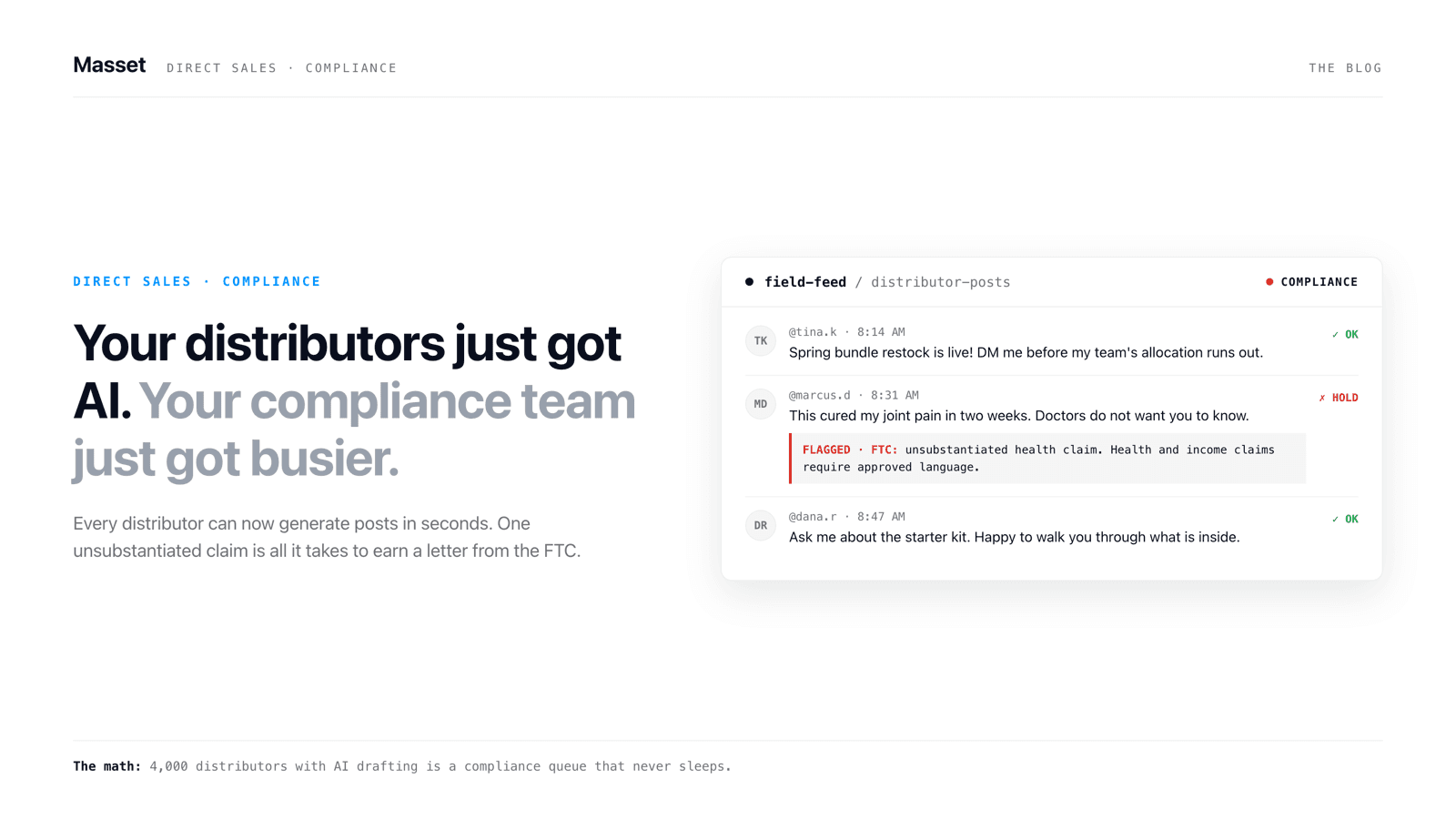
The FTC says your distributors' posts are your problem
Direct sales compliance now has an AI problem. If you run marketing at a direct sales company, your company is legally responsible for the marketing claims your distributors make, including posts an AI wrote for them. The FTC says there is no safe harbor. The fix is structural: one approved content home, distributor AI that drafts only from it, version control that updates every copy, and training that sticks.
That first sentence isn't my read on the situation. It's the FTC's own language. Its business guidance on multi-level marketing says companies "are liable for the FTC Act violations of their agents" and that "there is no safe harbor or exception to this principle under existing law." Liability applies "regardless of where the participant statements are made, including on social media and in small group recruiting meetings."
You didn't write the post. You may never see the post. It's still yours.
It cuts the other way too. The same guidance covers what lawyers call "means and instrumentalities." If your company hands distributors a claim that turns out to be false, you violated the FTC Act yourself, even if you never published it. The content you push out to the field carries the same liability as the content the field invents.
“You didn't write the post. You may never see the post. The FTC says it's still yours.”
The FTC already told you what a real compliance program looks like
The program design isn't a mystery. Q28 of the same guidance lists what the FTC expects. Train your agents on what violates the FTC Act. Monitor what they say and apply real discipline. Require pre-approval before income or product claims go out. Keep copies of every ad, including transcripts of private chats. Get access to every platform your field uses, private groups included. Then prove the whole thing works in practice, not just on paper.
Now read that list against your org chart. The Direct Selling Association counts 5.4 million sellers in the US and $34.7 billion in 2024 retail sales. Its own compliance handbook calls policing millions of independent sellers the industry's unique challenge. At 10,000 distributors, the FTC's six expectations are a full department's workload done by hand.
Count how many of the six you run today. If it's training at onboarding plus monitoring when somebody reports a post, you're at two. The FTC's list assumes all six, running continuously.
In 2026, the guidance turned into orders
For years that guidance read like theory. Back in October 2021, the FTC put more than 1,100 companies pitching money-making ventures, most of them MLMs, on notice with a Notice of Penalty Offenses. That was the warning shot. Then the orders started landing.
In April 2026 the FTC ordered Forever Living, its CEO, and its president to stop making deceptive earnings claims and to keep substantiation on hand. The complaint alleged that in each of the last five years, at least 77% of Forever Business Owners received no compensation at all. It alleged that after two full years, more than 89% hadn't recouped their roughly $300 start-up cost, and fewer than 7% ever received downline income. The FTC also sent $2.7 million back to harmed consumers.
The same week, the FTC did something it had never done before. It went after individual top distributors, not just companies. Stormy Wellington, a high-level participant in Total Life Changes and then Farmasi, had promised things like "60 new millionaires in 2026" on YouTube and Facebook. The income disclosures told a different story. The FTC said 76.8% of TLC's active participants, 23,124 people, earned zero dollars in 2023, and at most 0.4% earned more than $5,000. Her order bans deceptive earnings claims made "through images of homes, vehicles, purchases, or travel" and requires her to notify her own downline.
That should change how you think about your top earners. They're now personal enforcement targets, and their posts are the ones your whole field copies. The proposed rule didn't need to finalize for any of this. Enforcement ran on existing law. And this isn't a passing priority: in June 2026 the FTC's business blog framed the MLM earnings cases as the work of its Labor Task Force, worker protection rather than a one-administration project. The math compounds fast: FTC civil penalties run more than $53,000 per violation, adjusted annually. Per violation means per post.
What actually gets flagged is not your corporate site
The Direct Selling Self-Regulatory Council is the industry's own watchdog, and its 2025 numbers tell you exactly where the exposure lives. It brought 608 claims to companies' attention. 560 were business opportunity and earnings claims. Only 48 were product claims. About 94% of the flagged claims came from distributor social accounts, mostly Facebook, Instagram, and YouTube. Just 6% came from company websites. Its monitoring reviewed roughly 526,401 unique URLs in a single year.
Your corporate site is not the problem. The field is. And the most common flagged phrase wasn't exotic. It was distributors claiming a "full-time income."
DSSRC's VP Peter Marinello added one more warning worth sitting with: older content that stays publicly available keeps generating cases, and companies need to remediate legacy content. A 2022 post with an outdated income claim is a live liability in 2026. Stale content isn't an aesthetic problem. It's open exposure.
The claims that trigger cases rarely feel like lies when they're posted. A photo of the new car with a caption thanking the business is an implied earnings claim, deceptive if the typical distributor doesn't earn that. Hypothetical math is deceptive if the assumptions don't match typical experience. A "results not typical" disclaimer fixes none of it; the FTC says that's not enough. A sincere personal story needs a reasonable basis that the typical person in the audience can achieve the same result. And health claims need competent and reliable scientific evidence before they go up, with civil penalties on the table when they don't have it.
Then your field got ChatGPT
Now hand every one of those distributors a tool that writes confident marketing copy in seconds.
Ask a generic AI for ten posts about earning extra income with a wellness business and it will happily produce income hooks, urgency lines, and product benefits it made up on the spot. It doesn't know your income disclosure statement. It doesn't know which product claims your legal team has substantiation for. It writes what sounds good, and what sounds good in direct sales marketing is usually exactly what regulators flag. The distributor who used to write one risky post a week can now generate thirty in a sitting.
The FTC has already shown it will apply the means-and-instrumentalities doctrine to AI tools. In its September 2024 Operation AI Comply sweep, it sanctioned Rytr, an AI writing tool, for giving subscribers the means to generate false reviews and testimonials. The tool never posted anything. Providing the means was enough.
The instinct is to ban AI in the field. That fails the same way "just stop posting" fails: your best distributors don't stop, they hide. You lose visibility into content you were already liable for. AI use in your field isn't a policy decision you get to make. It already happened. The decision you actually get is what their AI reads before it writes.
You can chase bad posts, or you can change what the AI reads
There are two ways to run distributor content compliance, and most of the industry only talks about one.
The detection model watches the field and catches bad posts after they publish. It's what the monitoring vendors sell and what DSSRC does at industry scale. It works, and you need some of it. But it scales with post volume, and post volume just exploded. Half a million URLs reviewed in a year was the pre-AI workload for one watchdog.
The source model works before the post exists. Give every distributor's AI one approved source of truth: the claims legal signed off on, the current income disclosure, the approved product language, the on-brand images. The compliant post becomes the default output instead of the lucky one. Monitoring stays as the backstop, but it catches exceptions instead of everything.
Detection asks: how fast can we catch what's wrong? Source asks: why is wrong content the starting point at all? You need both. But only one of them gets cheaper as your field's AI use grows.
What the source model looks like in practice
The source model needs five mechanics. We build a product that does this (Masset), so I'm biased, and you should read this section knowing that. The shape matters more than the vendor.
One approved home for every claim. Every approved income statement, product claim, disclosure, and image lives in one governed library, the kind of AI-ready DAM a distributed field can actually pull from. Anything outside it is unofficial by definition. That single move gives your monitoring program a baseline: content either came from the home or it didn't.
The field's AI drafts from that home only. This is what MCP makes possible. It's the open standard that lets AI tools like Claude and ChatGPT read from an approved library instead of guessing. Masset's MCP server exposes 35 tools with permissions enforced on every call, so a distributor's AI can only draft from content you actually approved for them. The AI stops inventing product benefits because it finally has the real ones.
Fix a claim once and every copy updates. When legal revises an income claim, version control cascades the change to every board, share, and AI surface that uses the asset. That's the direct answer to DSSRC's legacy-content warning: old claims stop living forever in forgotten corners.
Different markets see different content. Per-market and per-team hubs mean a distributor in a market where a claim isn't approved never sees that claim in the first place.
Training that compounds. The first item on the FTC's Q28 list is training your agents. A once-a-year compliance webinar doesn't do that. Daily two-minute quizzes in Slack or Teams, generated from your approved content, do. And they produce the participation records that prove the program works, which is the FTC's sixth expectation.
Honest scoping: none of this replaces your lawyers, and it isn't a field-monitoring service. It's the layer those programs sit on. Monitoring gets easier when the content it audits came from one governed source. We wrote up how this maps to your world specifically on our direct sales industry page.
Your first 30 days
You don't need to buy anything to start. Steps one and two are the hard part anyway.
- Inventory what's circulating. Search your company name plus "income," "financial freedom," and "full-time income" on Facebook, Instagram, and TikTok. Screenshot what you find. This is the audit DSSRC would run on you, and it takes an afternoon.
- Write the approved-claims doc with legal. What the field can say about income and about products, with the substantiation attached to each claim. If the January 2025 proposed rule ever finalizes, written substantiation stops being best practice and becomes the law.
- Stand up the home. Put the approved claims, the current income disclosure, product language, and images in one governed library with permissions.
- Connect the field's AI to it. Any MCP-compatible AI client can do this today. The distributor keeps the tool she already loves. It just starts reading from your truth.
- Retire legacy content. Old assets with outdated claims are live liabilities. Update or kill them at the source so every copy follows.
- Measure. Track flagged posts per month. That's the number Q28 wants you to be able to show: proof the program works in practice, not on paper.
The FTC isn't waiting to see whether your distributors adopt AI. They already have. The only open question is what that AI reads before it writes.
Key Takeaways
- The FTC holds direct sales companies liable for distributor marketing claims. There is no safe harbor, and social media counts.
- April 2026 changed the stakes: orders hit Forever Living and, for the first time, individual top distributors.
- 94% of claims flagged by the industry's self-regulator in 2025 came from distributor social accounts, and 560 of 608 were earnings claims.
- Generic AI multiplies the risk. AI grounded in one approved content home reverses it.
- Start without software: inventory the claims already circulating, then write the approved-claims doc with legal.