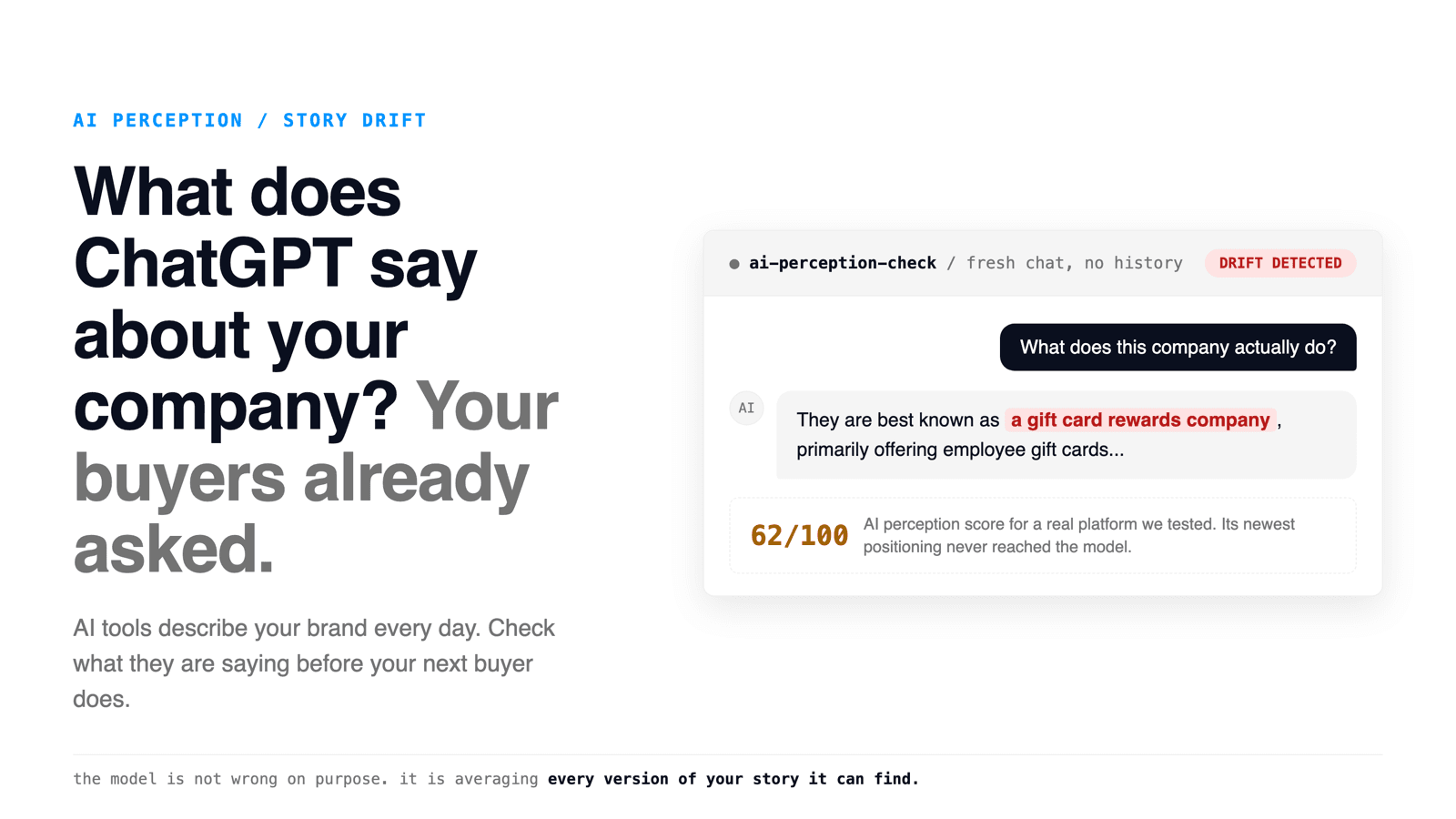
Your buyers already ask AI about you. You never see the answer.
The audit is simple. You ask ChatGPT six questions about your own company, cold, the way a stranger would. You score each answer as right, old, wrong, or blank. Then you fix the failures in a specific order. The whole thing takes about ten minutes, and it tells you something no analytics tool can: what AI actually says to buyers when you're not in the room.
This matters because the conversation has moved. When a buyer asks ChatGPT "what's the best tool for X," the answer they get is the new first impression of your brand. Researchers at Harvard Business Review studied AI shopping agents this year and found the persuasion tricks that work on humans don't work on them. The AI doesn't see your ads. It sees your facts, wherever it last found them.
And here's what makes it uncomfortable. Your website has analytics. Your emails have open rates. The ChatGPT conversation about your brand has nothing. It happens thousands of times, it ends in a decision, and you get no transcript. The only way to know what AI says about you is to ask it yourself.
Three rules make this a clean test
Rule 1: Use a temporary chat. If you've ever talked to ChatGPT about your company while logged in, its memory knows you. It will flatter you with your own words. Open a temporary chat (or log out entirely) so you get the same cold answer a stranger gets.
Rule 2: One prompt per chat. Each question gets a fresh conversation. If you ask all six in one thread, your earlier questions teach the AI what you want to hear, and the test goes soft.
Rule 3: Run it twice, and don't panic over one answer. AI search is probabilistic. The same prompt produces different answers across sessions, days, and model versions. One bad answer is a data point. The same bad answer twice is a pattern. Treat this audit as a sample, not a verdict.
One more thing worth knowing: ChatGPT with web search on and ChatGPT with it off are testing two different things. With search off, you're testing what the model absorbed in training. With search on, you're testing what it finds about you live. Run prompt one both ways if you want to see the difference. The rest of the audit works either way.
The six prompts, and what each one actually tests
Copy these, swap in your company name, your category, and your closest competitor, and run them one at a time:
1. What is [company]?

2. What does [company] do, and who is it for?

3. What are the best [category] tools for [your target audience]?

4. [company] vs [competitor]: which should I pick, and why?

5. What do customers say about [company]? What are the common complaints?

6. How much does [company] cost, and what's included?
Each one is testing something different. Here's what to look for.
“You can't read the transcript. You can only change what the AI finds the next time it looks.”
1. “What is [company]?” tests whether you exist
This is the existence check. A good answer names your category, your audience, and what you do, in roughly the words you'd use yourself. A bad answer confuses you with a similarly named company, invents products you don't have, or comes back with "I don't have information about that company."
Don't grade on flattery. Grade on accuracy. The question isn't whether the AI is nice about you. It's whether a stranger reading that answer would understand what you sell.
2. “What does it do, and who is it for?” tests which version of your story AI learned
Most companies have repositioned at least once. This prompt tells you which version of your story the AI absorbed. If you rebranded eighteen months ago and ChatGPT still describes the old you, every buyer who asks gets the pitch you retired.
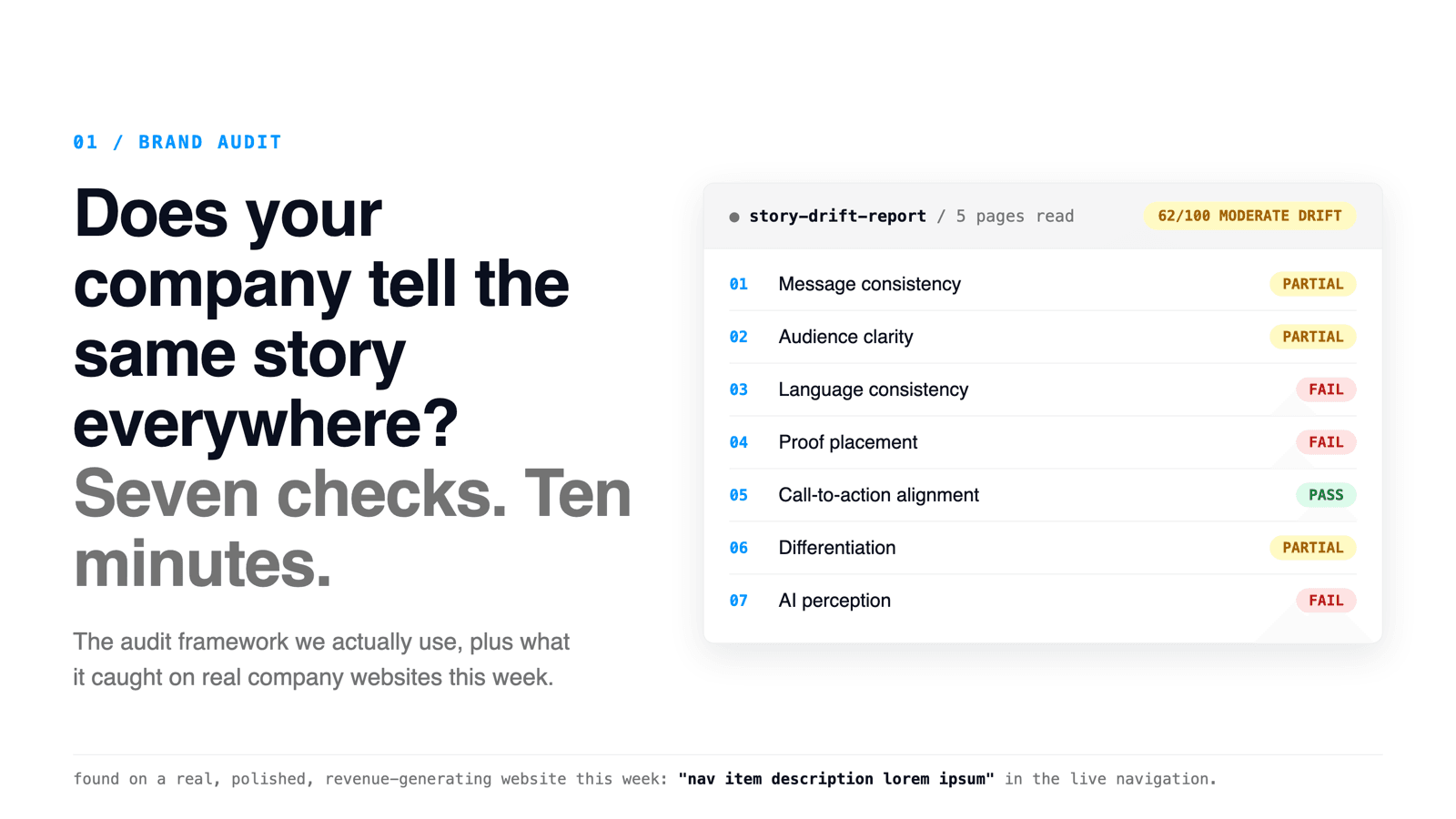
We have a name for what happens when your own team tells five versions of your story. We call it story drift. This is the AI edition of the same disease, and it's worse, because the AI tells the stale version with total confidence and at infinite scale. I've watched it happen to us, and I'll show you that in a minute.
3. “What are the best [category] tools?” tests whether you make the shortlist
This is the one that hits the pipeline. When a buyer asks for the best options in your category, the AI reads back a shortlist, and the shortlist is the new page one. If you're not on it, you didn't lose the comparison. You were never in it.
Note who is on the list. Those are the names AI reaches for in your category, and their content is what it's citing. You'll want that list when you get to the fixes.
4. “[Company] vs [competitor]” tests whether the comparison is fair
Buyers run this exact prompt before talking to sales. Check two things in the answer. First, the facts: are your features, integrations, and positioning right, or is the AI conceding points you actually win? Second, the verdict: AI answers usually end with "choose X if..., choose Y if...". Make sure the "choose you if" sentence describes your actual best-fit customer.
A wrong comparison is the most expensive failure in this audit, because it arrives at the exact moment of decision. We treat this the same way for our own category: we publish how Masset compares to Seismic ourselves, so the facts AI reaches for come from a page we keep accurate instead of one we never see.
5. “What do customers say?” tests your reputation footprint
The AI can't interview your customers, so it pulls from what's public: review sites, Reddit, forums, case studies. This prompt shows you which sources it leans on for sentiment about you. If the answer is thin, your reputation footprint is thin. If the complaints it cites are from 2023, your freshest reviews aren't where AI looks.
6. “How much does it cost?” tests how stale your facts are
Pricing changes more often than anything else about a company, which makes it the perfect freshness test. If the AI quotes your pricing from two years ago, assume everything else it knows about you is two years old too. And a buyer who walks in expecting the old price isn't a lead. They're a refund waiting to happen.
Score every answer: right, old, wrong, or blank
For each of the six answers, give one of four grades. Right means a stranger would come away understanding you correctly. Old means the facts were true once. Wrong means the facts were never true, or you're confused with someone else. Blank means the AI doesn't know you exist.
Here's the ranking that surprises people: wrong is worse than blank. A blank answer costs you a buyer. A wrong answer costs you a buyer and hands them to a competitor with confidence in its voice. If you have to pick what to fix first, fix wrong before you fix invisible.
Your six grades will cluster into one of three patterns, and each pattern has a different fix. Mostly blank means AI doesn't know you're an entity yet. Mostly old or wrong means AI knows a stale version of you. Right about you but absent from prompts three and four means AI knows you but never recommends you. Hold your pattern in mind; the fixes are below.
“A blank answer costs you a buyer. A wrong answer costs you a buyer and hands them to a competitor with confidence in its voice.”
Claude described Masset five versions ago. It was painful, and it was fair.
I didn't learn this from a tidy audit. I learned it by accident, running a story drift report on our own company. Claude described Masset in language we'd experimented with several pivots back: marketing enablement, the content layer, content infrastructure. Terms we had tried on to see if they meant anything to people, then moved past. The AI had kept them.
It wasn't fun to read. But I couldn't be mad about it either. We're a startup. We had changed how we talk about the product over and over, and no version had been used consistently, everywhere, for very long. The AI didn't get our story wrong. It picked up exactly what we put down.
Seeing your company from the outside like that forces a decision. For us, the discipline was to stop scooting around with high-tech labels and embrace the plain version: Masset is a home for your content. Yes, there's AI all through the product, and some of it is genuinely great. But the core benefit is that your content is in one place and everyone can get what they need, when they need it, whatever tool they're working in. That sentence now does the work everywhere we show up, because the next time an AI learns our story, I want there to be exactly one story to learn.
“The AI didn't get our story wrong. It picked up exactly what we put down.”
What to fix first, by failure pattern
If you scored mostly blank: you have an entity problem. Start with one sentence on your homepage that says exactly what you are: "[Name] is a [category] that [does what] for [whom]." Then make that sentence consistent everywhere your company appears: LinkedIn, G2, Crunchbase, your footer. AI builds its picture of you from your whole public footprint, and right now that footprint doesn't add up to a clear answer. Making your site readable to AI crawlers is part of the same job.
If you scored mostly old or wrong: the AI learned a version of you that's no longer true, and it learned it from pages you probably forgot exist. Old pricing pages, a stale About page, third-party listings nobody has touched since the rebrand. Hunt down every public surface still telling the old story and update it. When you rewrite those pages with AI, run them through the prompt that makes AI sound less like AI so the new copy reads like you and not like a machine. Then put a date on your key pages and keep it current; fresh, dated content is what retrieval systems prefer to quote.
If you're known but never shortlisted: you have a comparison-content gap. The shortlist answers are pulled overwhelmingly from list-and-comparison pages; one analysis of nearly 400 million AI citations found 63% pointed to listicles. If nobody has written the honest comparison in your category, write it yourself, and follow the rules that make AI actually cite it: real numbers, named sources, a real verdict. Reviews matter here too; thin G2 presence keeps you off reputation answers.
And if you're still pivoting, here's the reframe that helped me. Startups change their story because they're hunting product-market fit, and that's the job. But once you find the thing you do really well, focusing your story is discipline, not constraint. AI punishing inconsistency is just pressure to do what you owed your business anyway: decide what you are, and say it the same way everywhere, instead of staying nebulous and broad because committing feels risky.
One honest caveat before you rebuild your roadmap around this. Nobody can promise you a citation. AI search is probabilistic, the studies in this space are young, and anyone selling you a guaranteed spot in ChatGPT's answers is selling something else. What the research does support: clear definitional copy, hard numbers with named sources, and fresh dated pages all measurably improve your odds. The Princeton team that coined "generative engine optimization" found adding statistics, quotes, and citations lifted visibility by up to 40%.
Then put the audit on a calendar. Ten minutes, once a quarter, same six prompts. The answers change as models update, and the whole point is to read the new first impression before another thousand buyers do.
Sources
Every number in this post links to its source inline. Here they are in one place.
- Harvard Business Review, "Research: Traditional Marketing Doesn't Work on AI Shopping Agents," May 2026.
- Evertune Research, "AI search loves listicles: What 25,000 URLs reveal about citations," Search Engine Land, May 2026.
- Aggarwal et al., "GEO: Generative Engine Optimization," KDD 2024.
Key Takeaways
- Buyers ask ChatGPT about brands thousands of times a day, and there's no analytics for those conversations. The only way to know what AI says about you is to ask it the way a stranger would.
- The audit is six prompts run cold in temporary chats: what is the company, what does it do, the category shortlist, the head-to-head comparison, customer sentiment, and pricing. About ten minutes total.
- Grade each answer right, old, wrong, or blank. Wrong is worse than blank: an invisible brand loses a buyer, but a misdescribed brand loses the buyer and sends them to a competitor.
- The three failure patterns map to three fixes: blank means an entity problem (one clear definitional sentence, everywhere), old means stale public pages, and unshortlisted means a comparison-content gap.
- If you pivot a lot, expect AI to be telling a past version of your story. The fix is the discipline you owed it anyway: pick what you are and say it the same way everywhere, on fresh pages.
- AI answers are probabilistic and change as models update. Run the same audit quarterly and treat each run as a sample, not a verdict.