A brand audit answers one question
A brand audit answers one question: does your company tell the same story everywhere a buyer might meet it? Not "is the story good." Just "is it the same." Because a good story told three different ways reads like three mediocre companies.
The traditional version is an agency engagement. Six weeks, a five-figure invoice, and a deck you read once. The useful version is smaller and more frequent: a fast, honest check you can run yourself, often enough to catch drift before your buyers do.
This week I got an unusually close look at what these audits turn up. We rebuilt our free audit tool, and to test it we ran it against real company websites, including our own. This article is the framework the tool uses, the embarrassing things it found on real sites, and how to run the whole check yourself in about ten minutes.
The seven checks
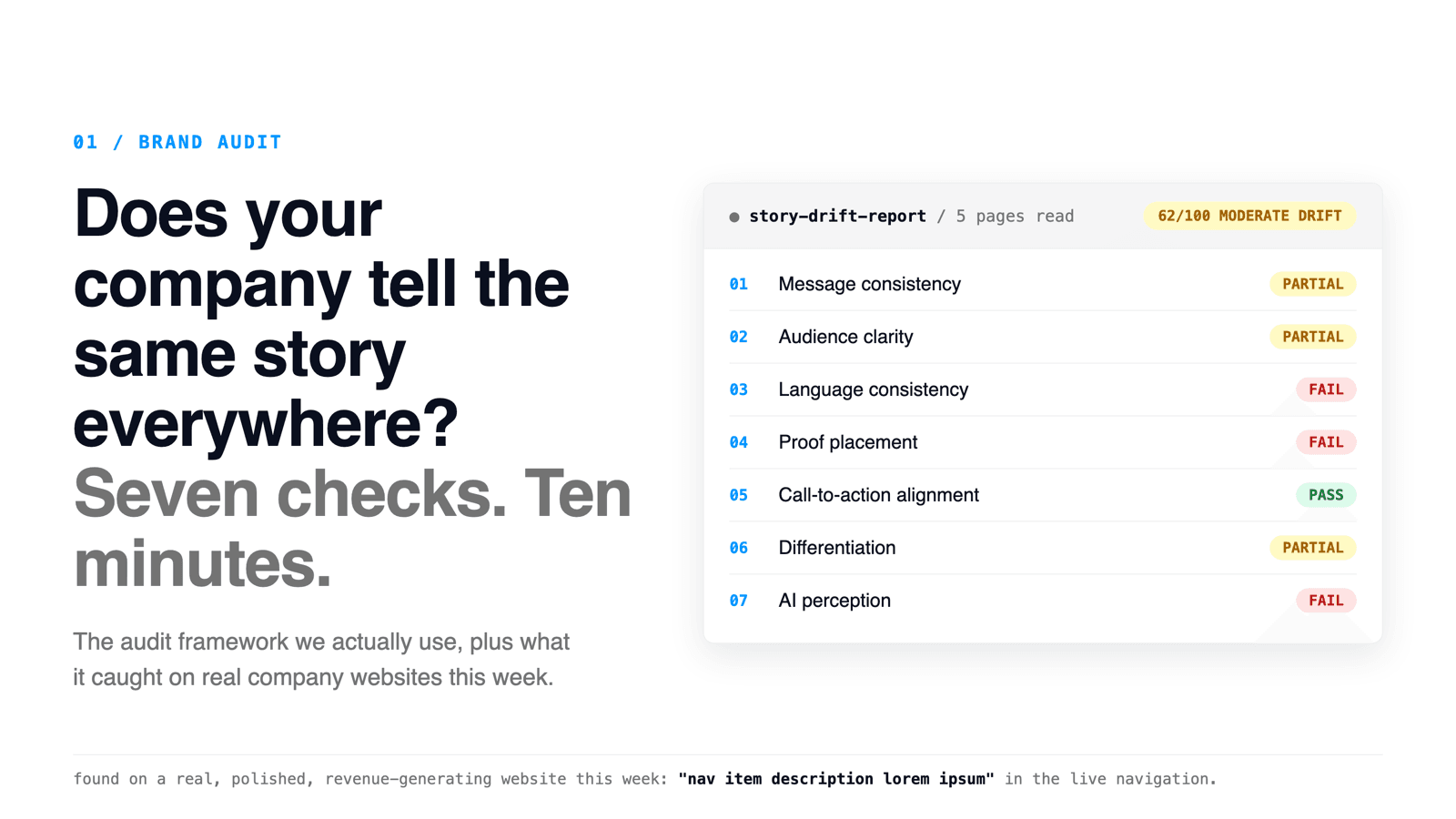
Pull up your homepage, your main product page, your about page, and one or two pages your buyers actually land on. Then walk these seven checks. The first six measure your site. The seventh measures something most audits skip entirely.
Score each check pass, partial, or fail. Ten minutes, honest answers, and you will know more about your brand's real state than most teams learn in a quarter.
What we found auditing real websites this week
Frameworks are abstract until you see what they catch. Here is what came out of the real audits we ran while testing the rebuilt tool. Companies anonymized, findings verbatim.
The one that made me laugh out loud: an established software company, polished brand, real revenue, shipping placeholder text in their live navigation. The dropdown descriptions on every page, in every locale, read "nav item description lorem ipsum." A template default went to production and nobody caught it, because nobody was looking at their site the way a stranger does.
The same audit found their customer proof intact but invisible. Real quotes, real case studies, all parked behind a menu link most visitors never touch, while the homepage and partner pages made claims with no evidence in sight. Check four fails quietly like that: the proof exists, so the team feels covered, but the buyer never sees it.
A third finding: their French-Canadian page had drifted into its own brand. Different promotion in the hero, different call to action, translation inconsistencies against the English tagline. Multiply that by every locale, location, or franchisee you have, and you can feel how drift compounds.
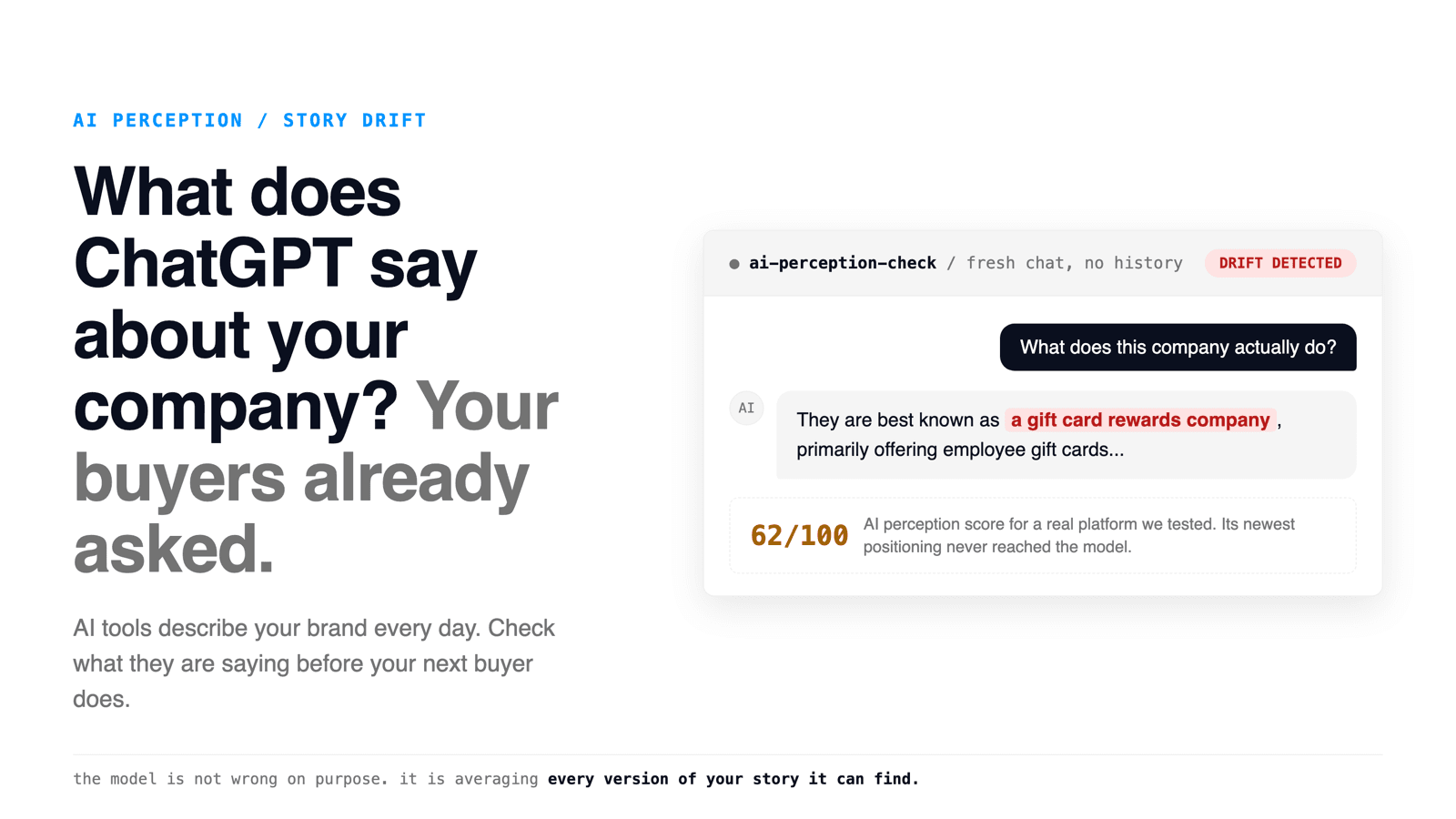
And the services firm I mentioned scored 18 out of 100 on AI perception because its site tells four stories at once. The AI could not confidently complete the sentence "this company is." Neither could a buyer.
“Brands drift the same way tools break: quietly, one small mismatch at a time, until someone actually looks.”
Why multi-location brands drift fastest
If your company is one team in one building, your story drifts slowly. If you are a brand operating through many hands, it drifts every single day, because every location, franchisee, distributor, and agent is a place the story gets retold from memory.
We see the same shape across very different industries: franchises where each location edits the flyer themselves, senior living operators where every community writes its own tour materials, direct sales companies where thousands of distributors post whatever version of the pitch they remember. The structure guarantees drift. The audit is how you see how far it has gone.
For these brands I would add one working question to the seven checks: pull the three most recent pieces your field actually sent or posted, and hold them against your current brand guide. The gap between headquarters' story and the field's story is usually wider than anyone at headquarters believes. In direct sales specifically, that gap is not just a brand problem anymore. We wrote up what happens when your distributors' own AI starts inventing the income and health claims you never approved, and why the FTC now treats those posts as your problem.
The 2-minute automated version
The Story Drift Analyzer runs checks one through seven automatically. It reads up to six pages of your site, scores the six consistency dimensions from 0 to 100 with quoted evidence, then separately asks an AI what it believes about your brand with no access to your site, which is check seven. You get a scored, shareable report by email in about two minutes. It is free and does not require an account.
The honest backstory: this tool was offline for three weeks because it kept failing, and we chose to hide it rather than serve a broken audit. Rebuilding it this week taught us the same lesson the audits teach. The tool was failing because of small, invisible, compounding inconsistencies, including a timeout that lost to its own analysis by four seconds every run. Brands drift the same way tools break: quietly, one small mismatch at a time, until someone actually looks.
One more capability we just shipped: if you browse with an AI agent that supports WebMCP, your agent can run this entire audit for you. Our pages register the analyzer as a tool agents can call directly. Your agent confirms your site and email, runs the audit, and reads you the scores and top fixes. As far as we know, we are one of the first sites anywhere your AI can do that on.
What to do after the audit
An audit that ends in a document changes nothing. The fixes that matter are usually these three, in this order.
First, agree on the sentence. One core promise, written down, that every page and every person repeats. Most drift starts because the sentence only exists in the founder's head.
Second, fix the top three findings, not all of them. A placeholder in the nav, proof moved onto the homepage, one call to action per page. Small fixes shipped this week beat a rebrand planned for next quarter.
Third, fix the system that let it drift. Content scattered across drives, decks, and inboxes will always drift, because nobody can see all of it at once. That is the problem we built Masset to solve: one home for your business content, where the current version is the only version your team, your field, and your AI tools can find. When the source cannot drift, the story stops drifting with it.
But the audit comes first, and it costs you ten minutes. Run the free one, or walk the seven checks by hand this afternoon. Either way, look. The gap between the story you think you are telling and the story your buyers are hearing is the most expensive unknown in your marketing.
Key Takeaways
- A brand audit answers one question: does your company tell the same story everywhere a buyer might meet it?
- You can run a useful audit yourself in ten minutes with seven checks: message consistency, audience clarity, language consistency, proof placement, CTA alignment, differentiation, and AI perception.
- Real audits this week found placeholder text shipped in live navigation, proof buried where buyers never look, and locale pages drifted into separate brands.
- Multi-location brands (franchises, senior living, direct sales) drift fastest because every downstream hand retells the story from memory.
- The free Story Drift Analyzer automates all seven checks in about two minutes and emails a scored, shareable report. AI agents can even run it via WebMCP.
- After the audit: agree on one sentence, fix the top three findings, then fix the content system that let the drift happen.