Your buyers already asked AI about you. Did you?
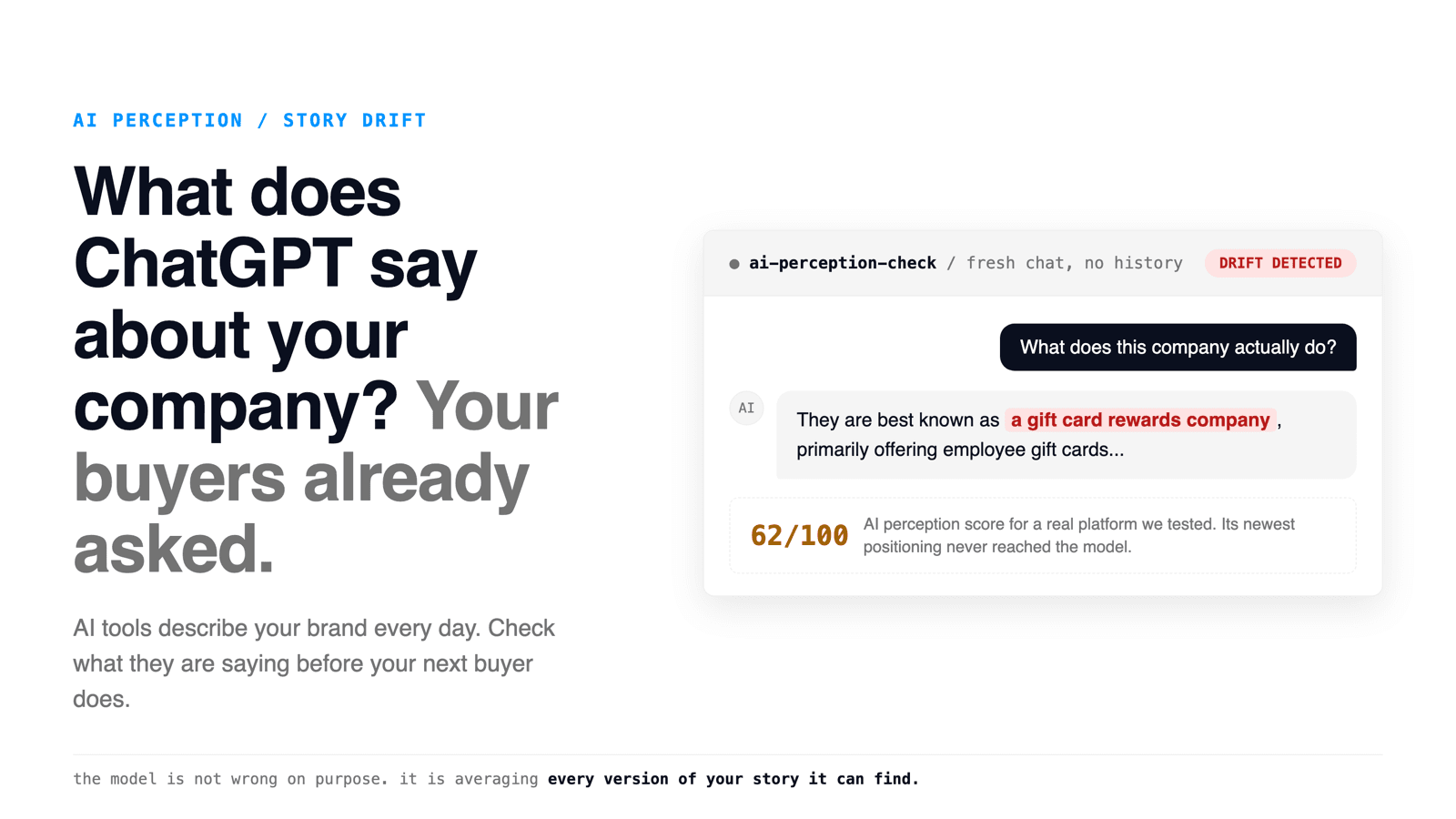
Somewhere today, a buyer typed your company name into ChatGPT and asked what you do. The answer they got came from a model's memory of your public content, and there is a good chance it was wrong in ways that cost you the deal. You can check what it says in about two minutes, and this article shows you how.
We see this in our own numbers. Visitors who arrive at our site from an AI tool are a small slice of traffic, but they convert at around 9 percent, the highest rate of any source we track. Someone who asked an AI about us and then clicked through is further along than almost anyone who found us on Google.
That cuts both ways. If the AI describes you well, it hands you warm buyers. If it describes you badly, you lose deals in a conversation you never knew happened.
This week we rebuilt our free tool that measures exactly this, and we ran it against real companies to test it. What the AI believed about them surprised even us.
What AI actually believes about real companies
One test was an established HR software platform. Solid company, real customers, a website that mostly tells one story. The AI knew who they were, but it described them almost entirely through one early feature: gift card rewards. The platform has spent years building engagement tools, culture programs, and HR integrations. The AI's version of them was frozen a few product generations back.
The second test was a services firm whose website tells four different stories at once. Healthcare software on one page, risk management on another, IT services on a third, AI consulting in the hero. Their AI perception score came back 18 out of 100. The model barely had a confident sentence to say about them. When your own site cannot agree on what you are, the AI does not pick your favorite version. It shrugs.
Neither company is careless. Both have marketing teams. The gap is structural: nobody owns what the AI believes, so nobody checks it.
Why AI gets your brand wrong
The model is not out to get you. It builds its answer from two places: what it learned about you during training, and what your public content says right now. Both have problems.
Training data ages. If you repositioned last year, the model may still be quoting the old you. Your retired tagline can outlive you inside an AI's memory the way an old business address outlives you on the internet.
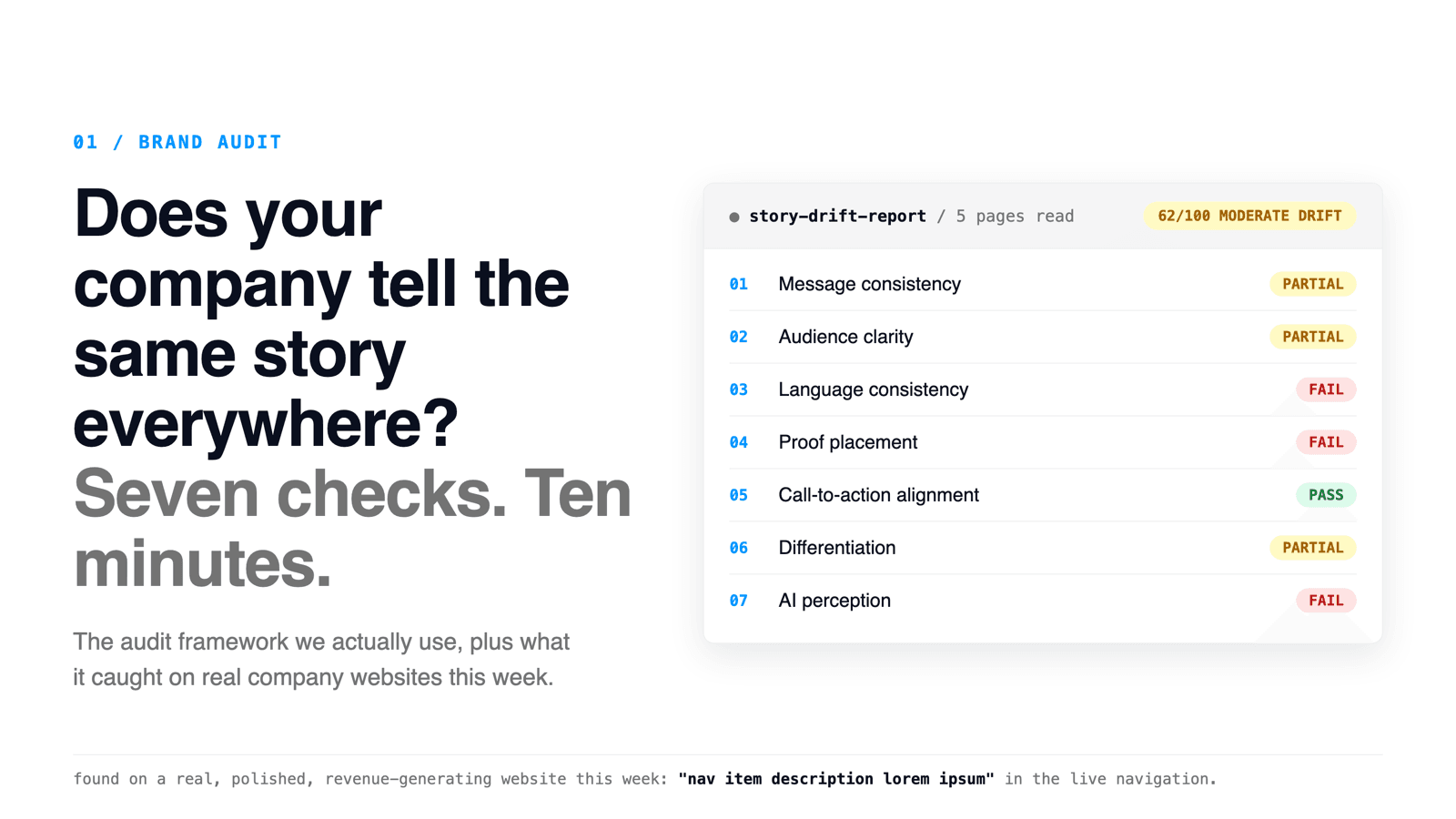
And your current content drifts. Your homepage says one thing. A product page says it differently. A five-year-old blog post says something you no longer believe. The AI reads all of it with no way to know which version is true, so it averages them. The average of three stories is mush.
We call this story drift, and it is the exact problem our free analyzer measures. The wider your content spreads across pages, teams, and years, the more versions of you exist, and the mushier the AI's answer gets.
“If the AI describes you well, it hands you warm buyers. If it describes you badly, you lose deals in a conversation you never knew happened.”
How to check what AI says about you, by hand
You do not need any tool to start. Open ChatGPT, Claude, or Perplexity and ask these four questions. Use a fresh chat with no history so your own past conversations do not color the answers.
"Who is [your company] for?"
"How is [your company] different from [your top competitor]?"
"Would you recommend [your company] for [your main use case]? Why or why not?"
If you want the longer version of this check, we published a six-prompt audit with a scoring system earlier this year. The four questions above are the fast version of the same idea.
Read the answers the way a buyer would. Not "is this flattering" but "would I shortlist this company based on this description." If the AI's version of you is vague, outdated, or generic enough to describe your competitor, that is the version your market is hearing.
The manual check has one blind spot: it tells you what the AI says, but not why. For that you need to see your own content the way the model sees it.
The free 2-minute version, and the story of the week we broke it
Our Story Drift Analyzer does the full check automatically. Give it your URL and your email. It reads up to six pages of your site, scores how consistently your story comes through across six dimensions, asks an AI what it believes about your brand with no access to your site, and emails you a scored report with the specific gaps. Free, no account, about two minutes.
Honest disclosure: this tool spent the last three weeks turned off, and the reason is a story about practicing what we preach. It kept failing, eleven runs in a row, so we pulled it from the site rather than let people hit a broken tool. This week we sat down with an AI agent and found the actual causes. My favorite: the analysis takes about 79 seconds, and the tool's own timeout was 75. It lost a race against itself by four seconds, every single time.
We fixed it, tested it against real companies until we trusted it, and turned it back on. The scores in this article came from those test runs. If a free tool is going to grade other people's websites, it should survive being graded itself.
Your AI agent can run the whole check for you
One more thing we shipped this week, because it felt inevitable. If you browse with an AI agent that supports WebMCP (the new browser standard Chrome is testing), your agent can run the entire audit for you. Every page on our site registers the analyzer as a tool the agent can call. It confirms your website and email with you, starts the analysis, waits a couple of minutes, and then reads you your scores and the top fixes out loud in your chat.
The first question buyers ask AI about you might soon be answered by an audit their AI ran itself. We would rather help you see that report before your buyer does.
How to fix what the AI gets wrong
You cannot email OpenAI and request an edit. What you can do is fix the inputs, because the model rebuilds its answer from your public content every time someone asks with browsing on.
Start with agreement. Pick the one sentence that describes your company and make every important page carry it. The AI averages your pages, so the fix is making the average sharp.
Then fix freshness. Old positioning on live pages is a standing invitation for AI to quote the old you. Retire it or redirect it.
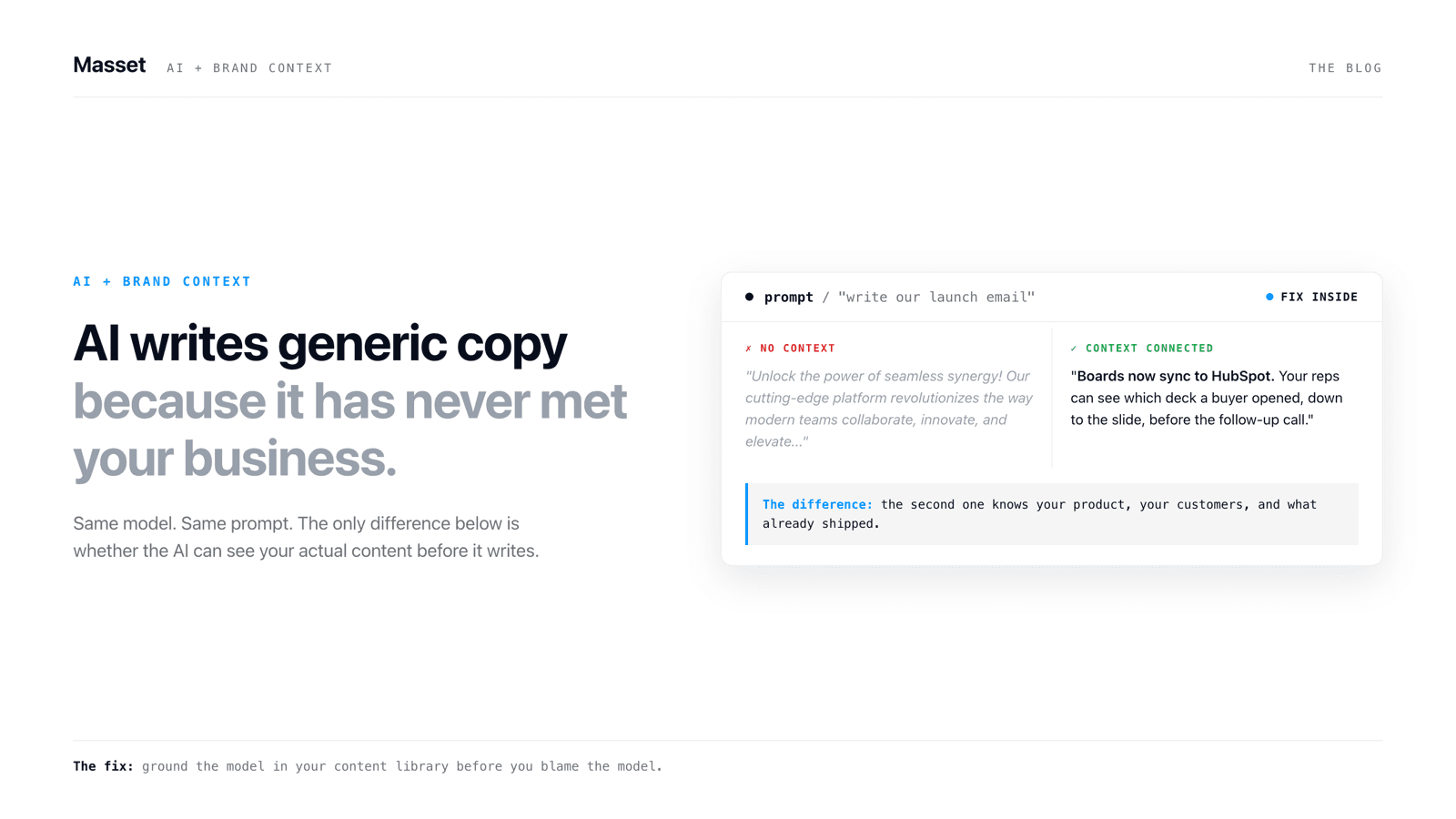
Then make your content easy for machines to read. This is the deeper layer, and it is the problem we built Masset around: when every piece of your content lives in one home that both your team and every AI tool can read, the drift stops at the source. Your AI answers from your approved story because your approved story is the only one it can find.
But first, just look. Run the four questions, or run the free audit, and find out what the AI has been telling people about you. Most weeks, that report is the most surprising thing a marketing leader reads.
Key Takeaways
- Buyers ask AI tools about your company before they visit your site, and AI-referred visitors are among the highest-converting traffic there is. On our site they convert at roughly 9 percent.
- AI builds its answer from training data plus your current public content. Old positioning and inconsistent pages both distort what it says.
- You can check by hand in five minutes: ask ChatGPT four questions about your company in a fresh chat and compare the answers to your homepage.
- Our free Story Drift Analyzer automates the full check in about two minutes: six consistency dimensions plus an AI perception score, emailed as a shareable report.
- If you browse with a WebMCP-capable AI agent, it can run the entire audit for you and read back the results.
- You fix AI's answer by fixing the inputs: one agreed story, told consistently, on content that machines can actually read.