AI writing sounds generic for two reasons, not one
AI writing sounds generic for two reasons. Style: language models are trained to predict the most likely next word, so they drift toward the average of everything on the internet. Substance: the model has never seen your business, so it fills the gap with filler that fits anyone. Better prompts fix the style problem. Only context fixes the substance problem.
You can find out which problem you have in about two minutes. Ask your AI to write a paragraph about why customers choose you. Read it once, then ask one question: could your closest competitor publish this unchanged?
If the answer is yes, your prompt isn't the problem. The model doesn't know anything true about your business, so it wrote something true about everybody's.
Almost everything written about this question covers the first cause. Reddit threads list the telltale words. Essays explain the statistical averaging. The second cause gets skipped, and it's the one that decides whether AI is actually useful to your team.
The style problem is real, and researchers have measured it
Language models learn by predicting the next word across billions of pages of text. The most likely next word is, by definition, the most average one. Ask for nothing specific and you get the statistical middle of the internet, delivered with confidence.
The evidence goes past vibes. A study in Science Advances (July 2024) gave writers access to AI-generated ideas. The individual stories rated as more creative and better written. But the stories were measurably more similar to each other. AI raised the floor and shrank the range.
The house vocabulary is measurable too. Researchers analyzed more than 15 million biomedical abstracts from 2010 to 2024 and found an abrupt spike in certain style words right after ChatGPT arrived. Their estimate: at least 10 to 13.5 percent of 2024 abstracts had been processed by an LLM. A 2025 follow-up tested 135 candidate AI-flavored words and found 103 of them spiking past statistical doubt.
The pattern even has a name now. A widely-shared February 2026 essay, debated at length on Hacker News, called it semantic ablation: models sand rare, precise language down toward the median, and the tuning that makes chatbots agreeable punishes unusual cadence. The New York Times Magazine asked "Why Does A.I. Write Like That?" in December 2025. When the Times covers your writing tics, the problem is officially mainstream.
This half has a cheap fix. We published the exact prompt we use to make AI sound less like AI, and it works. It kills the hedging, the triplets, the "delve." But strip every tell out of a paragraph that says nothing, and you get a clean paragraph that says nothing. That's the second problem.
The bigger problem: the AI has never met your business
Your AI has read most of the internet and none of your business. It has never seen your customer interviews, your case studies, your pricing logic, your win-loss notes, or the 40 pieces your team already published. It doesn't know the words your best customers use. It doesn't know what you'd never say.
So it does the only thing it can do. It fills the gap with plausible filler. I think of it as horoscope copy: true for everyone, useful to no one. "We help teams do more with less." "Solutions that scale with you." Nobody can disagree with it. Nobody remembers it either.
This explains the pattern that confuses people. The same model writes sharp copy for one team and slop for another. The model didn't change. The context did.
It also explains a number that should bother every marketing leader. HubSpot's State of Marketing puts AI use for content creation at 80 percent of marketers. Their generative AI research found 71 percent say AI helps them create significantly more content, while 53 percent struggle to make their content stand out in an AI-saturated market. More volume, same middle.
That 53 percent doesn't have a style problem. Everyone has the style prompt by now. They're all drawing from the same well: a model with no access to anything that makes their business different. Want to see the gap on your own company? We wrote up how to test what ChatGPT actually knows about your brand. Expect less than you'd hope, and some of it wrong.
“The same model writes sharp copy for one team and slop for another. The model didn't change. The context did.”
Why better prompting only rents the fix
The standard advice says to write richer prompts. Paste in your positioning, your audience, a few writing samples. Good advice, as far as it goes. It works once, for the one person who typed it.
Then the session ends. Tomorrow the same person pastes it again, or forgets. A teammate never had it. Pricing changes in March, and every saved prompt on the team is quietly wrong. Prompt-level context is a fix you rent, one chat at a time.
The industry already named the durable version: context engineering. Andrej Karpathy popularized the term in 2025, and Anthropic wrote an engineering guide on it. The core claim is simple: the quality of a model's output is set by the quality of the context you give it. The model is rarely the bottleneck anymore. The context is.
| A better prompt | Connected context | |
|---|---|---|
| What it fixes | Style: tone, pacing, AI tells | Substance: facts, customers, proof |
| Who it helps | The one person who typed it | Everyone on the team |
| How long it lasts | One chat session | Every session, in every AI tool |
| When facts change | Every pasted copy goes stale | Update the source once |
| Where it lives | A doc someone pastes from | Your content home, queried directly |
The table is the argument. A better prompt fixes style, helps the person who typed it, and lasts one session. Connected context fixes substance, helps the whole team, and stays current because you update the source once instead of chasing every pasted copy. Both are worth doing. Only one compounds.
The fix has three steps, and they build on each other
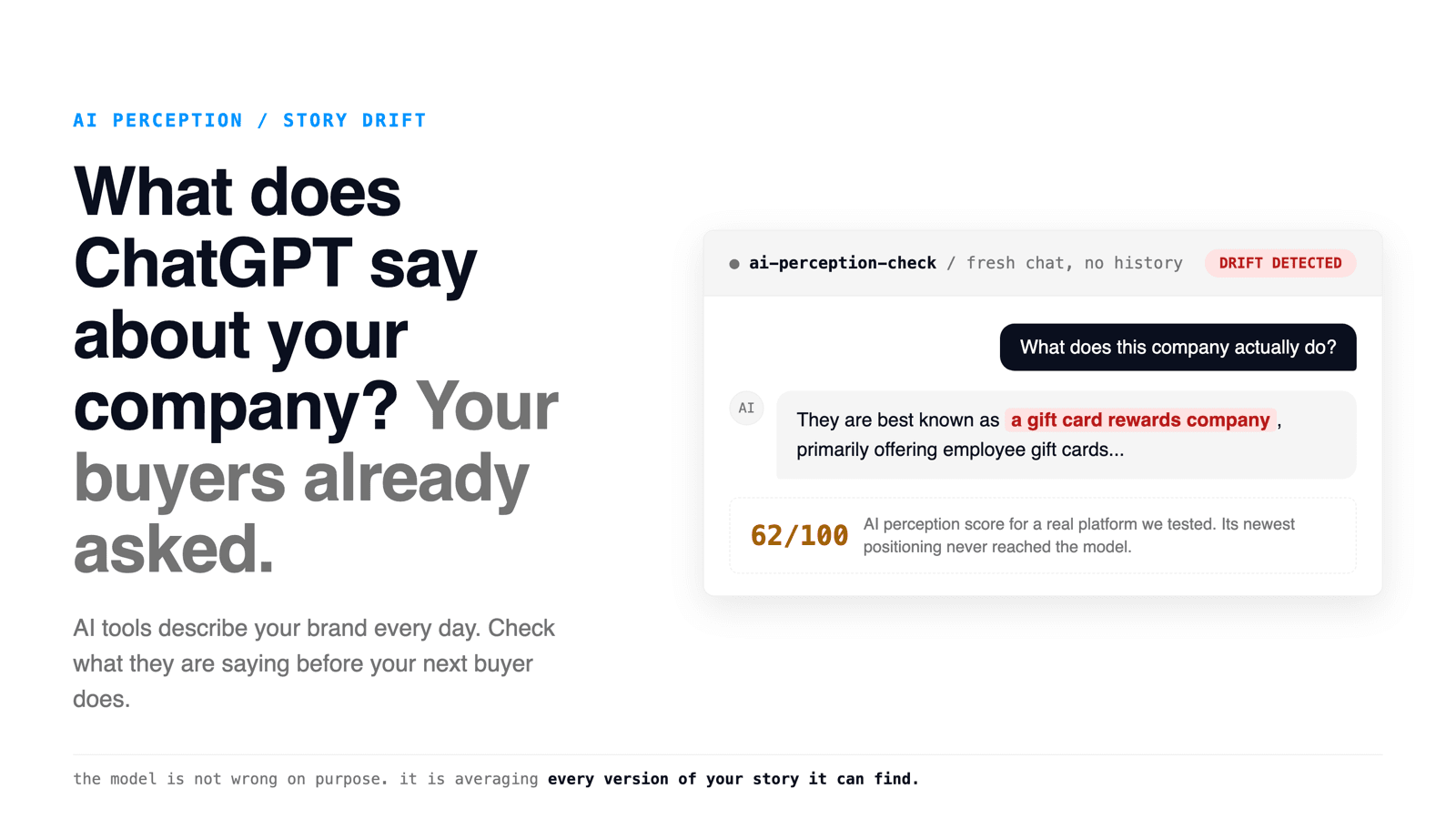
Before the fix, it helps to see the damage. The same context gap that makes AI write generic copy also makes it describe your company wrong to buyers. We measured it: here is what ChatGPT actually says about real companies.
Step one: fix the style. Use a reusable prompt that strips the AI tells, ours or your own. Ten minutes of setup, immediate lift. This is the half most teams have already done.
Step two: write your context down. A voice guide with do-and-don't examples. Your point of view and the claims you'll commit to. The exact words customers use, pulled from real calls. Your proof points, with numbers. If this lives only in someone's head, your AI can't use it, and neither can your next hire.
Step three: give your AI standing access to the real content. This is context engineering at the team level. Instead of pasting snippets into a chat window, you connect the AI tools your team already uses to the place your content actually lives. The open standard for that connection is MCP, and it's how an AI goes from guessing about your case studies to reading them.
We build one of these homes, so I'm biased. Masset's MCP server gives Claude, ChatGPT, Cursor, Copilot, and any MCP-compatible client 35 tools against your content library: 21 reads and 14 writes, with your permissions enforced on every call. Ask your AI to draft a customer email and it pulls the actual case study, the approved messaging, the current pricing. Not a confident guess about any of them. If you're comparing options for an AI-ready content home, our DAM buyer's guide covers the landscape, including the MCP question to ask every vendor.
What changes when the AI actually knows your business
Picture a marketing lead at a 40-location home services brand. She asks her AI: "Write an email announcing our new maintenance plan to past customers."
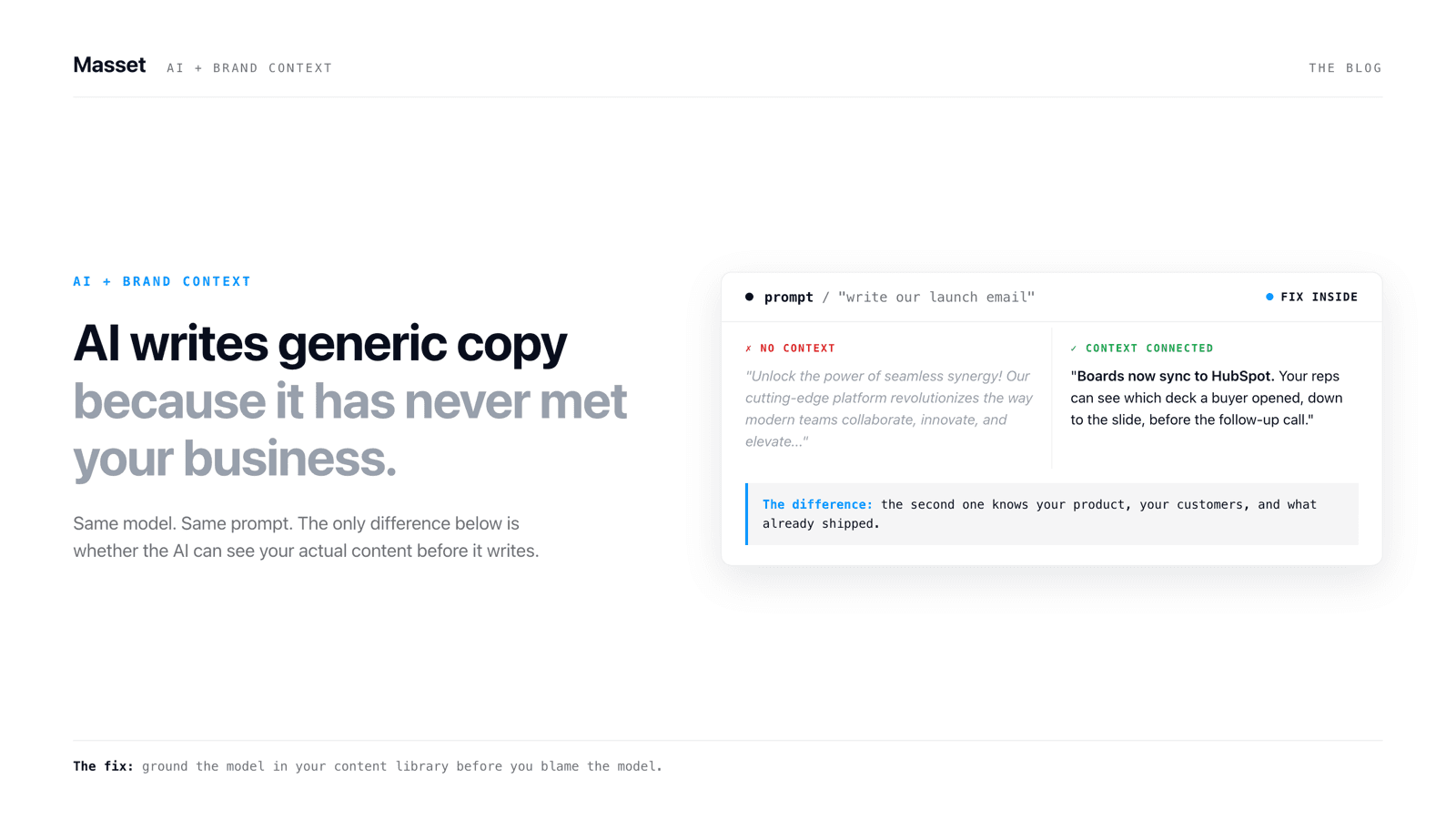
Without context, she gets the email you're already imagining. "We're excited to announce..." A list of benefits that fits any maintenance plan sold by anyone. She spends 45 minutes rewriting it, which is the quiet tax on every team using AI this way.
With connected context, the AI reads the launch doc and quotes the real price. It cites the pilot result from the one-pager her team made in April. It answers the two objections straight from the customer FAQ, in the voice her brand guide defines. She spends five minutes editing instead of 45 rewriting.
Same model. Same request. The only difference is what the AI could see.
So run the test. Ask your AI why customers choose you, and read the answer honestly. If any competitor could publish it, the fix isn't a cleverer prompt. Your AI has read almost everything ever written except the one thing that would make it useful: your business. Introduce them.
Key Takeaways
- Generic AI copy has two causes: models average the internet (style), and they know nothing about your business (substance).
- The style half is measurable: AI-assisted writing is more homogeneous, and studies of 15M+ abstracts found a detectable AI house vocabulary.
- Prompts fix style for one person, one session. They can't supply facts the model has never seen.
- The durable fix is team-level context: write your voice and proof down, then give AI standing access to your real content over MCP.
- Quick test: if a competitor could publish your AI's output unchanged, you have a substance problem, not a prompt problem.