I let an AI change my website on its own
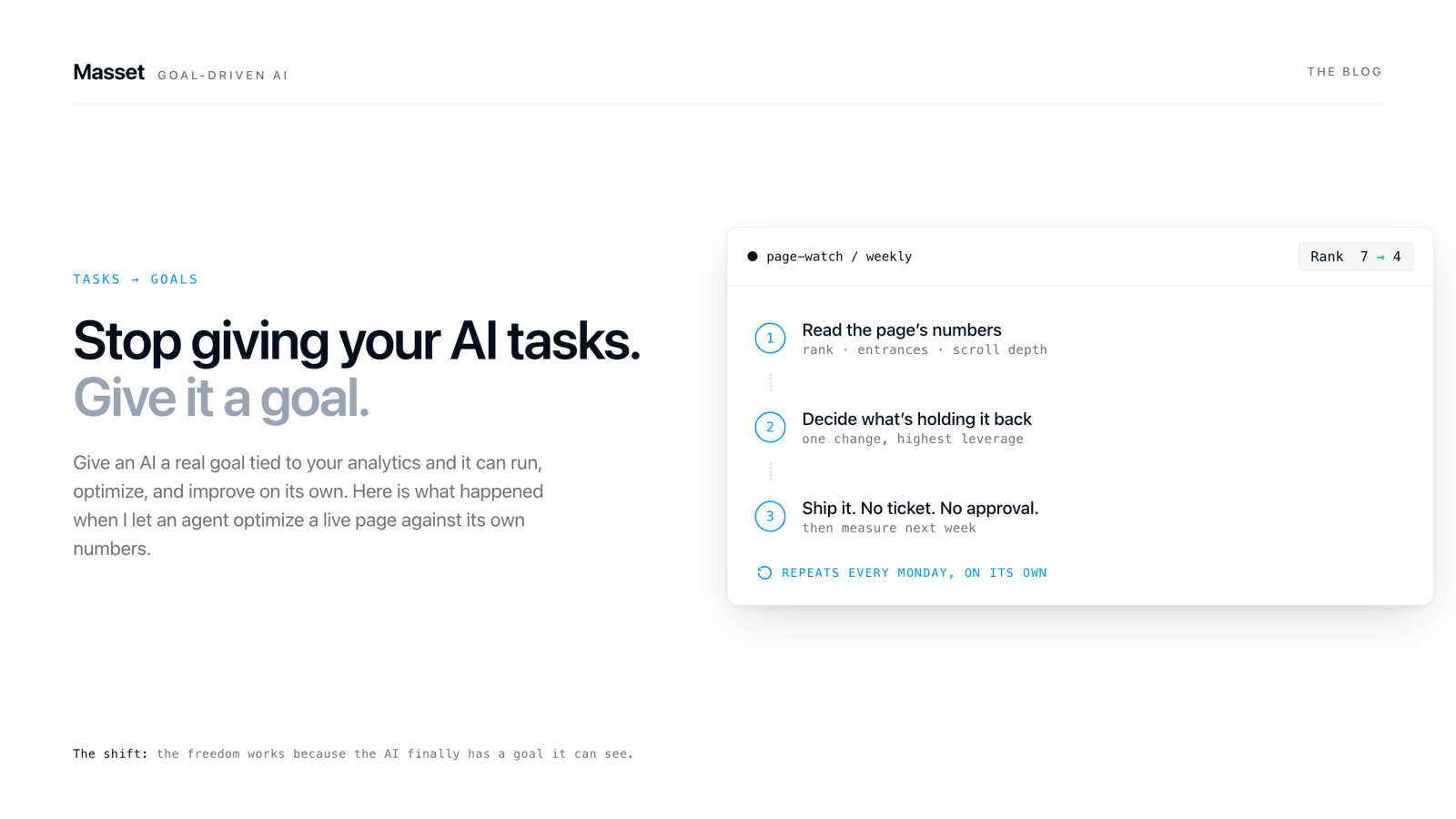
The first change went out yesterday, while I was setting it up. The page is our guide on how Claude skills work, and the numbers were rough. Almost nobody finds it. It ranks nowhere for the two terms it should own.
So the agent did what a decent marketer would do. It added a clear, direct answer to the exact question the page is named for, so Google and AI have something clean to quote. Then it pushed the change live and left itself a note to grade the result in about a week.
The unlock was letting it see the scoreboard
Here's the part that matters, and it's not the part that sounds scary. The agent could do any of that because it could finally see the scoreboard.
For most of the last year, AI has been blind to its own work. It writes the page, then has no idea if anyone read it, found it, or left. So a few weeks ago we fixed that. We put our real analytics right inside the AI I work in every day. Traffic. Time on page. Where people came from. How a page ranks. Whether AI engines send anyone.
Once the AI could see those numbers, an obvious question showed up. If it can see the result, why not let it work toward the result?
A clear goal is what lets anything perform
This is the same thing that makes people good at their jobs. Give someone a clear picture of what winning and losing look like, and they can aim. Take it away, and they just row in any direction.
It's how the reward side of machine learning works too. A model only improves when it knows the target. And the catch is identical for people and machines. It only works if the target is the right one.
The goal has to be the right one
That's the whole game, and it's easy to get wrong. Tell a marketer to hit a lead number and quality dies. Tell the same marketer to drive bookings, and lead count stops mattering while quality comes back. Point an AI at pageviews and it'll chase pageviews, including the junk ones.
The goal has to ladder up to something real. Otherwise you row hard in the wrong direction, hidden underneath a report that looks like you're doing everything right.
My first version isn't even the best version, and I'll say that plainly. Right now the agent watches high-level page numbers. The better goal is the stuff that actually maps to revenue. Did the page pull someone in. Did that person reach a demo page. Did they fill out the form. I know that. I pointed it at the simpler numbers first because I wanted to watch the loop run before I trusted it with the ones that count.
Let it run where the stakes are low
I also gave it this much freedom on purpose, because this page is low stakes. If it makes a bad call, I lose a little traffic on one guide. Plenty of other things would keep my hand on the wheel. The reason to let it run loose here is speed. The fastest way to learn what an AI can do with a real goal is to get out of its way.
That's the part I most want to get better at, honestly. Not cutting people out of the loop. Building better ways for a person to step in right when it counts, without sitting there babysitting all day. We're not there yet. We'll get there.
Try it this week
If you want to try the idea this week, it's simple. Write down the numbers you personally get judged by. Find a way to put them in front of your AI. Then give it a goal, let it work in loops, and watch what it does.
Mine grades its own homework in about a week. I genuinely don't know yet if it worked, and that's the fun part.
Key Takeaways
- An AI with no goal optimizes in any direction. Give it a real goal it can measure, and it can aim, run, and improve on its own.
- The unlock is letting the AI see the scoreboard. It can't work toward a result it can't see, so put your real analytics where the AI already works.
- The hard part is picking the right goal. A vanity metric makes the AI chase the wrong thing while the report still looks good.
- Tie the goal to what maps to revenue, not just what's easy to measure. Leading indicators beat surface numbers.
- Start where the stakes are low. Let it loop, stay in the loop where it counts, and judge it by whether the numbers move.