AI sales enablement software does six jobs
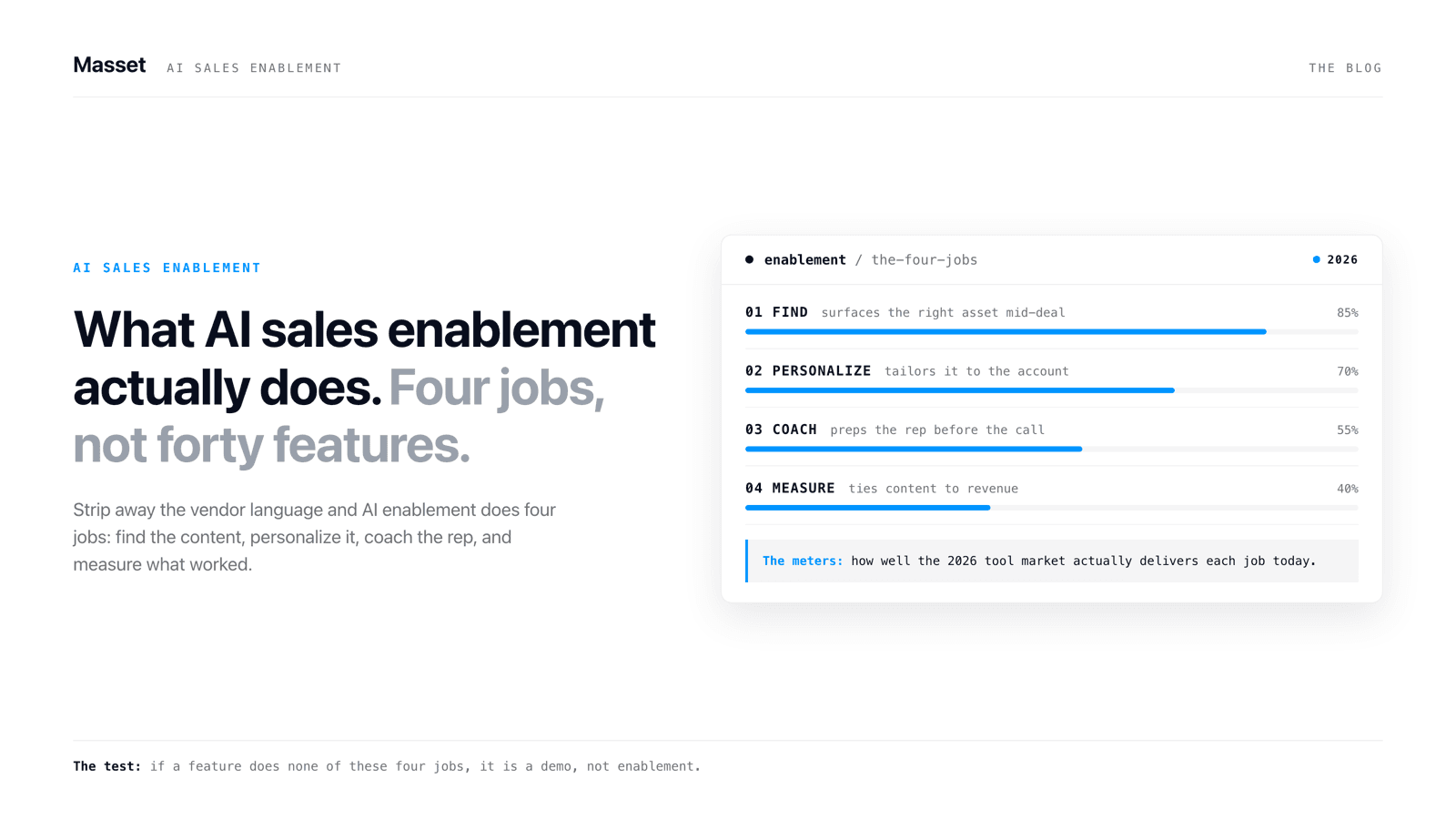
AI sales enablement software helps sales reps sell by doing six jobs: it finds the right content on demand, answers deal questions from approved sources, coaches reps using real call recordings, drills product knowledge in short daily reps, personalizes what each buyer sees, and reports which content actually influences revenue. Every vendor pitch you'll hear this year is some mix of those six jobs with the word "AI" in front.
- Find content. A rep types a plain question ("the healthcare case study with ROI numbers") and gets the asset, not a folder tree. This is the job most teams buy first, because reps waste real selling time hunting for files.
- Answer deal questions. "What's our SOC 2 answer?" "How do we handle the pricing objection?" The AI answers from approved content instead of the rep's memory or a stale deck.
- Coach from real calls. Conversation intelligence records calls, spots patterns like talk ratio and competitor mentions, and turns them into coaching. Gong made this famous. The big suites all sell a version now.
- Drill knowledge daily. Short quizzes generated from approved content, delivered where reps already work, so product knowledge sticks. Masset does a two-minute daily version in Slack and Teams.
- Personalize buyer touchpoints. Digital sales rooms, tailored follow-up pages, and content picked for the specific deal and stage.
- Report what moves revenue. Tie content usage to CRM outcomes, so you know which case study actually shows up in closed-won deals.
Notice what's not on the list: "has a chatbot." A chatbot is an interface, not a job. Hold every vendor to the jobs.
Are there AI-powered revenue enablement platforms that help sales reps engage and connect with buyers?
Yes. AI-powered revenue enablement platforms exist, and as of July 2026 they fall into three groups. The first group is the full suites: Seismic and Highspot (now merging into one company), Mindtickle, Showpad, and Allego. They bundle content management, coaching, digital sales rooms, and buyer engagement into one enterprise contract. Mindtickle calls itself "the leading AI-powered revenue enablement platform," so the phrase comes straight from vendor vocabulary. The second group is point tools that do one buyer-facing job well: conversation intelligence like Gong, or outreach tools that draft and send. The third group is newer: agent-accessible content platforms that skip the portal and make your approved content available to whatever AI your reps already use. Masset, my company, is in that third group, so weigh my take on it accordingly.
Which group fits you depends on where your bottleneck is. If reps can't find or trust content, fix that first. If coaching is the gap, start with conversation intelligence. If you want everything in one contract and have the budget, look at the suites. We keep a full breakdown of the category, with market numbers and pricing, in our sales enablement software buyer's guide.
What changed in 2026: the market consolidated and buyers pulled away
Two things happened this year that make most 2024-era buying advice stale.
The market consolidated. On February 12, 2026, Highspot and Seismic, the two biggest names in sales enablement, signed a definitive agreement to merge. The combined company will operate under the Seismic brand, led by Seismic CEO Rob Tarkoff, with Highspot founder Robert Wahbe joining the board. News coverage put the combined value at roughly $6 billion. Both platforms keep running independently until the deal closes, and closing still needs regulatory approval. No close date has been announced.
If you're a Highspot or Seismic customer mid-contract, that's not just industry news. Mergers tend to freeze roadmaps and eventually force one side to migrate. Ask your CSM which platform survives, and get the answer in writing before you renew. We keep honest comparison pages for both: Masset vs Highspot and Masset vs Seismic.
Buyers pulled further away from reps. Gartner's research on the B2B buying journey reports that 75% of B2B buyers prefer a rep-free sales experience. The same research finds buyers are 1.8x more likely to complete a high-quality deal when they use a supplier's digital tools together with a rep, compared with either alone. Read those two findings together. Buyers avoid meetings, but they buy better when reps stay involved through digital touchpoints. So the content your platform manages has to carry the deal in moments where no rep is present: the sales room a champion forwards, the follow-up a buying committee reads, the answer a buyer's own AI summarizes.
One more shift is easy to miss: reps changed where they start. Ask your own team. Many reps now open Claude, ChatGPT, or Copilot before they open the enablement portal. That shift is behind the part of this market nobody ranking for this keyword talks about.
Generative, agentic, and agent-accessible are three different kinds of AI
ZoomInfo's guide to this category draws a line I like: generative AI drafts an email when you ask, while agentic AI triggers the outreach itself when a buying signal fires. That's a real distinction and worth keeping. It's also incomplete, because both kinds still live inside one vendor's platform. You go to the tool, and the AI is a feature of the tool.
The third kind is agent-accessible. Instead of building a chatbot into a portal, the vendor exposes your content and actions through MCP (Model Context Protocol), the open standard AI assistants use to connect to outside systems. Once that connection exists, a rep asks the AI they already use, and it answers from your approved content with your permissions enforced. The AI comes to the content instead of the rep going to the AI.
Why does this matter more every quarter? Because of where reps start their day. An AI feature locked inside a portal is a feature reps have to remember to visit. Content that travels to the assistant meets them where they already are. The suites see this too, which is why several are shipping MCP servers of their own.
Which sales enablement vendors have real MCP servers, checked July 2026
MCP status is the most verifiable claim in this market, because you can read the developer docs yourself. I checked each vendor's own pages on July 7, 2026.
Seismic has an MCP server in Early Access, which means you ask your CSM to turn it on. It exposes 18 tools, 13 reads and 5 writes, covering generative search, digital sales rooms, meetings, LiveSend links, and CRM context. Highspot has a public MCP server product page promising search, recommended content, and actions inside OpenAI, Anthropic, and Microsoft Copilot clients, but the page doesn't state whether it's generally available or gated. Showpad says its MCP capability is in beta, and we keep an honest Masset vs Showpad comparison too. Mindtickle has no public MCP server I could find as of July 2026, after checking their site, developer docs, and the news. Masset, ours, ships a generally available MCP server with 35 tools, 21 reads and 14 writes, working with Claude, ChatGPT, Copilot, Cursor, and every MCP-compatible client, with per-user permissions enforced on every tool. Details are on our MCP server page.
The point of this table isn't that more tools wins. The point is that it's checkable. A vendor claiming "AI-powered" should be able to hand you an MCP endpoint you can connect to Claude in ten minutes. If the answer is a demo of their portal chatbot instead, you just learned which kind of AI they sell.
“A vendor claiming AI-powered should be able to hand you an MCP endpoint, not an AI slide.”
Five questions that separate real AI from the AI slide
If you're evaluating AI sales enablement software this quarter, these five questions do more work than any demo.
- Where does the AI run? Inside the vendor's portal only, or inside the AI your reps already use? Portal-only AI adds another tab. Agent-accessible AI meets reps where they work.
- Can I see the MCP endpoint? Ten minutes with Claude connected tells you more than an hour of slides. If there's no endpoint, that's an answer too.
- What does it cost, in numbers? ZoomInfo's own comparison of 18 AI enablement tools lists ten of them as quote-based, several enterprise-only. If you can't see a price, budget for a long procurement cycle before any value shows up.
- Does the vendor train AI models on my data? Get the answer in writing. Masset doesn't, and any vendor worth signing can answer this in one sentence.
- Can I pilot it in two weeks with a real team? Pick one team, one quarter's content, and a handful of metrics like content found, questions answered, and time saved. A vendor who resists a small pilot is telling you something.
Then decide between a suite and a focused layer. A suite fits a large org that wants coaching, learning, conversation intelligence, and content in one contract, merger risk and all. A focused content layer fits a team whose real bottleneck is content chaos and whose stack is already AI-first. Formal enablement correlates with higher win rates (49% versus 42.5% without it), and the market is projected to grow from about $6.1 billion in 2025 to $25.6 billion by 2034, so the noise will get louder, not quieter. The full suite-versus-focused breakdown lives in our sales enablement software guide.
Whichever way you lean, run the ten-minute MCP test before you sign anything. It tells you more than the demo will.
Key Takeaways
- AI sales enablement software does six jobs: find content, answer deal questions, coach from calls, drill knowledge, personalize buyer touchpoints, and report what moves revenue.
- Highspot and Seismic signed a merger agreement in February 2026. The combined company will operate under the Seismic brand.
- There are three kinds of AI in enablement: generative (drafts on request), agentic (acts on signals), and agent-accessible (your content available to any AI over MCP).
- Gartner finds 75% of B2B buyers prefer a rep-free experience, so your content has to carry deals where no rep is present.
- The fastest vendor test: ask for the MCP endpoint and connect it to Claude in ten minutes.