
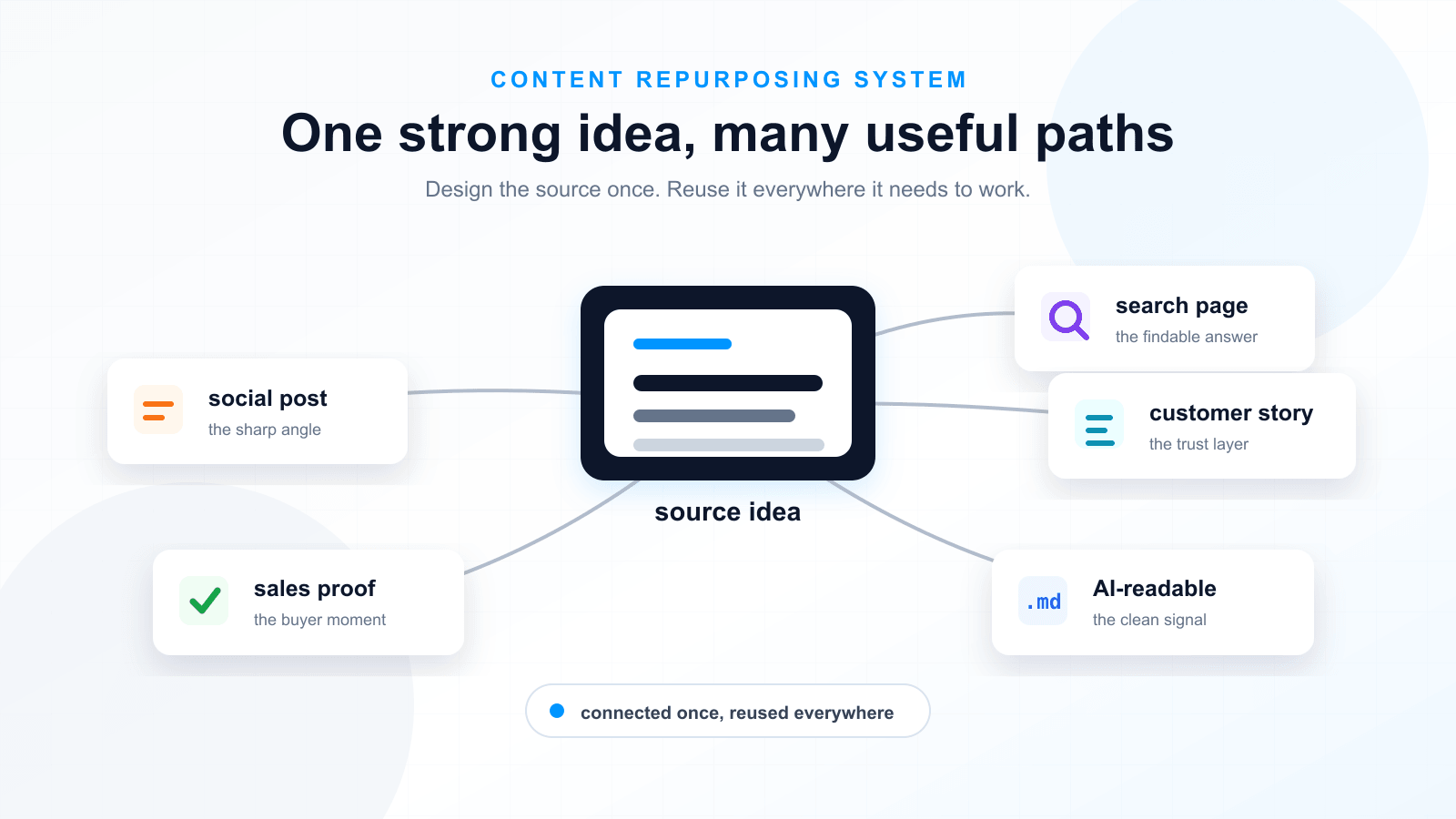
Repurposing Usually Starts Too Late
Most repurposing starts after the main asset is done.
The webinar is over. The podcast is published. The report is live. Then someone asks, "What else can we turn this into?"
That is better than doing nothing. But it is still late.
When repurposing starts at the end, the team is mostly salvaging value. They are trying to squeeze a few more posts out of something that was not designed to travel.
The better question comes earlier:
If this idea is worth creating, where will it need to show up?
That question changes the whole workflow. It turns repurposing from a production task into a strategy.
The Pattern From 400+ Podcast Conversations
We have been building a structured brain from the Content Amplified podcast archive. It is still early, but one pattern keeps showing up.
Repurposing works best when there is a system behind it.
Not a folder full of final files. Not a spreadsheet of links. A real reuse system that knows:
- What the core idea is.
- Who needs it.
- Which proof points support it.
- Which formats it can become.
- Where sales, marketing, and customer teams can use it.
- How the team will know when the idea is actually worn out.
That is the difference between "we made clips" and "we built a campaign from one strong idea."
“Repurposing works when teams design content to travel before they create it.”
Five Rules For Building A Real Repurposing System
These are the rules I would pull from the archive so far.
1. Start With A Strong Idea, Not A Format
Jeremy McLerran's episode makes the simplest point: most teams move on too fast.
They publish something useful, mention it once or twice, get bored internally, and start building the next asset.
His argument is to run the content dry. Take the strongest ideas, adapt them by channel, and keep distributing them until the data says the audience is done with them.
That last part matters. The team being bored is not a signal. Flat engagement, weak calls to action, and declining performance are signals.
A good repurposing system starts by asking which ideas deserve more mileage.
Source: Episode 31 with Jeremy McLerran
2. Plan Distribution Before You Create
Andrew Adams brings a newsroom lens to this.
Before creating the asset, ask whether the topic is timely, useful, and something the audience actually cares about. Then plan how it will reach them.
That sounds obvious. It is not how most content gets made.
Most teams start with the asset. A blog post. A webinar. A report. A customer story.
The stronger move is to start with the campaign shape. What is the source asset? What are the derivative assets? What does sales need? What does social need? What does the website need? What should an AI tool be able to understand from it later?
Source: Episode 37 with Andrew Adams
3. Build A Library, Not A Pile
Jeremy Fuchs talked about repurposing as a survival strategy after Avanan was acquired by Check Point.
Suddenly, a small team had to support a much larger global company. The answer was not to stop creating original content. It was to get much more value from the high-quality content they already had.
That is where a real content library matters.
If the team can find assets by topic, audience, region, proof point, buyer stage, and use case, repurposing gets easier. If everything is just a file in a folder, every reuse moment becomes a search project.
Customer stories pulled from call recordings are one of the most valuable assets a library can hold, and one of the least likely to get there. A call transcript is all you need to draft one.
Source: Episode 38 with Jeremy Fuchs
4. Package The Same Insight For Different People
Kirsten Von Busch's episode is one of the clearest examples.
Her team works with deep automotive data. The insight might be the same, but the packaging should not be.
A data scientist may want the full report. A LinkedIn scroller may need a 30-second clip. A partner may need a video story. An executive may need the visual summary and the "so what?"
Same insight. Different packaging.
That is the heart of good repurposing. It is not copying and pasting the same message everywhere. It is respecting how different people consume the same idea.
5. Make The Small Pieces Lead Back To The Bigger Idea
Orin Bliss Brecht has a useful way to think about complex products: turn one elevator pitch into eight.
Each short piece should stand on its own. But it should also act like a breadcrumb back to the bigger idea.
That is the part teams miss.
If a clip, quote, social post, sales snippet, or email angle has no path back to the source idea, it becomes content confetti. It may get attention for a minute, but it does not build a system.
Repurposed content should always know where it came from and where it is pointing.
A Simple Operating Model
Here is the workflow I would use.
- Pick the source idea. Choose one idea with enough weight to support multiple uses.
- Define the audiences. Buyer, customer, sales rep, executive, partner, AI agent. Be specific.
- Map the proof. Quotes, customer examples, data points, objections, stories, product screenshots, call moments.
- Choose the formats. Article, LinkedIn post, email angle, sales snippet, short video, FAQ, customer proof point, Markdown page.
- Connect everything back. Every smaller piece should link, cite, or point back to the source idea.
- Measure until the idea is dry. Use performance data to decide when to stop, not internal fatigue.
That last piece is the difference between repurposing and recycling.
Recycling says, "We already made this. Can we use it again?"
Repurposing says, "This idea matters. How many useful ways can it travel?"
Where AI Fits
AI makes this more important, not less.
When a buyer asks ChatGPT or Claude to summarize your company, your ideas, or your point of view, the system is looking for clean structure. It needs to understand the source, the claim, the evidence, and the relationships between pages.
That is why we have been making more of our own content AI-readable.
The human version can be designed, visual, and rich. The agent version should be clean, structured, and easy to parse.
For a repurposing system, that means every major idea should eventually have:
- A human-readable article.
- A Markdown version for AI agents.
- Links to the source podcast episodes or transcripts.
- Internal links to related Masset pages.
- Clear headings that answer the obvious questions.
I have to believe this helps with LLM search. But I am not going to pretend we have proof yet.
What we do have is common sense: make the idea easier for humans to use and easier for AI to understand.
One more piece of that system: capture your brand voice and your best content patterns as a reusable Claude skill, so when you repurpose with AI it already knows what good looks like for your brand.
Why This Matters For Masset
This is exactly the kind of problem Masset exists to solve.
Most companies do not have a content shortage. They have a content usage problem.
Their best ideas are scattered across podcast recordings, sales calls, customer stories, PDFs, webinar decks, Slack threads, and old campaigns. The team keeps making more because finding and reusing the good stuff takes too much work.
A real repurposing system needs structure underneath it.
It needs to know what an asset is about, who it is for, which proof points it contains, where it has already been used, and what else it can become.
That is the shift.
Content repurposing is not a format change.
It is infrastructure.
“Your team probably does not need more content. It needs a better system for using the content it already has.”
Key Takeaways
- Content repurposing works best when it starts before creation, not after the main asset is already published.
- The strongest teams build a reuse system around a clear idea: source asset, audiences, proof points, derivative formats, distribution paths, and measurement.
- Different audiences need different packaging for the same insight. A report, short clip, sales proof point, and executive summary can all come from one source idea.
- Repurposed content should point back to the larger idea. Otherwise it becomes disconnected content confetti.
- AI makes structured repurposing more important because agents need clean pages, links, source evidence, and Markdown-readable content to understand what matters.
Frequently Asked Questions
What is content repurposing?
Content repurposing is the process of turning one source idea or asset into multiple useful formats for different audiences, channels, and buying moments. The stronger version starts before the asset is created and maps how the idea will travel.
What is the difference between repurposing and recycling content?
Recycling starts with an existing asset and asks how to use it again. Repurposing starts with a strong idea and designs the source asset, derivative assets, distribution paths, and measurement system around it.
How many pieces of content should one source asset become?
There is no fixed number. A strong source idea might become an article, three LinkedIn posts, a sales snippet, a short video, a customer proof point, an FAQ section, and a Markdown page. The useful number depends on the audience and the channels where the idea needs to show up.
How does AI change content repurposing?
AI makes repurposing faster, but it also raises the value of structure. If your source content is clean, linked, and easy to parse, AI can help turn it into useful derivatives. If the source content is scattered or unclear, AI mostly makes the mess move faster.
How does Masset help with content repurposing?
Masset gives teams a structured content layer where assets, proof points, customer stories, podcast episodes, sales materials, and AI-readable pages can be organized and reused. That makes it easier to find the right source material and turn it into the next useful asset.