Not one edit. A standing job
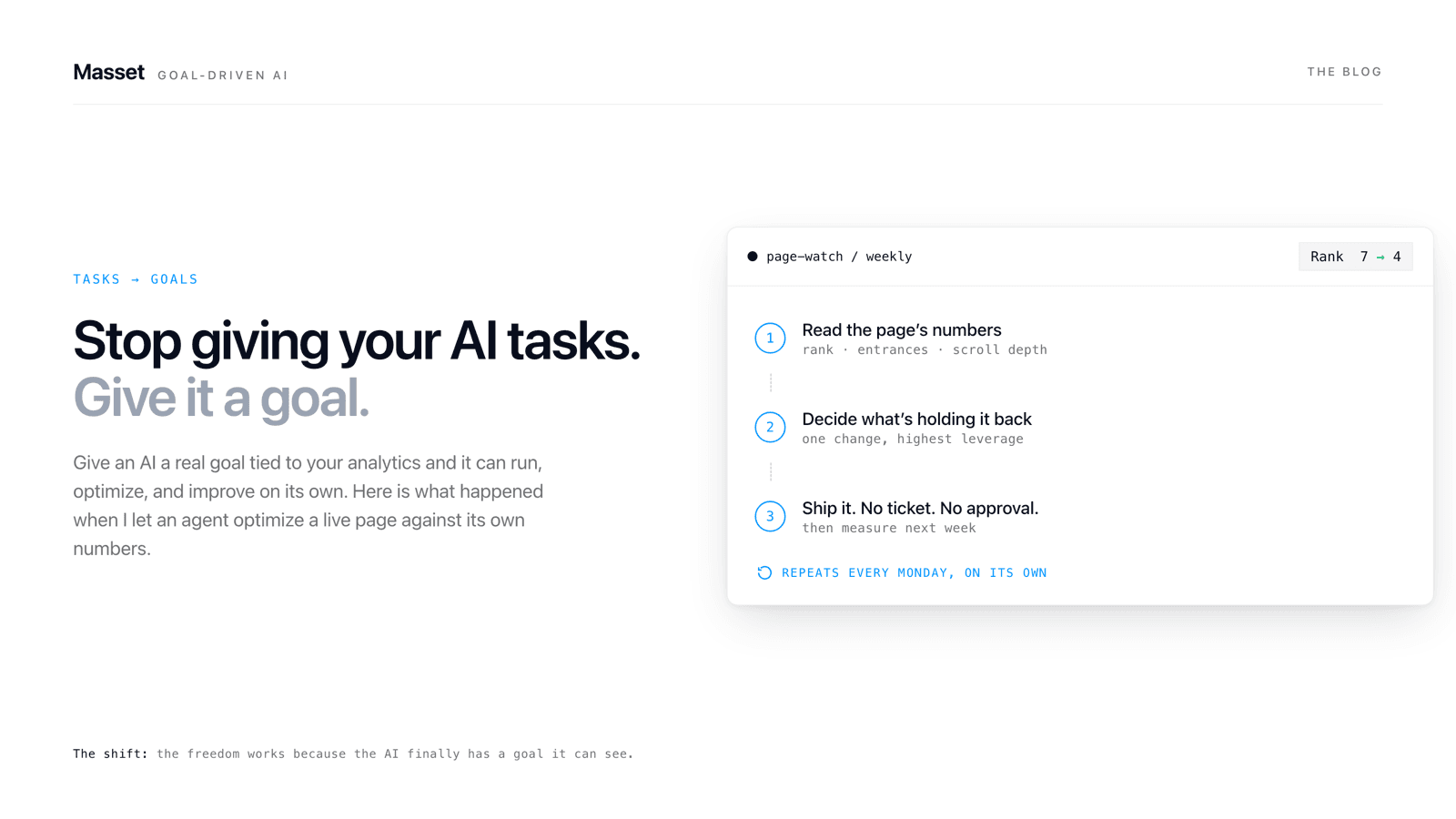
There is a difference between asking AI to do a task and giving it a job. A task is "rewrite this paragraph." A job is "this page is yours now, make it better over time, and report back." I wanted to see what the second one felt like on something real, so I pointed it at a live page that actually matters to the business, the one we want to rank for "sales enablement software," and gave it a standing weekly job.
Every week the agent does the same loop on its own. It reads how the page is really doing from our analytics. It scores the change it made last week to see whether that change actually helped. It picks the single highest-leverage improvement it can find. It makes that one change, checks that the site still builds, ships it to the live page, and then writes me a short note saying what it did and why. No pull request for me to approve. It just goes.
Why I let an AI deploy to my live site with no review
My normal rule, the one I am strict about, is that nothing goes live without a branch and a review. Every change gets looked at before it ships. So letting an AI edit a real commercial page and push it live on its own, with no human in between, is a genuine break from how I work.
People assume that kind of trust is a leap of faith. It was not. It was earned. I have built enough of these agents now, enough self-improving page and article loops, that I trust the pattern, not the individual run. I am not betting that the AI will be brilliant this Tuesday. I am betting on a system I have watched behave inside guardrails over and over. When you have seen the same shape work ten times, letting it run unattended on the eleventh is not faith. It is evidence.
“People assume that kind of trust is a leap of faith. It was not. I have built enough of these that I trust the pattern, not the individual run.”
The guardrails are what make self-deploy safe
The autonomy is real but it is fenced. The agent can do exactly one valuable thing and nothing else, and the fence is what lets me sleep. This is the part to copy if you ever do this yourself: do not give an agent freedom, give it a small, well-walled freedom.
- Edit one specific page, and nothing else
- Ship it live, but only if the site still builds
- Make exactly one change per week
- Touch any other page or file
- Ship anything if the build fails
- Turn the page into a bland listicle
The blast radius is one page. If a change would break the site, the build check stops it cold and the agent discards the edit and reports the failure rather than pushing it. It is not allowed to wander into the rest of the codebase. The reason I could hand it the keys is that I knew exactly how small the room is that I handed over.
What makes it an agent and not a script: memory and a verdict
A script does the same thing every week. An agent gets better. The difference is two things most automations skip: memory, and a feedback loop.
The agent keeps a running journal of every change it has made and a learnings file of what has actually worked. So the loop does not start cold each week. Before it touches anything, it pulls up last week's change and checks the real numbers: did the thing it predicted would help actually move? It writes down a verdict, improved, flat, or dropped, and then it leans into the kinds of changes that have a track record and retires the kinds that flatlined. Over time it is not just editing. It is learning what moves this particular page.
The job I gave it is not a vanity number either. It optimizes for rank, for how many people land on the page, for how many of those come from AI search, for how long people stay, and for how far they read. The danger with an agent is that it will chase whatever number you hand it, even a useless one, and look busy doing it. So the numbers have to be ones that ladder up to real business, not just traffic for its own sake. If you want the longer version of why the goal you pick matters more than the model you pick, I wrote about that here.
The honest result so far
Is it working? The truthful answer is: too early to say, and I am going to show you why instead of picking the flattering number.
So: the page genuinely pulls search traffic, thirty-three landings in a month. The tracked keyword actually bounced from ninth place to out of the top hundred between two checks, which could be a real slip or could be the normal week-to-week noise that search rankings have, especially at low volume. And the page's clearest weakness, the thing the agent keeps aiming at, is that people do not stay on it as long as they stay on the rest of the site.
I am not going to dress that up as a win. At this sample size and this young a loop, no honest person can say "the agent is working" yet. What I can say is that the loop is now running, on its own, every week, and it corrects itself instead of repeating what did not help. The value today is not a number that went up. It is that I have a system pointed at the right outcomes that gets a little smarter each week, and a journal I can read instead of a guess I have to make.
You do not have to be technical to steal this
The mechanics here are mine to maintain, but the pattern is not technical, and it is the real takeaway. It is four steps. Name the numbers you personally get judged by. Find a way to put those numbers in front of the AI you already use. Give it a small, bounded job and a memory of what it has tried. Then let it work in short loops and judge it only by whether the number actually moves.
Start somewhere low stakes, where a bad call costs you almost nothing, exactly like I did by pointing this at one page instead of the whole site. The first time an AI hands you back a verdict on its own last decision, "I tried this, here is what happened, here is what I am doing differently," you will feel the shift from using a tool to running a teammate. That shift is the whole reason I am spending these hundred days building things like this in the open.
I will report back as the weeks of data pile up, with the numbers as they actually are. If the agent flatlines, you will read that here too.
Key Takeaways
- The agent has a standing weekly job on one live page: read the analytics, grade its last change, make one improvement, ship it live with no human review, and log what it did.
- Letting an AI deploy itself was earned, not blind trust. After building enough guard-railed loops, you trust the pattern rather than any single run.
- Self-deploy is safe because the freedom is fenced: one page only, a build check that blocks anything broken, exactly one change a week, and no access to the rest of the site.
- What makes it an agent and not a script is memory plus a feedback loop. It grades its last edit against real numbers before acting, so it learns what moves the page.
- Honest result so far: 33 search visits in 30 days, a noisy rank that slipped from 9 to out of the top 100, and time on page as the weak spot. Too early to call it working, but the loop runs and self-corrects.