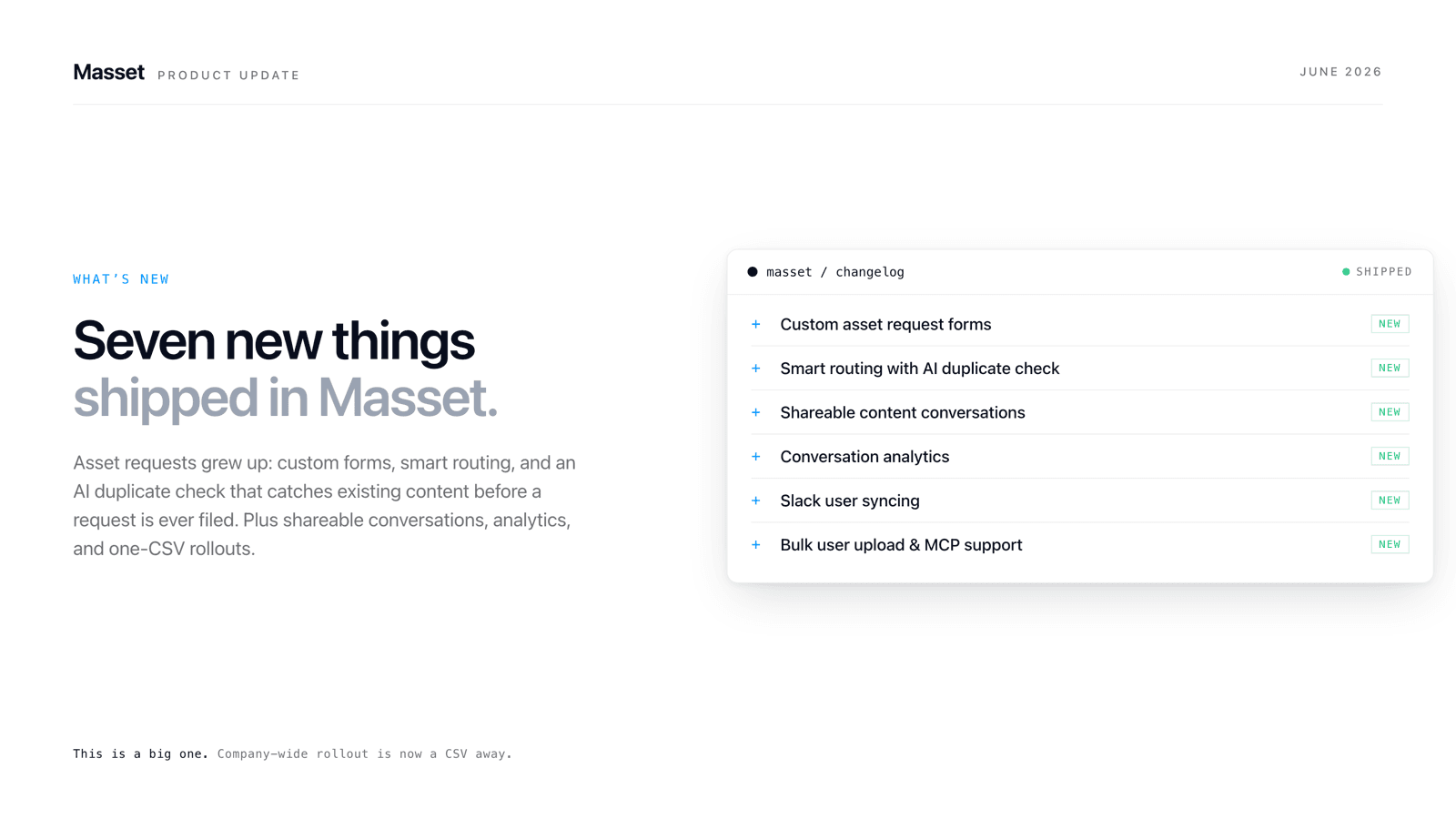
Seven new features just went live. Most of them came straight from customer requests, and together they hit two themes we care a lot about: making content requests actually work, and making company-wide rollouts painless.
Custom asset requests
Every marketing team fields requests differently. Some need to know the campaign. Some need the target persona. Some just need a deadline and a yes or no on whether legal has to see it. Until now, the asset request form was the same for everyone.
Now you can configure it. Admins can add custom fields to internal asset requests: short text, long text, dropdowns, multiple choice, and yes/no inputs. Rename fields, set their order, and mark the ones that are required. When someone submits a request, every value they entered flows into the resulting tasks, emails, and other notifications, so whoever picks it up has the full picture from the start.
This is V1, and more functionality is coming. But the days of "can you add more context?" replies are over.
Requests that route themselves
Custom fields are only half the story. The new asset requests are also routeable. You decide who the default recipient of a request is, and you can route to users or groups based on the value of a field, based on whether the request needs more information, or based on AI-powered analysis of the request itself.
So a request where "Content type" is "Case study" can go straight to your customer marketing lead, while video requests land with your video team. No triage meeting required.
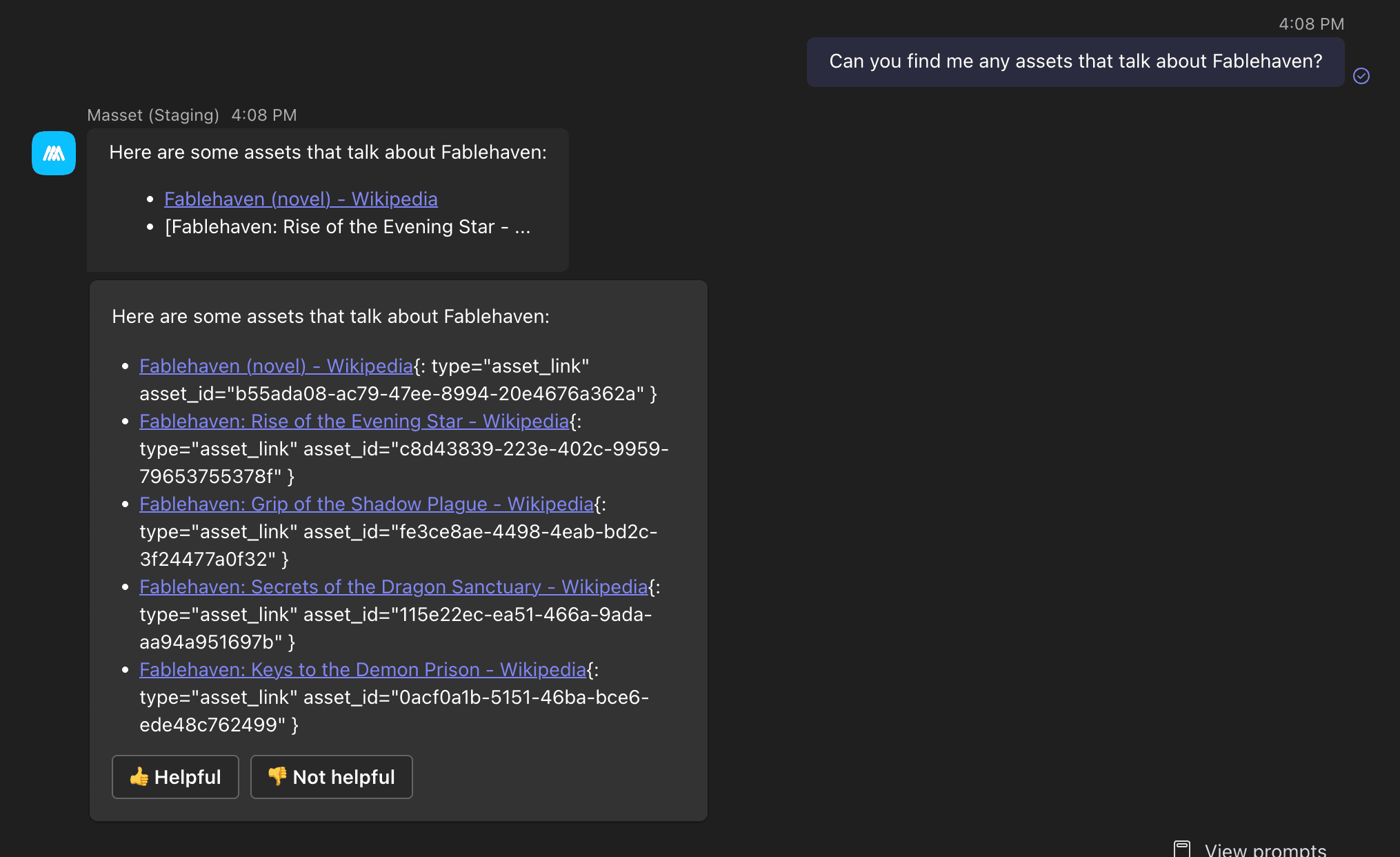
And there is one more layer we are especially proud of: a smart duplicate final check. Once all the values are entered, Masset uses AI to scan your library one more time, with the full context of the completed form, to see if any assets already match the request. The best content request is the one that never needed to be filed because the asset already existed.
Asset requests from inside your AI tools
Custom asset requests work over MCP too. When someone asks Claude, ChatGPT, or any MCP-compatible AI tool for content that does not exist yet, they can file a request without leaving the conversation. The AI prompts them through the exact fields you configured, then submits the request, which routes by your rules like any other.
Your request workflow now follows your team wherever they work, including inside their AI tools.
Shareable content conversations
You know that moment when Myca surfaces exactly the right answer and your first thought is "the rest of the team needs to see this"? Now you can act on it. Every content conversation has a Share button in the top right. Click it and you get a link you can send to anyone in your company.
Good answers should get found once and reused by everyone.
Conversation analytics
Admins can now see analytics about content conversations happening in the web UI and in chat programs like Slack and Teams. Choose your breakdowns and filters: by channel, by team, by time period.
Downloads tell you what your team took. Conversations tell you what your team was looking for, including the things they never found. That second signal is where your content gaps live, and now you can see it. Continued improvements are planned here as well.
Slack user syncing
This one removes the single biggest speed bump in company-wide rollouts. The Slack integration now automatically syncs users from your Slack instance into Masset, so admins can map Slack users to Masset users centrally. Nobody has to configure anything on their own.
If you have been waiting to roll out the Myca Slack agent to the whole company because per-user setup felt like herding cats, this is your moment.
Bulk user upload
And for everyone not on Slack, or onboarding a big team all at once: admins can now bulk upload users into Masset using a templated CSV. The guided experience shows you exactly what happened, including successes, errors, and any skipped invites. No guessing whether row 47 made it in.
Why this batch matters
Two threads run through all seven features. First, the gap between "my team needs content" and "the right person is building it" should be as close to zero as we can make it. Custom fields, routing, and the AI duplicate check all attack that gap. Second, rolling Masset out to a whole company should take an afternoon, not a quarter. User syncing and bulk upload get us a lot closer.
As always, most of this came from customer requests. If something in your content workflow still feels harder than it should be, hit reply and tell us. That is usually how these get built.
Thanks,
Ben and Tyler
Co-founders of Masset