Where the merger stands right now (July 7, 2026)
Seismic and Highspot signed a definitive merger agreement on February 12, 2026. As of July 7, 2026, the deal has not closed. Both companies still operate independently. Your contract works exactly like it did in January. Nothing forces you to act this week.
But no emergency is not the same as no decision. If your renewal lands in the next twelve months, you'll be negotiating with a vendor mid-merger. That's the one moment they need your signature more than you need their roadmap.
The deal was announced February 12, 2026. No closing date has ever been publicly confirmed. Australia's competition regulator has cleared the deal, according to merger-register trackers, and that's the only regulatory milestone visible so far. Seismic's own newsroom still lists the February announcement as its latest merger release. Until close, you're a customer of two separate companies.
What was actually announced in February
Strip away the analysis and the announcement said five things. The combined company keeps the Seismic name. Seismic CEO Rob Tarkoff runs it. Highspot founder Robert Wahbe joins the board, not an operating role. Permira, Seismic's investor since 2020, stays on as controlling shareholder. And financial terms were not disclosed. Anyone quoting a deal value is doing arithmetic on old valuations, not reporting a fact.
The scale here matters for what comes next. Highspot raised $650 million since 2011 and was valued at $3.5 billion in 2022. It has over 1,000 employees and customers like Compass, Nasdaq, and Stripe, with its largest deployment topping 50,000 users. Seismic was founded in 2010, was valued at $3 billion in 2021, and serves roughly 2,000 customers. These are the two biggest players in sales enablement becoming one company.
One sentence from the press release does most of the reassuring: "both platforms will continue to be supported thereafter." Read it carefully. It's a company statement, not a contract term. It has no date attached, no feature-parity promise, and no price promise. It can be completely sincere today and still mean "supported while we build the thing that replaces one of them." That's not cynicism. That's how every platform consolidation in this category has worked, which is the next section.
What mergers like this have meant before
Sales enablement has been consolidating for years, and the pattern is consistent: two or three products go in, one platform name comes out.
| Year | The deal | What survived |
|---|---|---|
| 2018 | Seismic acquires SAVO | The Seismic platform |
| 2020-21 | Bigtincan acquires ClearSlide, then Brainshark | The Bigtincan platform |
| 2021 | Seismic acquires Lessonly (~$170M) | Seismic, with Lessonly folded in |
| 2025 | Vector Capital acquires Showpad, folds Bigtincan into it | The Showpad name |
| 2026 | Seismic and Highspot sign a merger agreement | The Seismic name (announced) |
Vector Capital announced its acquisition of Showpad in August 2025 and folded Bigtincan into it, keeping the Showpad name. Bigtincan itself had already rolled up ClearSlide in 2020 and Brainshark in 2021. Three products became one, twice, inside five years. And Seismic has its own absorption history: SAVO in 2018, Percolate, Grapevine6, and Lessonly for around $170 million in 2021.
Even analysts who like this deal say the same thing. Aragon Research's take: customers should prepare for an eventual convergence plan. Convergence doesn't mean your platform dies next quarter. It means that over some multi-year window, one architecture wins and the other becomes a migration project. You don't know which side you're on yet. Neither, honestly, do the account teams telling you everything is fine.
Your renewal date decides your move
The right response isn't panic and it isn't nothing. It's a function of one number: how many months until your renewal. These contracts are real money. Vendr's benchmark puts the average Highspot contract around $91,000 a year, with deals ranging from about $20,000 to $175,000. At that size, an hour of preparation per month is cheap.
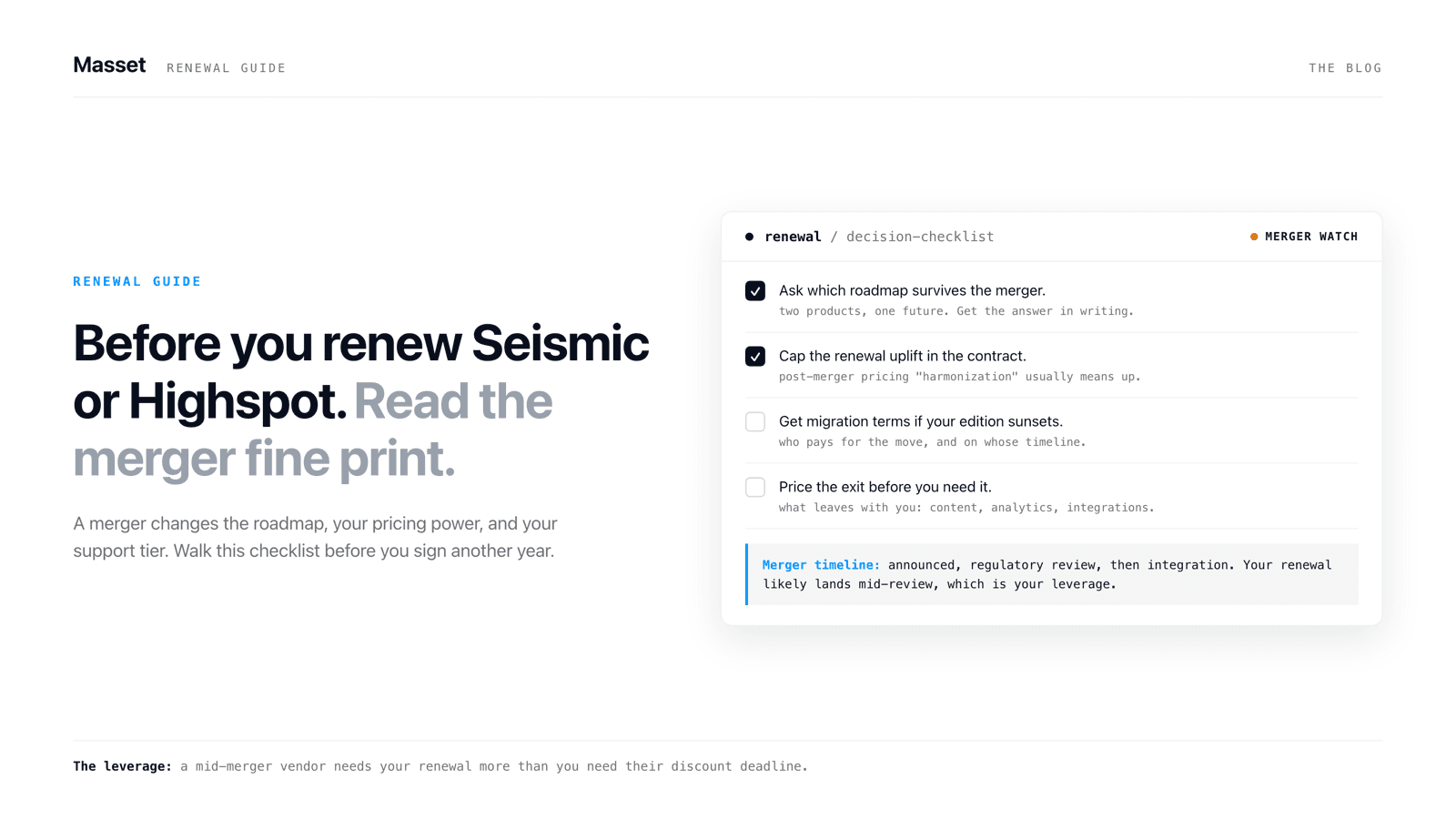
Renewal in 0 to 3 months. You're negotiating now whether you meant to or not. Ask the ten questions in the next section this week. Push for a one-year term instead of multi-year, unless they offer protections strong enough to justify locking in (section six). Get a full data export before you sign anything, just to prove you can. And ask for pricing in writing that survives the close.
Renewal in 3 to 9 months. This is the best position on the board. You have time to build leverage and the merger will likely still be mid-flight when you sit down. Document your setup now: what content lives in the platform, which integrations you depend on, what training and analytics data you'd lose in a migration. Run a light parallel evaluation of one or two alternatives, not to leave, but so your "we have options" is true when you say it. Draft your protection asks early so procurement isn't inventing language the week of signature.
Renewal in 9+ months. Watch two events: the close announcement and the first combined-roadmap communication after it. Those two tell you which platform is winning convergence long before any deprecation notice. Set a calendar reminder to re-run this playbook at the 9-month mark. Until then, collect receipts: save every vendor communication about the merger, because "you told us X in writing" is leverage later.
“The merger is not the risk. Renewing like nothing changed is the risk.”
The ten questions to ask before you renew
Competitor blogs have published question lists since February. Most stop at four or five and none tell you what a bad answer sounds like. So here are ten, with the red flags spelled out. Your CSM won't be able to answer all of them. How they handle not knowing is itself information.
| Ask this | A good answer | A red flag |
|---|---|---|
| 1. Which platform's architecture wins at convergence? | "Undecided, here's who decides and when." | Pretending convergence isn't the plan. |
| 2. Will my price change at renewal or after close? | A number, in writing. | Verbal reassurance only. |
| 3. If my platform is deprecated, who pays for migration? | A commitment they'll put in the rider. | "That's hypothetical." |
| 4. Can I run a full data export today? What's in it? | A documented export incl. metadata and analytics. | Export exists but drops your data's context. |
| 5. What happens to my CSM and support tier? | Named continuity commitments. | "No changes planned" with nothing in writing. |
| 6. What's the roadmap for the features I actually bought this for? | Feature-level answers. | Only combined-company vision talk. |
| 7. What happens to the AI layer (Nexus, Aura)? | Honest "being worked out." | "Everything carries over." |
| 8. What happens to the MCP server and APIs my team built on? | They know what you've built and commit to notice periods. | They don't know you're using them. |
| 9. Will my CRM, LMS, and SSO integrations survive convergence? | Per-integration answers. | "We expect no disruption." |
| 10. Will you put any of this in the contract? | Yes. | No. |
Four of these carry most of the weight. Question two, pricing: anything not in writing is a mood, not a commitment, and account teams turn over during mergers. Question three, migration cost: if they call deprecation hypothetical, ask why the precedent table above exists. Question four, the export: run it now, while nothing is wrong, because the day you need it is the worst day to learn it drops your tags, permissions, and engagement history. And question ten is the real test. A vendor confident in "both platforms will be supported" should have no problem writing it down.
The other questions cover continuity: your support team, your named features, your integrations, and your AI workflows (more on that below). None of them are hostile. You're asking the vendor to say in specifics what their press release said in general.
Get it in writing: five protections for your renewal
Talk is free during a merger. Contract language is not. These are the five protections I'd hand to procurement as concepts. I'm not your lawyer, and your counsel should write the actual words.
- A price lock. Renewal pricing capped, in writing, through the next 12 to 24 months or through integration completion, whichever is later. Post-merger price moves are the single most common customer fear here, so answer it in the document.
- Migration coverage. If your platform (Highspot or Seismic) is deprecated or converged during your term, the vendor funds migration services and gives you a minimum notice period, say 12 months.
- A data export guarantee. Full export of content, metadata, permissions, and analytics in documented formats, on request, at no cost, with no throttling. This is your walk-away power. Without it, every other clause is polite fiction.
- A material-change exit. The right to terminate without penalty if named features you depend on are removed or materially degraded. Name the features. "Materially degraded" without a list is unenforceable.
- Change-of-control continuity. Your terms, support tier, and named entitlements survive the close and any later restructuring. Mergers shuffle account teams; the contract shouldn't shuffle with them.
If the vendor accepts three of five, you've de-risked the renewal enough to sign with a straight face. If they reject all five, that's an answer too, and a much cheaper one to learn now than mid-migration.
The question nobody is asking: what happens to your AI workflows?
Every merger take I've read covers pricing, support, and roadmap. Not one covers the AI layer, and that's the layer changing fastest.
Both vendors ship MCP servers today. MCP is the open protocol that lets tools like Claude, ChatGPT, and Copilot read and act on your systems. Highspot's MCP server has been live in the OpenAI ChatGPT App Store since June 8, 2026, and also reaches the Anthropic and Microsoft Copilot ecosystems. Seismic's is in Early Access: you request it through your Customer Success Manager, and it exposes 18 tools (13 reads, 5 writes) behind a two-layer permission model where an admin enables each tool individually. I've written detailed teardowns of both: the Seismic MCP server and the Highspot MCP server.
| Vendor | Status | Tools | How you get it |
|---|---|---|---|
| Highspot | ChatGPT live | Not published | ChatGPT App Store (since June 8, 2026), Anthropic and Copilot ecosystems |
| Seismic | Early Access | 18 (13 read / 5 write) | Through your CSM, plus per-tool admin enablement |
| Masset (we build this one) | Generally available | 35 (21 read / 14 write) | Self-serve, works with every MCP-compatible client |
So the combined company inherits two MCP servers, two AI engines (Highspot's Nexus, Seismic's Aura), and two sets of agent integrations. Aragon Research already named fusing Highspot's Nexus with Seismic's platform as the core technical challenge of this merger. At convergence, one AI stack wins. If your team built agent workflows, custom GPTs, or Copilot integrations on the losing one, that's a rebuild nobody has budgeted for.
Highspot's MCP is live in ChatGPT with no published tool count, and it also reaches the Anthropic and Copilot ecosystems. Seismic's is Early Access with 18 tools, gated behind your CSM. Masset's (ours, so I'm biased) is GA with 35 tools, 21 reads and 14 writes, self-serve. The point of the comparison isn't the score. It's that AI access to your content is now a real contract-level dependency, and it deserves a place in your renewal questions. Ask question eight from the table above and watch how long the answer takes.
If you decide to look around
Be honest with yourself first: leaving isn't automatically the right move. The merged company might ship a stronger product than either half did alone. Migrations are expensive and disruptive, and switching mid-merger out of fear is how you trade a known problem for an unknown one.
But a renewal during a merger is the cheapest evaluation window you'll ever get, so use it well. Four criteria matter more than feature checklists right now. Can you get your data out completely, whenever you want? Can your AI tools reach your content without a vendor gatekeeper? Can you leave without penalty if things change (month-to-month beats multi-year lock-in during uncertainty)? And how much of the suite do you actually use? If your team lives in 20% of an enablement platform, price the 20%, not the suite.
Where does Masset fit? We build it, so I'm biased, and I'd rather be upfront about the gaps than pretend there aren't any. Masset has no LMS and no coaching, so if Lessonly-style training or call scoring is your core use case, we're not your answer. What we are is the home for your business content with AI access built in from the start, not bolted on. If the content side of enablement is what you'd actually miss, start with the head-to-head pages: Masset vs Seismic and Masset vs Highspot. And if you want the whole category mapped, merger included, the sales enablement buyer's guide covers it.
The merger will close when it closes. Your renewal date is the deadline you control. Work backward from that.
Key Takeaways
- The merger was announced February 12, 2026 and had not closed as of July 7, 2026. Your contract is unchanged until renewal.
- Enablement consolidations end with one surviving platform. Plan for convergence even while both products are supported.
- Your renewal date sets the play: negotiate now at 0-3 months, build leverage at 3-9, watch and document at 9+.
- Get protections into the contract: a price lock, migration coverage, a data export guarantee, and a material-change exit.
- Ask what happens to the AI layer: Nexus, Aura, and both MCP servers. It's the dependency nobody else is pricing in.