Benjamin Ard00:00 — Welcome back to another episode of Content Amplified. Today I'm joined by Karen. Karen, welcome to the show.
Karen Cooper00:05 — Thank you for having me.
Benjamin Ard00:06 — Yeah, Karen, I'm excited. This is going to be a ton of fun. This is a question that everyone is asking in marketing, and I think it'll be a fun discussion. But before we dive into that, the little cliffhanger, let's get to know you. If you don't mind sharing a little bit about yourself or the audience so they know who you are, that would be a great way to kick it off.
Karen Cooper00:25 — Thank you for having me here. I'm Karen Cooper and I am director of marketing for the content experience team at my company, Wolters Kluwer. We are in the health division and it's been really a crazy ride for the last four years that I've been at the company. I lead a team of designers, motion graphic artists, writers, social media, creator and project management. So we are very much in shared service right in the middle of all the busy product work that we're doing, the program work we're doing, and campaigns. So that's where we've been living big time and growing our marketing function within the health organization.
Benjamin Ard01:07 — Love it. That is so cool. And this is really interesting. You have a cool perspective. You have such a creative team. You're talking about the roles, the writers, the designers, all of that kind of stuff that really leads us into our discussion today with artificial intelligence. You can't go more than five seconds without talking about AI right now. Everyone is being asked to do so much more than they ever have before. And they're given a $200 cloud account saying, great, they should replace half your head count. Let's go do this. But it is creating kind of a sacrifice or at least a compromise when it comes to creativity. So when you are looking at it from your perspective, are you seeing a push around a volume play versus creative output? And where do you feel like that pressure is coming from? Like, I feel like some marketers feel it, some don't, it may depend on their company, but where do you think that's all coming from? And do you feel like AI is kind of the genesis of that?
Karen Cooper02:04 — Absolutely, 100% I feel like AI is the genesis of that. And I think, you know, we have a lot of, I think the pressure is, I would say, top down within a large company, especially. And what they're looking at is just our industry and the market and how it all is moving so fast. And we're all competing with each other within this AI space and who has the best product and who has the best tool. It's interesting because with my team, it's more of the how we use AI within our work in order to support our products. And then our products are how do we use AI within the products in such a very sensitive area like healthcare and working with patients and clinicians and how do we advance that responsibly and ethically? And then how do we get more of that message out there faster with the creative teams? And so it's pressure all around from just the environment we're in and it's exciting too. Just to put that in there, you know, it can be kind of a tougher sensitive topic, but I think using AI within for content, for social, for creative and design is really exciting. But we are in this weird space where it is that do more. So thankfully we haven't been asked to have less head count, but we have been asked to increase the volume of output. And so what does that look like and how can I use tools to scale it with the small amount of writers or designers that they have? And then how does that volume, how do we get that under control? Where management is like, you've got to do more, produce more, we need more videos and we need it all faster. And then how do we make sure that that's quality and is that the right choice to do more?
Benjamin Ard03:51 — And that's a great question to ask right there.
Karen Cooper03:53 — Yeah, is that volume really moving the needle for us or would it be better to slow down and produce something, take a little bit more time in the brainstorming strategy side and then produce something. You can still use AI tools. You can still do it really quickly and it should be enablements versus the end result.
Benjamin Ard04:12 — I love that. So you are in this cool position, right? So you're gonna, you're going to be talking about at B2B Ignite. Is that right? And in preparation for this, you have been running a LinkedIn poll to collect some data. Tell me about the poll. Tell me about the results. Like what did you expect versus what you're getting? I'd love to hear this.
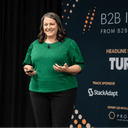
Karen Cooper04:21 — That's right. Yeah. Absolutely. The reason that I applied to speak at B2B Ignite, I got an email. I've spoken at the North America one in Chicago several years ago and I had such a great experience. I think I was the only talk that spoke about the marketer as a person rather than marketing as a function. So everybody's so focused on what we are doing within our basically our discipline and not really the people behind the discipline, which is obviously critical. So I was familiar with their work in their conferences and I was at a team meeting actually, our leadership team meeting on site and just the influx of requests and I was starting to feel that swirl and like it drowned out and I can't even, there's so much volume that it's hard for me to even carve out time to test out fun AI tools which is, that's the exciting part right? Testing it out and trying to decide which ones we're going to use and what application and is it worth our money? You know, things like that. So it was just this perfect storm of do more. I need the creative team to output more. What tools are they using? Is anybody testing this? And it was just this swirl and kind of a stressful situation. And so I started creating this topic that was just in the back of my mind of do more with less. And then how are we, what are we doing to our creative team is when we're forcing them to produce so much more volume of work and then forcing them to use AI tools that they really haven't had a chance to test out, to play around with, to see if it's worth our effort. And how do I as a leader carve that space where they can play around and be able to recommend, yes, I definitely love this particular video tool. This other one did not comply with brand, you know, that sort of thing. So that's where the impetus of this whole talk. And then from there, and I got accepted. And so from there, I started, I was like, man, I need to do some research with my peers and see if anybody else is thinking this way too, and feeling the strain and burnout and, you know, just battling those conversations that we have to have as leaders and managers with our team where they're coming to us like, I can't keep up, I'm so stressed. You know, or even their own personal beliefs. I don't want to use AI. I don't want AI to take my job. I don't want it to hurt the environment. So we're kind of managing quite a bit. The one thing I found very interesting, I've had three polls. And you know, I'm just a small person with a small following. So I've got just kind of a few core votes and so I'm hoping to get more of a data foundation for data. But what really surprised me the very first one, looking over my notes, because I wanted to talk about it today, but the very first one was around what is the first thing to get sacrificed when you're asked to do more quickly in a shorter time frame and it was around, let's see, it was, is it process efficiency, is it creative quality, is it your employees' well-being, or is it a priority clarity and priorities? I 100% thought it was going to be top one creative quality, especially with, you know, like looking at my thought, who my audience is because I was like, oh, it's totally creating quality or they're going to really feel that. But it was actually priority clarity. That surprised me. And I was like, well, I can definitely see that.
Karen Cooper08:04 — With the volume becomes who's got the top priority. Everybody thinks their project is priority, but with shared services, not everybody can have a top priority. And so that really surprised me that that was the clarity issue of that was number one. And then after that, it's been kind of tied. So the latest one that I have right now is super duper fun and it is about, let's see here where we at. So what's the hardest part about maintaining A plus work when everything is moving fast? And that one, again, a little bit of surprise. It's like, is it the rework, the bottleneck, the last minute request, or not enough creative time? Not enough creative time was actually the lowest scoring in that poll. The top one was last minute requests. That's what, that is what causes our A plus work or our top work to suffer is more constantly getting less and less.
Benjamin Ard08:57 — Interesting. Do you feel like that's gone up because of AI? People are like, well, of course you can just prompt this in two seconds and give it to me, right?
Karen Cooper09:05 — I do, so it makes it tough to do. It makes it tough to do quarterly planning because we have to be agile. Social media really is a great example of social media. It's not, you can't plan three months ahead. Things change so quickly. So how do we completely pivot our processes? That's what these polls are kind of telling me. Well, how do we adjust our processes where we've got, we're able to plan because I only have a certain amount of head count. So we're able to plan for our days in advance, but then we also have to be nimble and agile for things that are hot requests because the market dictates it as such.
Benjamin Ard09:42 — Interesting, very interesting. Okay, so you've got data, you're going to go talk and this is going to be fascinating. I wish I could be there. This is so cool. If they record it, please share it with me. I'd love to see this. So with all of this, what are you kind of coming to as a conclusion as a leader? How are you managing the expectations of output? How are you determining your standard for quality? How are you, like your poll asked, how are you managing priorities for the team so they know what should take time and effort versus other things? How are you starting to internalize this and what are some of your recommendations?
Karen Cooper10:19 — And that's a great question because I don't actually have a definitive answer. And I don't know if I ever will or will be evolving as we evolve very quickly with AI. And I was thinking earlier today about, you know, kind of the progress of our tool stack anyway, you know, going from, you know, hand drawing or writing on pen to paper, and then we've got Microsoft Word, and we start getting all these tools at our disposal, AI is just yet another tool for us to use. So then how do we look at it in that manner versus it's taking over everything? How do we look at it as, this is my latest tool that I get to learn, and all these companies are, whether they cater to video or content creation or even the strategy and brief creation. So how do we look at it? That's kind of my first step. How do we look at these different tools for due diligence? And I was reading a paper by, I think it's a Superside. Yeah, Superside and it's called, it's a breakpoint report about creative, like what are their breaking points with asking for more AI intervention with the work. And I found it really interesting. They said we're creating a new kind of burnout. It's a human problem, not a technology problem at this point. So if I think about the human problem of my team and what we're asking them to do, for me it goes back to planning, like I just kind of mentioned planning and process alignment, leaning in on our partner teams to make sure that we understand what their priorities are and having them do the legwork before it comes to us. Learning what their priorities are, but do their priorities align to the company's priority, align to the CEO priority, as well as the market priority, and then having that clear communication. It's also going to be critical for me personally as a leader to push back and say, hey, we've got the people we have, you can't get any more. You can't get any more output out of the people we have, even using the tools that we have at our disposal. So then it's like, are you putting your, you know, eggs in the right basket, essentially. Like, are you actually creating the right kind of priority? So that's a little bit of how I'm approaching it. And the foundational piece, surprising or not surprising, is a little bit more of an emotional piece for me. Like, I don't want my team to feel burned out. I don't want to feel burned out as a leader. And I don't want to feel that stress that we aren't delivering what we need to deliver, as well as putting the team's own work ethic in compromise, which is critical of creative teams. We were talking about entrepreneurship, but I have a husband who owns his own company now. He's a designer and an artist. And their company does outdoor adventure apparel. And all of their designs are their own, him and his business partner. And they are artists at heart. So one of the very key differentiators on their website is these are all human, human designs, not AI. They don't use AI. They just use their own pen to iPad, we should say. And they're designing even hand lettering. So for him, it's a conscious decision that he feels like it takes away from his work morals. I guess you should, you could say like his design morals. This is how I want to be a good artist.
Karen Cooper13:44 — And so then how do we balance that, know, artistry with my team as well as you have five booth graphics to make, we got to get these out today. So that's a long way to say I really don't have any answers other than from my own team we're trying very very hard as leaders, functional leaders, to work on the processes and the priorities and understanding, making sure that they match up with what's going to move the needle. You know, it might be one organic social post, it might take 15 minutes, but we do global work so if we have stakeholders, 50 stakeholders, all wanting a social post and that social person have video, now I've got two people that are going to be busy for the whole week and really did that move the needle, because we spread you guys out to, you know, to fit.
Benjamin Ard14:33 — Yeah. Well, and I love this conversation. I love the insights and the perspective, and I love that you're bringing data to the table. I love the polls and everything. It used to be, at least from my perspective, that we as a company had to have internal alignment. Like you said, our goals, our objectives, things that we want to do because there was only so much time in the day to get certain things done. So we needed to focus on the most productive ones that were going to hit the company KPIs. Not that everyone felt this way, but I think in general, people agree it gave us permission to say no to certain things that didn't line up with the overall priorities. And I feel like overnight, you mean, and not really, you know, it's been like three years, but in the grand scheme of things, that feels like overnight. It shifted where we still need the same level of internal alignment and company objectives, but it's no longer priorities because we don't have the resources. It's priorities because we can do so much, but we still have to do the right stuff. And it's interesting to see how you've been talking about that and how that really does come through. And so there's still this whole goal and objective of gotta have conversations with people. Gotta actually know what we're doing. We gotta be aligned. We gotta build towards priorities. We got to do what's right regardless of how many tools we have. It doesn't mean we should do anything and everything. And I love that.
Karen Cooper15:54 — I think you said that really well. It does not mean that we should do it just because we are capable of doing more, but at what cost. And even if the work isn't what suffers, it still again goes back to your people. And then you start to really lose your team morale and people's mental and physical health starts to deteriorate. And just that, I feel like it's a little bit different. Maybe I'm biased, but I feel like it's different even with creative people. Because as a creative person, you don't want to have to write on demand within a deadline, but have you ever been like, got to do this in 15 minutes and you're staring at a blank screen? Or I have to, thankfully we're in a heavily branded company. When you work for an agency, you've got a ton of different types of brands and creative in that respect, they get really difficult. Thankfully we have got more of a template-ed approach, but then the output is so high that they can only work within their template instead of really doing probably what we want them to do as creatives and think bigger and what's the next step. And that's something that I challenge my team a lot with is like, what tool is next? What have you researched? What do you see in not even in our industry, but out of our industry? And how can we adopt certain practices out of industry into healthcare from a creative standpoint? I don't think I've challenged them with that in the last six months because it's just been like this churn and burn that we.
Karen Cooper17:20 — And that's because we need to get AI in our products and we need to get our message out. So I understand the scope of it. I'm just arguing, is that really the best way to deal with creative team members? We think differently, right? Yeah, we think differently.
Benjamin Ard17:33 — 100%. Well, and the added pressure to always be performing and outputting, it takes away the magic. And that is what is what people want to latch onto and care about. And if they're under stress, again, it doesn't matter if it's an AI world or otherwise, if you're not giving these people the freedom to really come and bring their best selves to work, you're only going to get so much and people latch on and see it.
Karen Cooper18:01 — Yeah, and I think I like getting it to more like order takers. So when I started at the company, I was really trying to get my lead content marketer and my lead creative director into discussions early with the planning people. And even if they don't say anything on the calls, they're absorbing what that strategy is. And then they can deliver to say, hey, I think this particular asset is the best way to explain what you're trying to do. It could be an infographic work, could be a full EVA or an academic white paper, whatever it is. They have that input versus being order takers. We have never made that shift, my team, like we've never, it's been so difficult because of how much we're trying to do to make that shift to say hey, let's pause for a second, I mean my goodness, like two hours, three hours, and have like a creative brainstorm, like an actual creative brainstorm where we think about, you know, even A/B testing and things that can move our needle but like in three months.
Karen Cooper19:01 — And that's the thing, we never get to three months because we're doing things in the moment.
Benjamin Ard19:06 — Yeah, 100%. Well, Karen, we have run out of time. This has been a fascinating discussion. Thank you so much for the time and insights. This has been great. For anyone listening who wants to reach out and connect with you online, how and where can they find you?
Karen Cooper19:18 — I'm Karen Cooper. I'm KC narrative on LinkedIn. So feel free to, you know, connect with me there and please share and vote my polls that I'm going to be posting through June so that I can collect even more information for this talk and try to figure out what is going on and how can we move to the next step.
Benjamin Ard19:38 — Love it. Very cool. For anyone listening, please feel free to go down to the show notes. We will have the LinkedIn link right there. Click on it, connect with Karen, say hello. Say you came from the podcast, vote in the polls. That would be awesome. Karen, again, thank you for the time and insights today. I really do appreciate it.
Karen Cooper19:54 — Thank you so much.