Somebody asked an AI about a dentist today
Somewhere today a parent typed "best pediatric dentist near me" into ChatGPT instead of Google. The answer they got was built from whatever the AI could read about the practices in that town. We wanted to know what that actually is, so we crawled the websites of the 239 largest dental groups in America and 1,014 of the practice sites they own.
We expected to find dental groups locking AI out. That is the story you hear at every conference: publishers blocking bots, brands worried about being scraped.
That is not what we found. The doors are wide open. Almost nobody in this industry blocks AI crawlers.
What is missing is the sign on the door. Nearly four in ten corporate dental group websites never tell a machine what kind of organization they are. Not the practices. The corporate parent, the one whose whole job is explaining what the company is.
What we crawled, and what we checked
We built a list of 239 dental support organizations from published industry rankings, then crawled each one's corporate site and every practice website we could find linked from it. After dropping suppliers, trade publications, and anything that was not actually a dental site, we were left with 1,213 websites: 199 corporate sites and 1,014 practice sites. Between them, those groups claim more than 16,000 practices.
Every check we ran is a plain yes or no you could reproduce with a browser and a few minutes. Does the robots.txt file block GPTBot, ClaudeBot, PerplexityBot, or Google-Extended? Is there structured data on the page telling a machine what kind of business this is? Is there a meta description, a sitemap, an llms.txt file? Does a practice site mention the company that owns it?
No opinions, no scoring model, no AI judging anybody's brand. Just what is in the files.
Almost nobody is blocking AI
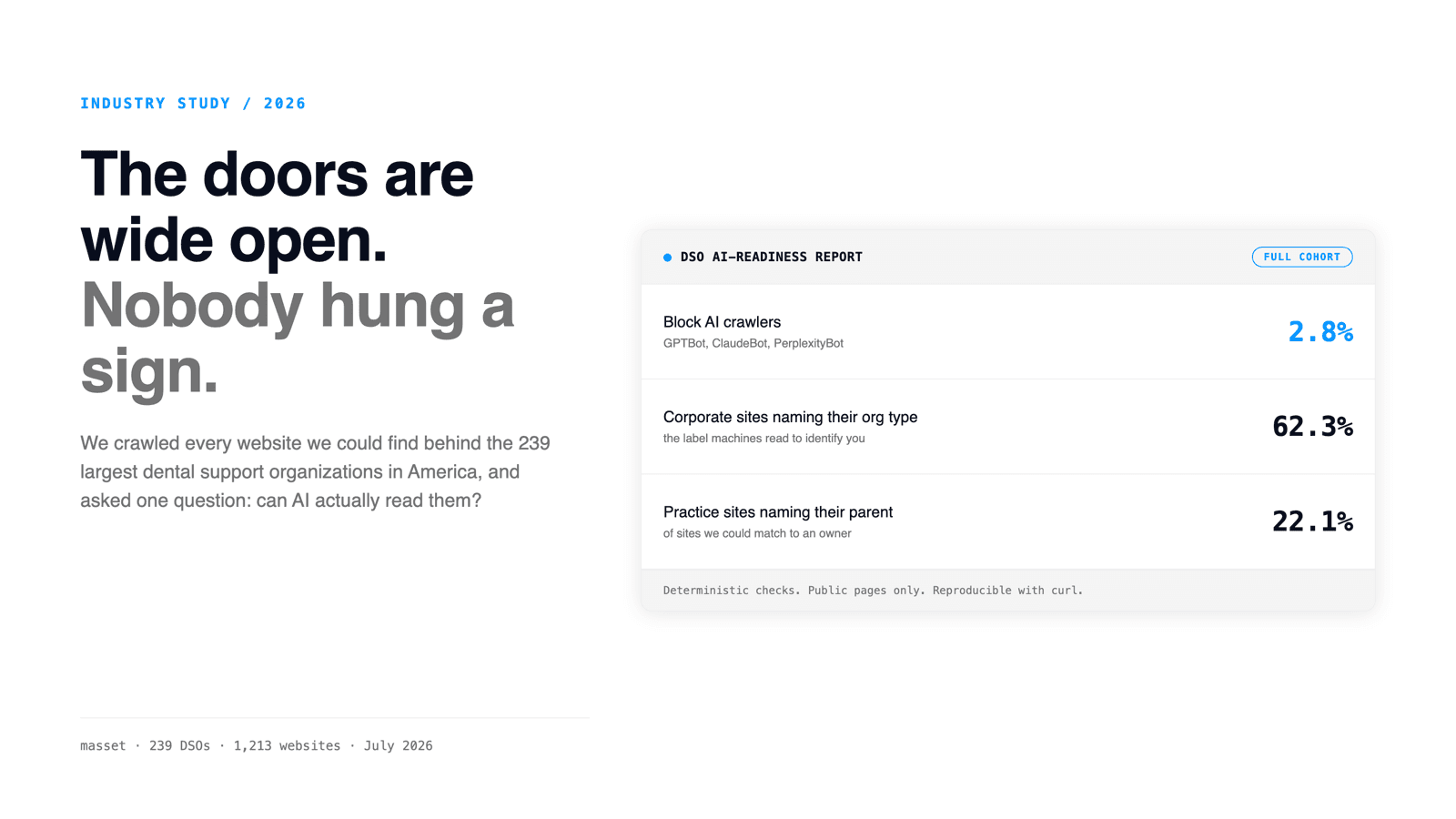
Only 2.8 percent of the sites we crawled block a single named AI crawler. Among corporate sites it is 5.5 percent. Among practice sites it is 2.3 percent. Not one practice site in the entire study blocks PerplexityBot specifically, and only 5 percent of corporate sites block GPTBot.
If you have been in a meeting where someone asked whether you should block AI from your website, this is the answer your industry already gave. It said yes, come in.
That is the right call, and it is worth understanding why. When a patient asks an AI which practices near them handle pediatric sedation, the AI can only recommend what it can read. Blocking the crawler does not protect you. It removes you from the answer.
So the interesting question is not whether AI can reach these sites. It is what AI finds once it gets there.
Four in ten corporate sites never say what they are
There is a quiet piece of code on most business websites called structured data. It sits in the page where visitors never see it, and it tells machines the plain facts: this is a dental practice, here is the address, here are the hours. It is the difference between a machine reading your words and a machine knowing what you are.
Among the 199 corporate dental group sites we crawled, 37.7 percent carry no markup identifying what kind of organization they are. Almost one in five (19.6 percent) has no structured data at all. And only 17.1 percent identify themselves as a dental business specifically.
Read that last number again. Fewer than one in five corporate websites belonging to a dental company tells a machine that it is in dentistry.
The words on the page say it, of course. A human reading the homepage knows instantly. But the label a machine looks for is missing, so the AI has to guess from context. Sometimes it guesses right. That is a strange thing to leave to chance when the fix is a snippet of code.
Your corporate site is the least readable thing you own
Here is the part we did not expect. We assumed corporate sites would be the polished ones and the individual practice sites, often inherited through acquisitions, would be the mess.
It is the other way around. On almost every check, the corporate parent scores worse than the practices it owns.
| Check | Corporate sites | Practice sites |
|---|---|---|
| Identifies its organization type | 62.3% | 74.4% |
| Identifies as a dental business | 17.1% | 44.5% |
| Has a meta description | 72.9% | 87.1% |
| Has no structured data at all | 19.6% | 13.6% |
| Blocks at least one AI crawler | 5.5% | 2.3% |
There is a reasonable explanation. Practice websites are usually built on dental-specific website platforms that ship structured data by default, because local search has mattered to dentists for fifteen years. Corporate sites tend to be custom builds, and custom builds only carry what somebody remembered to include.
The effect is that the site carrying your company story, your acquisition pitch, your recruiting message, and your brand is the one machines can read the least. Every office in your group is easier for an AI to identify than the company that owns them.
“The site carrying your company story is the one machines can read the least. Every office in your group is easier for an AI to identify than the company that owns them.”
Four out of five practice sites never name their owner
Only 22.1 percent of the practice websites we crawled mention the dental group that owns them anywhere on the homepage. Only 34.3 percent link back to the parent company's site at all.
Before you read too much into that, here is the honest caveat. Some of it is deliberate. Plenty of dental groups run a house-of-brands strategy on purpose, keeping the local practice name because that is the name the neighborhood trusts. When we looked at the groups scoring zero, several were exactly that: pediatric and specialty groups whose practices all operate under their own local brands. That is a strategy, not a mistake.
But the spread tells you it is not all strategy. Dental Care Alliance names itself on 86 percent of its practice sites. 42 North Dental does it on 78 percent. Bedi Dental Group does it on 90 percent. These groups decided to connect their practices to the parent, and did it consistently.
If you are somewhere in the middle, the number worth checking is your own consistency. A group where some practices name the parent and others do not usually is not executing two strategies. It is executing one strategy and forgetting to apply it to the practices it acquired last year.
One in five has a file nobody decided to add
There is a new convention called llms.txt, a plain text file that tells AI tools what a site is about. It is genuinely new, most of the web does not have one, and we assumed almost no dental group would.
Nearly a quarter of them do. 22.8 percent of the sites we crawled serve an llms.txt file.
Then we opened a few. Most of them start with a line saying they were generated by a WordPress SEO plugin. Nobody at these companies decided to be AI-ready. A plugin update decided for them.
That is worth sitting with, because it cuts both ways. Your website is being shaped for AI right now by tools making choices on your behalf. Some of those choices are good ones. None of them are yours. The groups getting this right on purpose are making a decision. Everyone else is getting a default.
What to fix, in the order that matters
None of this is expensive to fix. Most of it is an afternoon for whoever maintains your website.
The last one is free and takes two minutes. It is also the one most likely to change somebody's mind in a meeting, because reading an AI describe your company badly is more persuasive than any percentage in this article.
The 26 groups that passed every check
Twenty-six of the 199 corporate sites (13.1 percent) passed everything: they identify as a dental business in their structured data, carry a meta description and social tags, publish a sitemap, serve HTTPS, and block no AI crawlers.
They are worth naming, because they are proof this is achievable at any size. The list runs from a group with 550 practices down to groups with three.
We are naming the groups that passed and not the ones that did not. The point of this study is not a wall of shame. It is that the bar is low enough that 26 groups cleared it without, in most cases, setting out to.
Why this keeps happening to multi-location companies
The pattern underneath all of this is not really about code. It is about where content lives when a company grows by acquisition.
A dental group buys a practice. The practice keeps its website, its brochures, its new-patient forms, its Google listing. Somebody at the corporate office has a folder with the current brand guidelines in it. The two never meet, because nothing forces them to meet.
Five acquisitions later, there is no single place where the company's current story lives. There is a shared drive, a few inboxes, and 40 websites that were each accurate on the day they were built. The AI reading all of it has the same problem your new office manager has: too many versions, no way to know which one is true.
That is the problem we build for. Masset is the home for your business content, the one place your team and every AI tool can find the current version of what your company says about itself. If you run marketing for a dental group, here is what that looks like for a DSO.
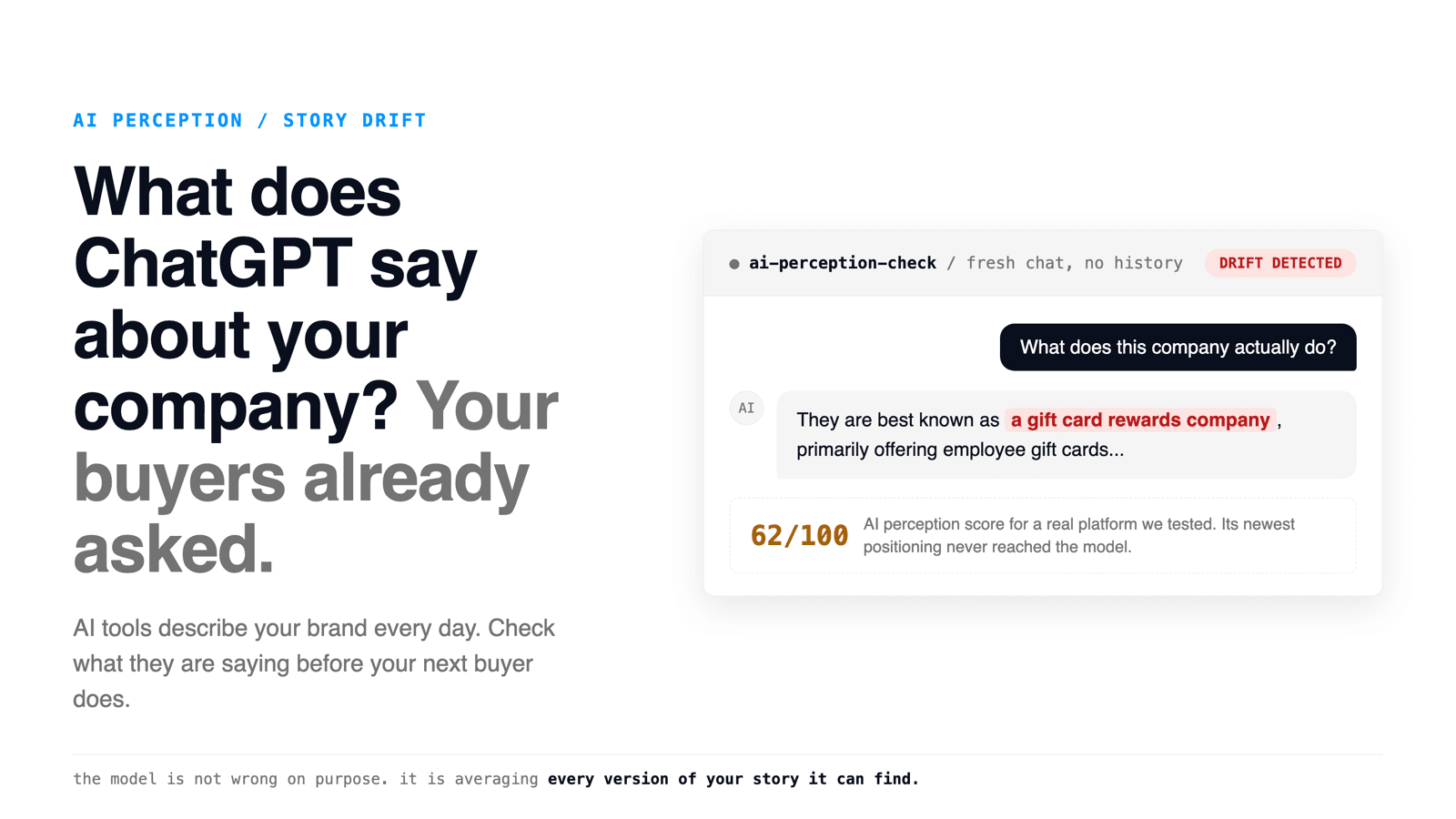
But you do not need us to run the check in this article. Open a fresh AI chat, ask it what your group does, and see whether the answer is the one you would give.
How we ran this study
The cohort is 239 US dental support organizations, assembled from published industry rankings including Becker's Dental Review lists from 2023 through 2026, Group Dentistry Now's emerging-group and deal coverage, ADSO membership, and several private-equity platform trackers. Together the groups claim 16,365 practices. Industry estimates put the total number of US DSOs around 3,100, so this is the large end of the market, not all of it.
We crawled each group's corporate website and, where a group linked its practices publicly, up to every practice site we could find from its location pages and announcements. We fetched 1,587 sites, of which 1,384 responded. We then removed 171 false positives: suppliers, trade publications, associations, and scheduling tools that were linked from dental pages but are not dental practices. Any site claimed by two different groups was treated as a false positive, since a real practice belongs to exactly one owner. That left 1,213 sites: 199 corporate and 1,014 practice.
Every check is deterministic. We read robots.txt for named AI crawlers, looked for llms.txt and a sitemap, parsed JSON-LD structured data for the type declared, and checked for a meta description and Open Graph tags. Practice sites were additionally checked for a mention of the parent group's name and a link to its site. We crawled public pages only, honored robots.txt, and rate-limited every request.
Three limitations worth stating. First, 203 sites (12.8 percent) did not respond to us, most of them returning a 403 to our crawler; bot protection that turns away an unknown crawler may or may not treat a named AI crawler the same way, so we report those separately rather than counting them as blocked. Second, practice-site discovery is partial: groups that do not link their practices publicly are under-represented, so the practice numbers describe the practices we could find, not every practice in the industry. Third, a parent-brand mention is a keyword check against the group's name, so a group that operates entirely under local brands scores zero by design, which is why the house-of-brands caveat above matters.
We plan to re-run this every quarter against the same cohort, so the interesting number next time is not the level but the change.
Key Takeaways
- 97.2 percent of dental group websites allow AI crawlers. Blocking AI is not what is holding this industry back.
- 37.7 percent of DSO corporate sites carry no structured data identifying what kind of organization they are, and only 17.1 percent identify as a dental business.
- Corporate sites score worse than the practice sites they own on nearly every machine-readability check, most likely because practice sites run on dental platforms that include this by default.
- Only 22.1 percent of practice sites name the group that owns them, and 34.3 percent link back to it. Some of that is deliberate house-of-brands strategy, but inconsistency inside a single group usually is not.
- 22.8 percent serve an llms.txt file, mostly generated automatically by a WordPress SEO plugin rather than chosen by anyone.
- 26 of 199 corporate sites (13.1 percent) passed every check, at sizes from 550 practices down to three.