Why this page exists
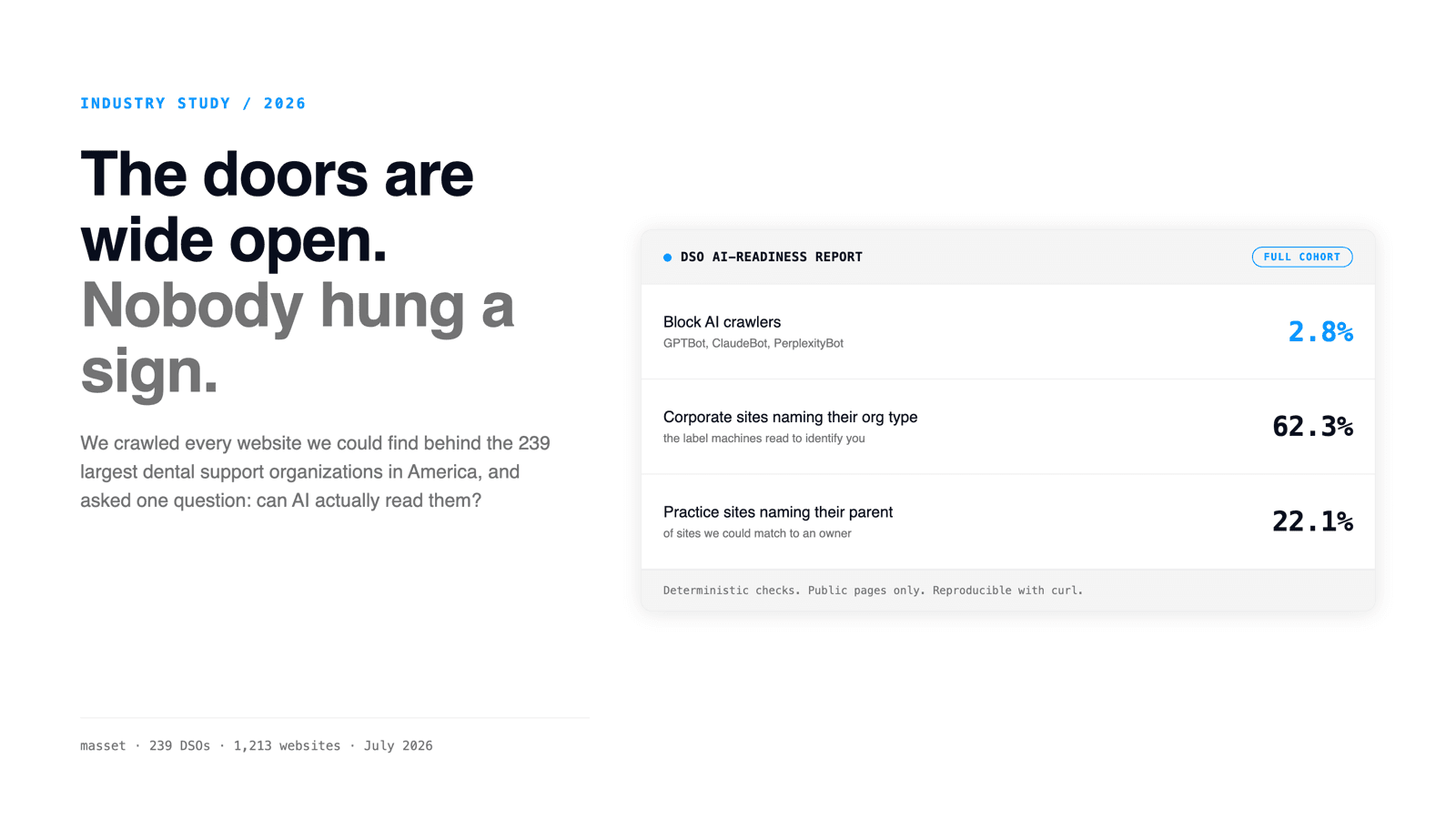
We published The DSO AI-Readiness Report, a study of 1,213 dental websites. This page is the receipt. It contains the re-verification we ran after publishing, the raw files behind each claim, the complete dataset as a download, and the errors we found auditing our own work.
The weakest form of proof is a summary written by the people who did the research. So we did the opposite of asking you to trust us.
After the study went live, a separate script went back out to the live internet, re-fetched the sites, and re-ran every published check from scratch using an independently written copy of the rules, so a bug in one copy would show up as a disagreement instead of being quietly duplicated in both.
66 of 66 sites re-confirmed, with zero disagreements
The re-verification covered two groups. Every one of the 26 companies we named publicly, because naming a company is the highest-risk claim in the article. Plus 40 more sites drawn at random with a fixed seed written into the script, so the sample cannot be cherry-picked and anyone re-running it lands on the identical sites.
The first run failed, and our checker was the thing that was wrong
This is the part worth reading, because a verification that passes on the first try tells you nothing about whether it would have caught a real problem.
The first pass came back with six disagreements. Every one pointed the same direction: we had published "yes" and the re-check said "no." Real websites change in both directions, so the pattern itself was the clue that something was off in our tooling rather than in the data.
We pulled the four worst cases by hand and checked them directly. All four genuinely carried the dental schema markup and meta descriptions at that moment. The fault was in the verification script: it was reading only the first 400KB of each page, and these dental websites routinely run 500KB to 700KB with their structured data sitting near the bottom of the file. The original crawler read the entire page, so the published numbers were correct and the checker was the broken part.
We fixed the checker and re-ran it. That is when it returned 66 of 66, with nothing changed in the study itself.
Every company we named, re-checked
These 26 appear by name in the study as having passed every check. Each was re-fetched and re-tested after publication.
| Company website | Live re-check |
|---|---|
| https://activedentalonline.com | re-confirmed |
| https://aligneddentalpartners.com | re-confirmed |
| https://apexdentalcollective.com | re-confirmed |
| https://blueprintsmiles.com | re-confirmed |
| https://brident.com | re-confirmed |
| https://brush365dental.com | re-confirmed |
| https://carolinasdentist.com | re-confirmed |
| https://coastdental.com | re-confirmed |
| https://cmohs.net | re-confirmed |
| https://dagsmiles.com | re-confirmed |
| https://endodonticpracticepartners.com | re-confirmed |
| https://higginbothamfamilydental.com | re-confirmed |
| https://jeffersondentalclinics.com | re-confirmed |
| https://kokuasmiles.com | re-confirmed |
| https://mfddental.com | re-confirmed |
| https://mismilesdental.com | re-confirmed |
| https://oms360.com | re-confirmed |
| https://pvpd.com | re-confirmed |
| https://parkviewdp.com | re-confirmed |
| https://phdental.com | re-confirmed |
| https://revealdental.com | re-confirmed |
| https://smiledoctors.com | re-confirmed |
| https://brace4success.com | re-confirmed |
| https://myunderbite.com | re-confirmed |
| https://westerndental.com | re-confirmed |
| https://willisdentistry.com | re-confirmed |
The 40 random sites
Chosen by seeded random draw from the full crawl, not hand-picked.
| Site | Live re-check |
|---|---|
| https://benbrookfamilydental.com | re-confirmed |
| https://madisonstreetdental.com | re-confirmed |
| https://dentalassociatesofbuckhead.com | re-confirmed |
| http://eastvalleyimplant.com | re-confirmed |
| https://forsyth.org | re-confirmed |
| https://dentaleconomics.com | re-confirmed |
| https://stgeorgedentalcenter.com | re-confirmed |
| http://wadasdental.com | re-confirmed |
| https://smilepoint.us | re-confirmed |
| https://stonecreekdentalcare.com | re-confirmed |
| https://meadowlakedentalcare.com | re-confirmed |
| https://mykidssmilereno.com | re-confirmed |
| https://alamooms.com | re-confirmed |
| https://jordanphamdentistry.com | re-confirmed |
| https://stillwaterdentalassociates.com | re-confirmed |
| https://premierdentalcare.com | re-confirmed |
| https://rockclifforalsurgery.com | re-confirmed |
| http://pdshealthtechnologies.com | re-confirmed |
| http://pediatricdentistryofmp.com | re-confirmed |
| http://southernctdental.com | re-confirmed |
| http://westrockorthodontics.com | re-confirmed |
| https://highpoint.edu | re-confirmed |
| https://rosefamilydentistry.com | re-confirmed |
| https://coloradooralsurgery.com | re-confirmed |
| https://vibrantsmiles.net | re-confirmed |
| https://paventybrownortho.com | re-confirmed |
| https://exquisitesmilesoakpark.com | re-confirmed |
| https://teethridgedental.com | re-confirmed |
| https://afiniadentalcincinnati.com | re-confirmed |
| http://globaldentalrelief.org | re-confirmed |
| https://sgadental.com | re-confirmed |
| https://fallspointedentistry.com | re-confirmed |
| https://oralsurgeonsofsandiego.com | re-confirmed |
| https://idahobraces.com | re-confirmed |
| https://wheatonprairiedental.com | re-confirmed |
| https://oysterpointoralandfacialsurgery.com | re-confirmed |
| http://childrensdentistmiami.com | re-confirmed |
| https://silverforestdental.com | re-confirmed |
| https://familysmilesdentist.com | re-confirmed |
| https://delafielddental.com | re-confirmed |
Check any claim yourself in about five seconds
You do not have to take our word for any individual number. Each headline claim maps to a single command you can run against any company in the study.
curl -s https://heartland.com/robots.txt | grep -i gptbot
# What does it tell machines it is?
curl -s https://heartland.com | grep -o '"@type":"[^"]*"' | sort -u
# Does a practice site name the group that owns it?
curl -s https://smilelodge.com | grep -ci 'MB2 Dental'
The llms.txt finding is the easiest one to see for yourself. Open smilelodge.com/llms.txt and read the first line: it announces that a WordPress SEO plugin generated the file. That is what "AI-ready by accident" looks like in practice.
The complete dataset, as a download
Every site we crawled, with every field, is published as a CSV. 1,587 rows covering the corporate sites and practice sites of 239 dental groups, including the rows we excluded and why they were excluded.
If you check a row and think we got it wrong, we would genuinely like to know. The fastest way to improve a dataset is somebody finding a hole in it.
The errors we found in our own work
An evidence page that claims the data is flawless is not evidence. Here is every problem we found auditing ourselves, and what each one actually cost.
One dental association website slipped through our filters. The American Academy of Pediatric Dentistry site was linked from a dental group's pages, and it passed our checks because it is genuinely a dental website and only one group linked to it. Its effect on the published figures: the share of practice sites naming their parent moves from 22.09 percent to 22.11 percent, and the share linking to their parent from 34.32 percent to 34.35 percent. Rounded to one decimal, both numbers are unchanged. We are disclosing it rather than quietly restating them.
Two claims were wrong in draft and corrected before publishing. An early version faulted corporate websites for lacking local business schema, which is unfair, because a corporate headquarters is not a local business. The published metric is whether a site identifies its organization type at all. Separately, the list of named companies had 27 entries against a computed 26; one company carried a generic business type rather than a dental one and was removed.
Coverage is partial, and the study says so. We found practice websites for 110 of the 239 groups. Groups that do not link their practices publicly are under-represented, so the practice figures describe the practices we could find, not the whole industry.
12.8 percent of our fetches failed, 129 of them a 403 to our crawler. Those are reported separately and are not counted as blocking AI, because a site that turns away an unknown crawler may well treat a named AI crawler differently.
How the numbers are produced
Nothing in the study was typed by hand. Every figure comes out of a script reading a database, which is the only way a number stays honest through a dozen drafts.
The cohort of 239 dental groups was assembled from published industry rankings: Becker's Dental Review lists from 2023 through 2026, Group Dentistry Now's emerging-group and deal coverage, ADSO membership, and several private-equity platform trackers. Each group's row records which lists ranked it.
Collection honored robots.txt, used an honest user agent with a contact address, rate-limited every request, and touched public pages only. No logins, no personal data, no scraping of anything a browser would not fetch on its own.
If you are running a similar study and want to compare notes on method, or you think we measured something the wrong way, get in touch. We would rather be corrected than cited incorrectly.
Key Takeaways
- After publishing, we re-fetched sites from the live web and re-ran every check from scratch: 66 of 66 re-confirmed, with zero disagreements.
- The re-verification covered all 26 companies named in the study plus 40 sites drawn by seeded random draw, so the sample cannot be cherry-picked.
- The first verification run failed with six disagreements, all caused by a bug in our own checker reading only part of each page. The published data was correct.
- The complete dataset of 1,587 crawled rows is published as a downloadable CSV.
- We document the errors we found in our own work, including one association website that slipped through our filters and moved a headline number by 0.02 percentage points.
- Every headline claim can be checked against any company in about five seconds with a single command.